Paul Rouse: Eight rule changes that could help to improve Gaelic Football
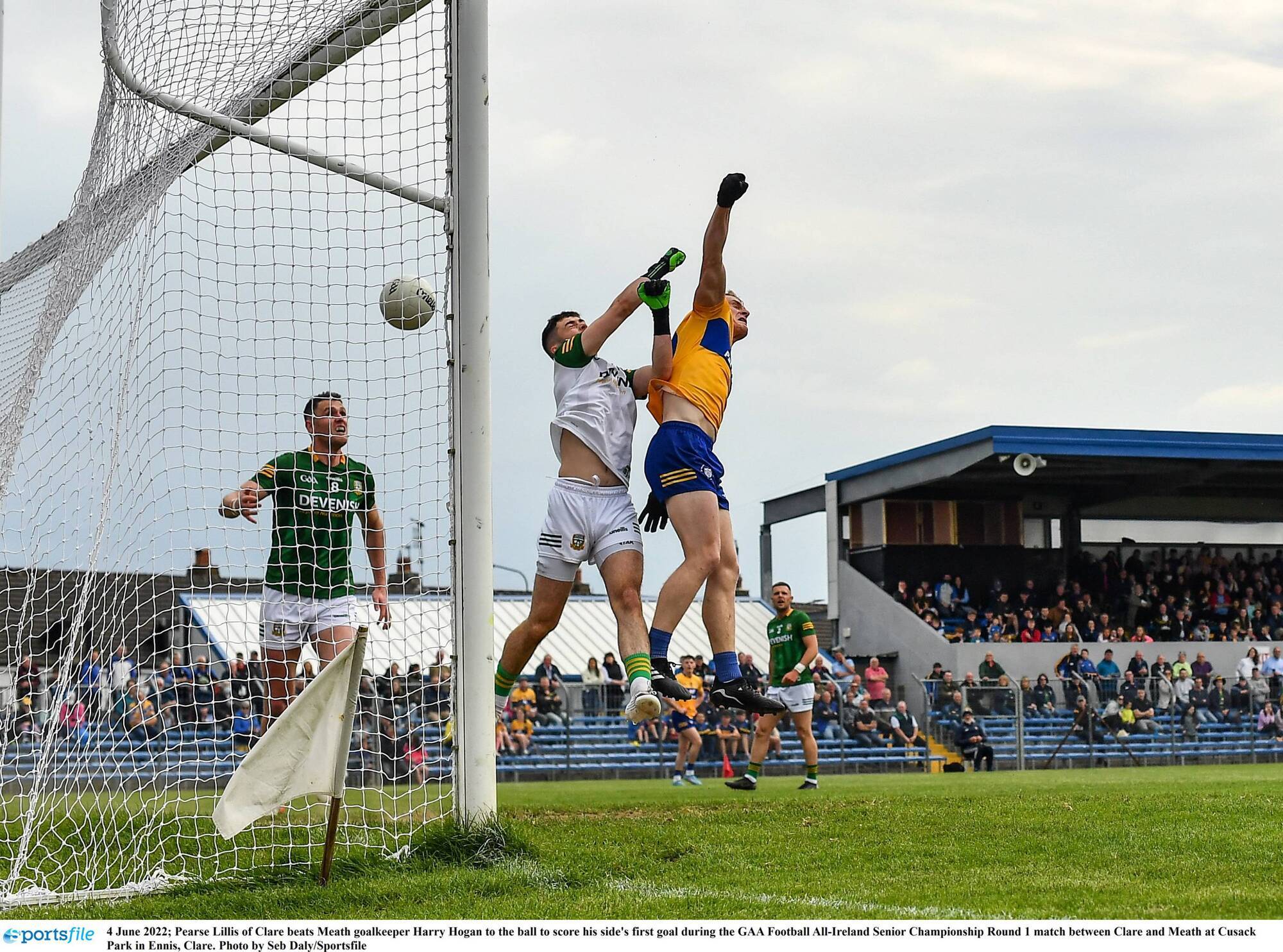
HIGH STAKES: Clare's Pearse Lillis fists the ball past Meath goalkeeper Harry Hogan for a goal in the All-Ireland SFC qualifier at Cusack Park. Could the value of a goal be increased to five points?
JUST as in every field game in the world, the rules of Gaelic football are changed ordinarily to achieve three basic aims: 1) To make the play faster and more open; 2) To reduce violence on the field; 3) To make the game easier to referee.
Throughout the history of Gaelic football, new rules have been introduced to shape how the game is played.
The early rules for Gaelic football allowed for throw-ins instead of sideline kicks and for four different types of wrestling holds (catch-as-catch-can, Greco-Roman, Collar-and-Elbow, and catch-hold) during matches.
The nature of the game has changed fundamentally over the decades. In the 1896 rulebook, you were not allowed to hope the ball and the solo had yet to be invented. Players had to kick or fist the ball away before they had taken four steps.
By 1910, the rules had changed to allow for a single hop of the ball if it had been caught by the player. Only in the middle of the twentieth century was soloing the ball a feature and even then it was rare and only made it into the rulebooks – it would appear – after the 197os.
Whenever there are football matches that are ultra-defensive or just generally poor, the call for rule changes becomes louder.
There are demands that limits be placed on the number of players a team can bring back into the half they are defending, limits on the number of players who can be between the 45s on kick-outs, and limits on the number of handpasses that a team can make consecutively are all at least worthy of consideration.
There are also calls for the reduction of the number of players on a team from 15 to 13.
On the other side of the argument, there are people running around the Internet with pitchforks demanding an end to all rule changes.
But all sports revise their rules relatively frequently — sometimes the changes are big ones, and sometimes they are largely irrelevant. Sometimes the rule changes work and improve the game. On other occasions, they are useless and are quietly dispensed with.
This should be considered to be absolutely natural and nothing to get unduly upset about — if it is possible to say that about anything at the moment.
Here are eight different areas to consider for change. Some are small and some are big. In case any hurling lads are inclined to get emotional, these are ideas that are specific to football.
It’s hard to think of a rule that is more abused. At present, players are permitted to carry the ball for four steps between a hop or solo, or passing the ball on. But players routinely take eight or nine steps before playing the ball. One of the great arts in disguising this is to pretend to be in the act of bouncing or handpassing it so that you can squeeze out an extra few steps. This is something that has fundamentally changed the nature of Gaelic football. It is exceptionally hard to take the ball off a player who is not in the act of playing the ball. But in trying to make such a tackle, fouling is commonplace.
The dilemma is that if the rule was strictly enforced, the number of frees in the game would be enormous.
And, for the referee, counting steps is one more thing to do – and not straightforward.
A motion to change the rule from “four steps” to “two seconds” was comprehensively defeated at the 2020 GAA Congress.
It is a rule that is worth trialling.
Anyone who has ever played or coached (or even watched) Ladies Gaelic Football can understand how allowing the ball to be picked off the ground speeds up the play.
It is true that picking the ball up at speed using your foot is a skill that needs mastering and it is one of the defining differences from any other football game played in the world.
But is it a defining skill that improves the game, or makes it worse?
Removing this rule is the logical extension of the way goalkeeping has changed. Why should a goalkeeper be treated differently than any other player when it comes to competing for the ball?
Contests for the ball in the square should be fully permitted.
And if an attacker is good enough to shoulder a goalkeeper into his own goal in a legitimate tackle, why should that not be allowed?
One of the great iconic images of the GAA from the 1950s is of some bishop waddling like a crazed duck towards the sidelines having thrown in the ball in an All-Ireland final. Behind him, mayhem was ensuing as eight players from each team (three half-forwards, two midfielders and three half-backs) contested the throw-in.
Before that, the rule was that every player from each team contested the throw-in. This led to the kind of trench warfare that military historians refer to as “bloody”.
While there is a certain kind of theatre in that kind of contest for the ball, the suggestion of the former Clare midfielder Gary Brennan that the ball be thrown in between just one player from each team is worth trialling. It would lead to a genuine contest for the ball between two players, without one being blocked off.
70 not from set-play) delivered by an attacking player on or beyond the opposing team’s 45m line, that travels at least 20m and without it touching the ground.
The longest rule in the rulebook, one of the most complicated, and among the most contentious. When a rule must be written in such detail, it’s a small bit ominous.
The mark which relates to the caught kick-out is a good one. It rewards high-fielding and encourages the ball to be kicked out in a way that can lead to contests in the air.
The mark which gives a free kick to an attacked who catches the ball inside the 45m provided it has been kicked further than 20m offers the kind of diverse outcomes that allows you to draw whatever conclusions suit your personal tastes.
Every so often the ball is kicked in high towards the square and someone catches it and takes a mark. In that moment, you can say the rule worked in a way that moved the play away from endless cycles of short handpassing.
Then, in the next moment, a 20m pass is given to a player who is standing in space out near the 45m. It’s the kind of pass and catch that two Under 10s would do in a warm-up. And yet it leads to play stopping and a free kick on goal.
There are two other things to note. Despite how elaborate the rule is, it does not give a sanction to a player who steals yards to improve the place from which they take their ‘free kick’. The 15 seconds between the awarding of the mark and the taking of the kick either passes exceptionally slowly or it is not being adhered to. Maybe it’s both.
In the round, this experiment was worth the trial but it has not improved the game.
The thrill of a goal in a game is immense. In the first rules of Gaelic football, a goal was worth more than any number of points; it was then changed to be worth five points before being reduced to a mere three points in 1896. It has remained unchanged ever since. Why is that?
A trial of a five-point goal is surely worth a spin. If nothing else, it would be interesting to see the shape it put on a game.
The argument that it might create more problems than it solves in terms of encouraging defensive play is not definitive; it may prove to be the case, but it would be nice to have the opportunity to judge.
Substitutions should be done away with. Each county should name a panel of 24 players for each match. These players should interchange during the game from a central point when the play is stopped.
All matches should last 40 minutes a half. The training-to-playing ratio is wrong. This is one way of increasing minutes of play. There is nothing as enjoyable as playing a match – whether you are a club player or a county player. So play longer.