Eimear Ryan: Like chemical compounds, you don’t know how quarter-finalists will react until you throw them together
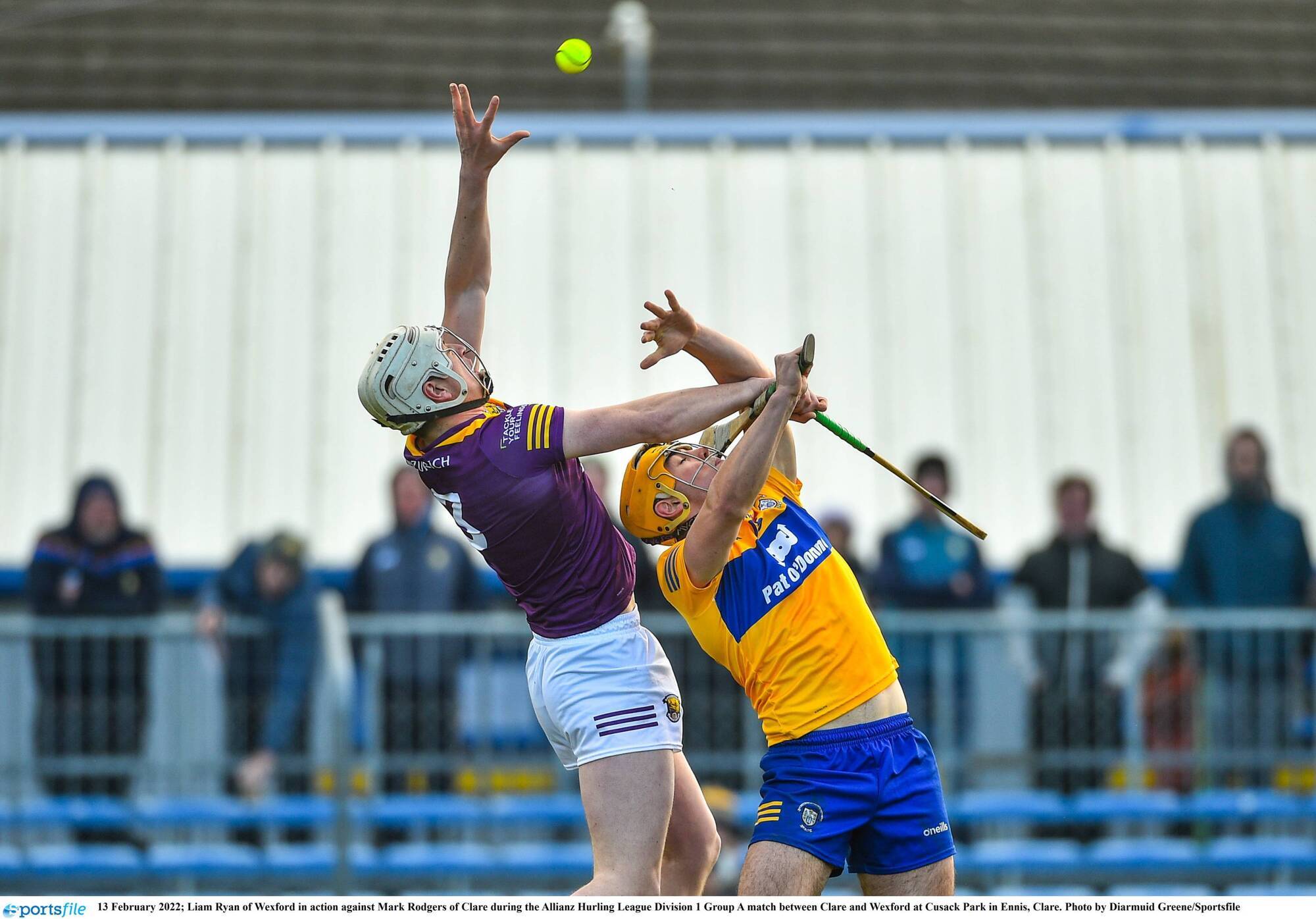
13 February 2022; Liam Ryan of Wexford in action against Mark Rodgers of Clare during the Allianz Hurling League Division 1 Group A match between Clare and Wexford at Cusack Park in Ennis, Clare. Photo by Diarmuid Greene/Sportsfile
In the championship, as in life, there are some things you can set your watch by. Limerick in full stride, and with Cian Lynch and Peter Casey returning to the ranks, will be very difficult for any team to get past. Kilkenny, for all their fallibility this year, can never be written off. The provincial champions await this weekend’s victors in early July.
But there’s still much about the 2022 championship that’s unpredictable. This weekend’s fixtures – Galway v Cork and Wexford v Clare – are evidence of this. That these counties don’t often meet in championship makes it all the more appetising for the viewer and all the more challenging for the writer of a preview piece. Like chemical compounds, you don’t know how these teams are going to react until you throw them together.
Galway at their best always look like All-Ireland contenders, and they’ve looked excellent at times this year – the only team in Leinster, really, to hurl with any sort of consistency. But they looked tired and overstretched in the Leinster final, serving up ferocious effort, but little in the way of inspiration.
Henry Shefflin’s main job in the weeks since will have been to leave them wanting more – get his players sharp and hungry again. I feel sorry for Shefflin that the story of his first season as an intercounty manager has been so far overshadowed by the passive aggression of his former boss. Saturday is a chance for him and his players to express themselves without such baggage.
They’re facing a Cork side who have been the opposite of consistent, but who have found a form and a freedom in recent weeks that has them playing with a sort of unshackled enjoyment and belief. After tough losses to Limerick and Clare, they’ve been a case study in how to turn around your championship mid-season – not easy to do when you’re playing matches week on week.
Ciarán Joyce has been key to this, solidly filling a role and releasing Mark Coleman to go and do what he does best. A tough qualifier against Antrim last week might have them on the back foot – Shane Kingston, Robert Downey and Sean O’Donoghue having picked up knocks – but Cork won’t want to squander this opportunity. Maybe they’ve gotten all the gremlins out of the system just in time for the knockout stages.
Wexford are another side that have been tormenting their supporters by veering from the sublime to the sketchy and back again. Will you get the Wexford that were the first to beat Limerick this year, that heroically drew with Galway, and beat Kilkenny when their backs were against the wall? Or the Wexford that dropped the ball against Dublin and Westmeath? I’m being a bit facetious here; I have no doubt that they’ll bring it on Saturday, but I’m not sure they have the breadth to contain Clare, the dark horses of 2022.
It’s all clicking for Clare this year. David Fitzgerald is hurling out of his skin at midfield; Shane O’Donnell, surely one of the most versatile players of the modern age, is still finding new strings to his bow; Tony Kelly – consistently excellent for a decade – has decided to ascend to another plane. The Munster final was a draining game but despite their disappointment, Clare will be buoyed by their performance all the same. The return of Peter Duggan as additional muscle and firepower up front means that Wexford will be hard pressed to contain the many dimensions of the Clare attack.
That is, I suppose, if Duggan’s retrospective suspension is overturned this week. Along with teammate Rory Hayes and Galway’s Cianan Fahy, Duggan received a suspension from the CCCC for an incident missed by the ref during the match but caught on camera – and, more pertinently, highlighted by the Sunday Game panel on TV.
There is understandable anger in Clare at what is perceived as Sunday Game snitchery. I’m a little bit torn myself. Were Shane Dowling and Brendan Cummins entitled to call it as they saw it? Yes. For the sake of balance, should they have called out Limerick and Kilkenny’s dark arts as well as Clare and Galway’s – even if just for appearances? Also yes.
One view is that it’s distasteful for former players to be acting like cops. They know what it’s like when the game is in the melting pot; let he without sin, etc etc. But when a player is caught redhanded by the camera, I think it would be disingenuous for Sunday Game panellists to say they saw nothing.
There’s a lot of minimising of fouling in the general discourse. Pundits are often very quick to declare that there was ‘no malice’ in some incident or other, when it may not quite have felt that way if you were on the receiving end of the belt. In a recent column, Jamesie O’Connor said it would be ‘nonsense’ to go reviewing tapes with the aim of catching sending-off incidents, especially since the Munster final was such a great spectacle. The vibe seems to be that if a game is entertaining enough, we’re willing to overlook a lot of off-the-ball messing.
The thing is, most stadiums are like panopticons now. If the ref, the linesmen, and the umpires don’t spot a red- or yellow-card offence, the crowd and the cameras certainly will. Are we happy to have our refs in the role of hapless panto eejit, with the crowd shouting ‘he’s behind you’? Is getting away with as much as possible now just a minimum requirement for being an intercounty player?
It comes down, as ever, to what we actually want out of our games, what kind of culture we want to generate. Do we want our players going out knowing that if they hit someone off the ball, they might not play the next day? Perhaps retrospective suspensions are the only way to eradicate dangerous behaviour on the pitch – but it has to be seen to be led by the GAA, not the lads on the Sunday Game couch.