John Riordan: Packie and Spike aim to make history in Brooklyn
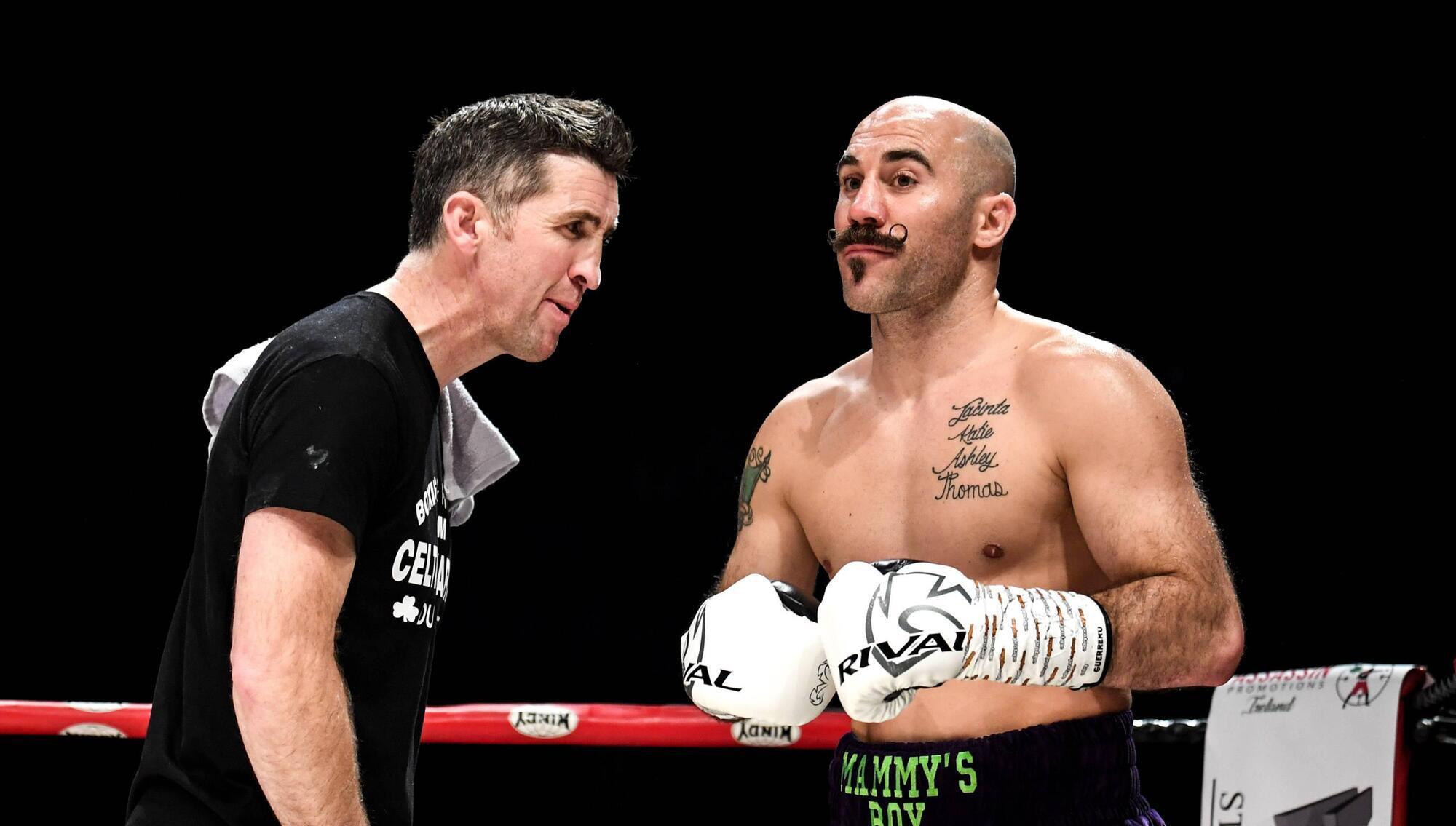
Journey of a lifetime: On a brutally cold and rainy January night in 2008, Gary 'Spike' O'Sullivan and trainer Packie Collins launched their unlikely relationship in Neptune Stadium, Cork.

There’s an ocean and a little more between Neptune Stadium and the home of the Brooklyn Nets but Packie Collins’ managerial career will bridge that gap later this month.
The Barclays Center is undeniably more glamourous and the rooftop rusting is more intentional by design but at least in Neptune they care more about basketball than being seen on the big screen.
On a brutally cold and rainy January night in 2008, Collins and Gary ‘Spike’ O’Sullivan launched their unlikely manager-fighter relationship at the northside cathedral of hoops. I was there for the Examiner because headliner Billy 'Boy' Walsh was fighting for the All-Ireland welterweight belt (he won on points) and an unknown quantity who had defected dramatically from Cuba, Mike Perez, was making his professional debut.
But down the card was O’Sullivan with whom I was a little familiar through mutual friends in the Blackrock Mahon area. He was giving the pro game a go because why not?
I looked back at my notes and it helps me vaguely recall that “O'Sullivan eased his way into the contest before a fifth round left hook just before the bell signalled the end of [Yorkshire's Peter] Dunn, the fight finally stopped after one minute of the sixth and final round”.
Paddy Hyland fought that night too - he would go on to become The Punisher and earn himself a couple world title shots. He lives in the New York these days but I truly had forgotten he was on the Neptune card.
I went down a little bit of a memory lane this week because in two weeks, O'Sullivan will himself earn his first world title shot at the age of 37 when he takes on two-division world champion Erislandy Lara whose people reached out to Collins in order to set up a defence of his WBA Middleweight.
I very improperly asked Collins for help with media access to the Mayweather Promotions event without even knowing if the phone number I had for him since all those years ago was still a number he even used. He was right back to me, got me sorted and then agreed to a call with me to help me understand the whirlwind of these past couple of weeks.
Sat outside his Celtic Warriors Gym, he had 20 minutes before continuing their work on an unexpected training camp getting Spike ready for a chance at glory.
Would that be enough time to talk? Of course, I reassured him, while I recalled to myself that he speaks at a rate of knots anyway so it’ll be more than enough time to draw plenty of chat and insight out of him.
It’s not just the stark contrast between the venues that hosted Fight One and the next one. It’s the sudden call to the biggest stage after over two years of stop/start activity and uncertainty that Collins and his fighter suffered and counter punched.
Apart from a pair of fights for Spike in 2021, a loss and a win, Collins and his stable of fighters were forced to find salvation through their gym work.
“I studied sports psychology in the States when I lived there all those years back and I went on to do a little bit more with high performance coaches on the mental side of sport,” Collins told me.
“When COVID kicked in and the guys were thinking their world is over, ‘what's going to happen’, I said ‘listen, life goes on. But what you do is you stay in the gym. You keep practicing. You know we don't just go missing for two years and then get back when boxing restarts. We keep improving. We stay ready when the call comes, and we'll hit the ground running’. And that's what got us through.”
*********************
THE Collins patriarch passed away when Packie was 11 and when his future world champion brother Steve was training at the iconic Petronelli Gym in Boston in the shadow of the legacy of ‘Marvellous’ Marvin Hagler and alongside the likes of Freddie Roach and Micky Ward. Packie was a nightmare for his mother and his sisters so he was shipped to Boston to come of age in an incredibly inspiring environment.
“I was like a sponge for all this boxing education. I remember when I left Boston, as a kid, I said ‘when I move back when I am old enough, I'll go professional’.”
He did just that, fighting professionally in the 90s, and then moved into training and management.
It readied him for the chess of matchmaking fighters but also for the phone call that came out of the blue after so many other blind alleys.
“We had moved down to junior middleweight which was Spike's weight. And we were waiting to fight the winner of Jermell Charlo and Brian Castano (who fight again this weekend).
“In the meantime, we're trying to make a fight with our Patrick Teixeira but he signed to fight in Russia and they couldn't get out of it even though there's a war going on. So we've literally just been training for somebody.
“And then I got a call and I was asked if Spike would be ready to fight on May 28 which was seven weeks away. ‘Who are you talking about?’ World title fight with Lara. ‘Give me five minutes’.”
Spike jumped at the chance and the always steady camp ramped up.
“You know Spike has only lost to world champions,” Collins points out to me as he begins to make the case for an upset in two weeks.
“Each fighter he lost to was bigger than him. Billy Joe Saunders, Chris Eubank Jr, David Lemieux was 20 pounds heavier, and Jaime Munguia. And they were younger men too.
“This time we have a guy from junior middleweight up to middleweight and he's older than Spike. So you know, I think everything's in our favour apart from the fact that he's a Cuban Southpaw and a really top amateur. I just feel he could be fading a little bit and I think this could be Spike's time.”
Manager and fighter were originally connected through promoter Gary Hyde while Collins was still based in Boston.
"There was no social media in those days so [Hyde] sent me a photograph and the name and I looked at the photograph, and I said to myself this guy looks a bit ... nuts. We did our first show in Neptune and [Spike] told me after that that his goal was to have one professional fight. But then I told him I was putting on a Boston Paddy's Day show and he jumped at it. All of a sudden, his second goal in life was to fight in America.
"And the funny thing is, in his mind that was going to be it for him, have two pro fights. Tried it, done it. Here we are 36 fights later, and he's fighting for a world title."
The Spike team will land into the familiar environs of Boston at the back end of next week where the pair feel so at home. They have taken 16 fights there and are well known around Dorchester where it feels like home.
Collins, a US citizen, sees his long-term future here, opening a gym, possibly, and training fighters while also tapping into where the real revenue is, the growing craze of boxing-inspired fitness classes.
“It's great exercise for the mental and physical health and you know you can do something like that in the States and you can make a good living from it outside of boxing.
“It takes anywhere between six, eight, 10 years to get to the point where you’re earning an income from bigger fights. So you're paying for everything for your prospects and you're making no money so somebody has to pay the bill. If people want to train their people to do box-fit classes, you let them in because it pays the bills.
“I wouldn't do it because I only train professionals and my dream is to train a world champion. My only reason for being a boxing trainer is to train professional fighters and to one day train a world champion. That's my goal.
"You're not gonna get rich from it. I'll never be rich from it but it's my drive in life to train world champions. It’s the one thing that would make me very happy and it would be incredibly special for Spike to do it because I've had him from day one.”