Kieran Shannon: Germany begins coaching plan all Irish sports can aspire to
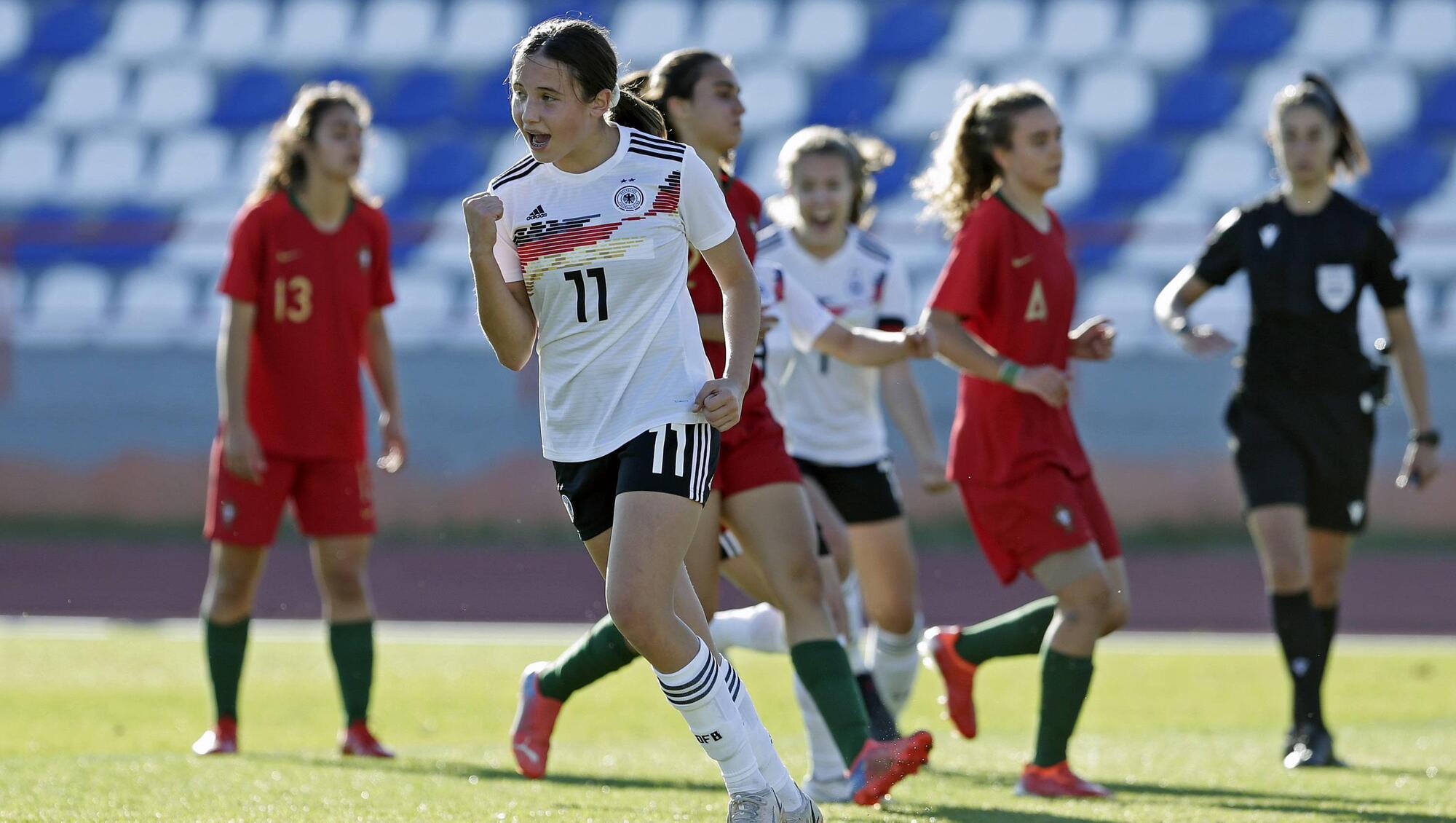
Germany U17's Loreen Benderof celebrates her goal againt Portugal in Albufeira in November 2021. Germany has been one the innovators in coaching in Europe. Picture: Ricardo Nascimento/Getty Images for DFB

For decades they were known for playing the most pragmatic, unromantic football known to man. Now the Germans are the biggest dreamers and kids that the game knows. And maybe who every sport, be it another global one like basketball, or an indigenous one like the GAA starting back up its Go Games this month, should know about and even emulate.
Its federation is launching nationwide a raft of changes in how underage football will be played in the country, underpinned by a shift in thinking succinctly summarised by its vice-president, a Ronny Zimmermann: “We need to think like children, not like adults.”
They already know what the kids think of the changes; as the excellent Training Ground Guru website explains, for two years the Germans trialled a range of formats before coming up ones which the children favoured. Essentially they were governed by the concept of Funino as coined by the German-born coach educator Horst Wein, the ‘fun’ being self-explanatory and ‘nino’ being the Spanish for child. In football Funino is lots of games, touches, goals and dribbling – and with minimal adult interference.
So, from here on in, clubs and regions can – and from 2024-25 must – dispense with traditional leagues and matches for any kid under 11.
U6s and U7s will play only games of 2v2 or 3v3 on small pitches with four mini-goals, meaning each team defends two goals. There will be no goalkeeper and no referee, and a maximum of two subs each team.
After each goal both teams sub someone in and someone out. After 10 minutes then you rotate: the ‘wining’ team advances one pitch and the losing team goes back a pitch, and so on all day, or all ‘festival’ as they want to call it, meaning over the course of your seven games or rounds you invariably are playing a team of kids your own level for most of it.
At U8 and U9 the games will be 3v3 without keepers and 5v5 with one apiece. After 12 minutes again you either advance or retreat a pitch. At U10 and U11 it fluctuates between 5v5 and 7v7 over two 12-minute halves.
It all stems from a sense that not enough kids are staying in and enjoying the sport and that not enough adults, even on the national team, are at the level the federation would want.
After the senior team failed to get out of its group at the 2018 World Cup and the U17s finished last in a prestigious tournament in Portugal the same summer, Oliver Bierhoff, the scorer of that golden goal that won Euro 96 and now director of the federation’s national teams, hinted at the necessary changes. “We need room for individualists… Through freer training, street football should be brought into the cubs. We need to create more space for creativity and enjoyment for our players.”
His colleague Panagiotis Chatzialexiou agreed. At underage the play was being dominated by the physically and technically stronger kids. Too many others at too young an age weren’t getting enough touches of the ball. “Our analysis has shown that at least a third of our talents are not essentially developed.”
And so they’ve now developed this vision. Every kid gets more touches of the ball, gets to make more decisions, play against players of their own ability, learn to defend organically, score more goals. And instead of having a crude blanket ban on heading, they’ve come up with ways that essentially eliminate it, between the smaller itches, and dribbling the ball in for restarts instead of throws and goalkicks.
Irish sport has made significant strides in the last decade or two to be more child-centred. Whereas a generation like this writer’s was reared on 11v11 from the moment we ever stepped on a pitch, smaller numbers and smaller pitches are en vogue now. The GAA through its Go Games model too has upped its game by reducing the size of underage pitches and teams.
But the German example shows there are ways clubs, counties and the association itself are and can be even more creative and proactive, starting with the Go Games that are being rolled out everywhere from this week on.
In Cork they’re trying out something as small as five-a-side at U7 and U8s and seven-a-side at U9 and U10, before it goes to nine-a-side at U11s. As one of their games development officers Colm Crowley noted upon seeing the German example, it’ll be interesting to see the feedback on those modifications at the end of the year, especially from the kids.
All sports could take a leaf from it. Basketball was actually one of the first sports to have a child-centred and age-appropriate model through the mini-ball movement, but it hasn’t been adopted as pervasively as it should have been. You still have the ridiculous situation of so many kids u13 and younger shooting into the same size hoop that LeBron James does, and worse, taking a free-throw from the same spot that he does.
This weekend Belgium will come to the Aviva as the number one side in the FIFA world rankings. Back in the noughties they too completely changed the paradigm of how they coached and viewed children’s sport. They looked at studies, including one by a university that recorded 1500 youth games and identified that in too many games some kids were barely getting a couple of touches a game. And so for U5s and U6s they changed it to just one-v-one with a goalkeeper; at that age kids don’t have the interest or cognitive capacity to pass. Then after a year they could progress to 2v2. It was only at U14 they went 11v11 and league tables were published. And even then you were still to coach the player more than the game or the team.
Kris Van Der Haegen, the Belgian’s FA director of coach education, termed it the Coaching Switch. From U14 under, the coaching focus should be on the player – the kid – not the team or the game.
“It’s really demanding, that switch,” he acknowledged in an interview with this paper three years ago. “You really do have to put in a big effort to change your whole way of thinking. To where it’s your individual relationship with a player and making individual corrections. That I’m not there for my team, I’m there for every player. I’m not there to make sure that we win the game. I’m there to make every player better.”
And to make their experience better.
It should be the goal of everyone in kid’s sport. If you’re refereeing an U12 or even an U14 basketball game and you see a kid from their first free throw clearly can’t hit the rim, bring them in a bit closer.
Irish sport with the likes of its Go Games has come a long way. But the example of Belgian and now German football shows, it can still go even further.