Peter Jackson: Mathieu Raynal did rugby a service
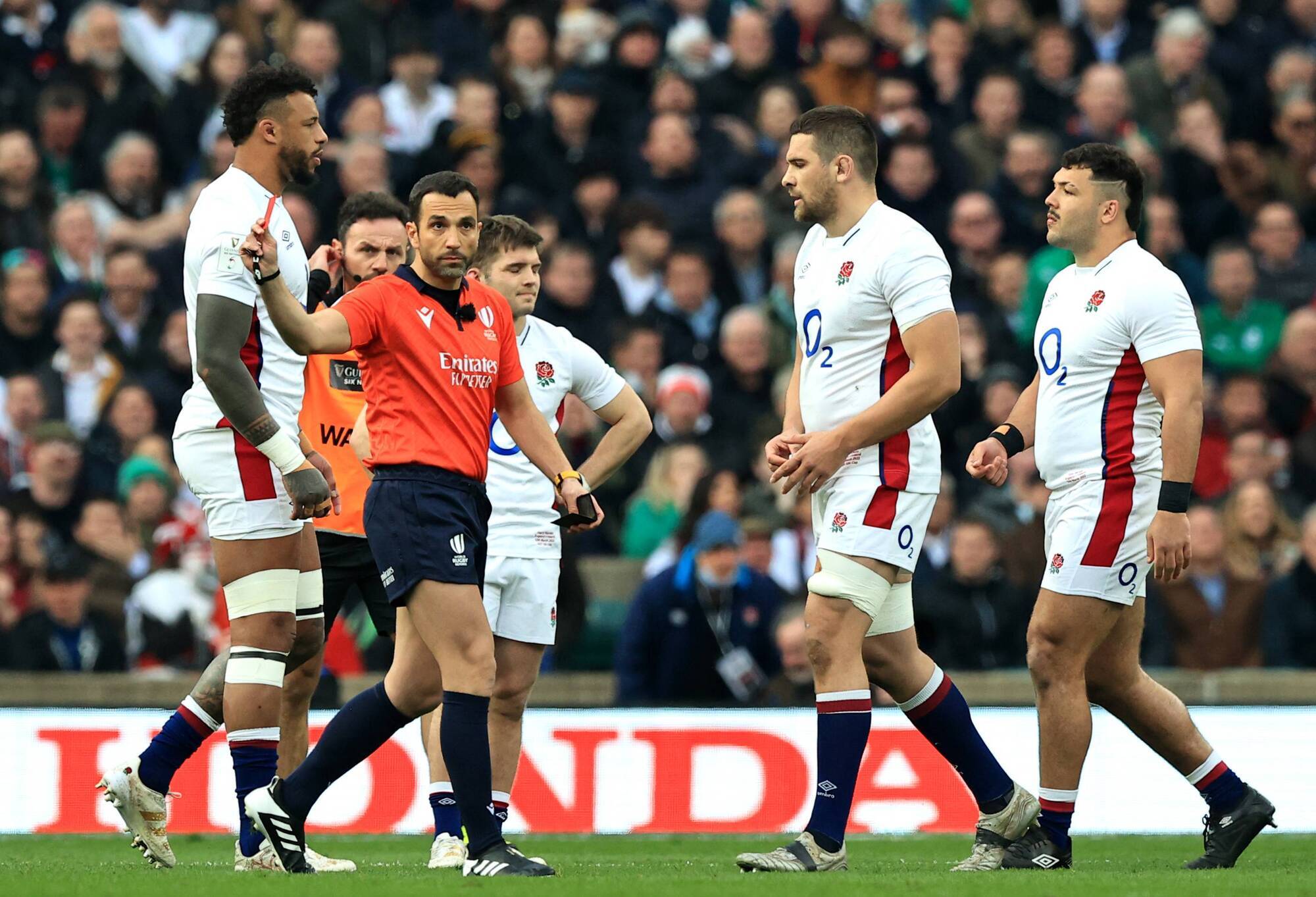
Referee Mathieu Raynal sends off England’s Charlie Ewels after less than two minutes of their Six Nations clash with Ireland at Twickenham. Picture: David Rogers/Getty Images
At least Charlie Ewels could walk away from the scene of the crime on his own two feet, quite something considering he didn’t have a leg to stand on.
It was more than could be said of James Ryan. The victim of a hit to the head, the Dubliner had to be helped gingerly along every step of the same path in such a dazed condition as to render any Head Injury Assessment a complete waste of everyone’s time.
Given his recent case history of concussion, it may be a while before the Leinster lock is cleared to hurl himself back into action. Only a few months ago he had been referred to a neurological specialist.
As for Ewels, he will finish the Six Nations in a state of suspension. Apologists for his fate will trot out the usual guff that he didn’t do it deliberately, thereby betraying their ignorance of a rugby law which does not consider intent, or lack of it, as a mitigating factor and rightly so.
Every player ought to know every word of World Rugby’s Head Contact Process in relation to Law 9.11 off by heart: High Danger. Direct contact. Lack of Control. High speed. Upright and dynamic = red card.
Mathieu Raynal would have known what it meant before running through the criteria, that Ewels, in making no attempt to lower his tackle, left the French referee no option. Charlie knew the score, that if he got it wrong his team would pay a hefty price for his dangerous indiscipline.
Many of those in the largely English crowd howling in anger would have done so on the absurd basis that the game had only just started, as if that somehow made it less of an offence. Having paid through the nose to see a contest, they felt short-changed, hence Johnny Sexton firing Ireland’s opening salvo to a deafening noise booming all around him.
The customary public appeal for silence in respect of the kicker would have been an exercise in futility second only to explaining the meaning of fair play to Comrade Putin.
Mercifully, the Six Nations had avoided provoking still greater outrage from an infinitely wider audience. They did so by refusing to touch the 20-minute red card rule with the proverbial bargepole.
In Australia and New Zealand, a sent-off player can be replaced after 20 minutes no matter how heinous his offence. Why would they do that? Because it ‘ensures fans are treated to a competitive, exciting matches in all circumstances.’
England’s reaction to suffering the earliest of early baths exposed that rationale as misguided to put it politely. It is predicated on a fallacy, that 15 men will always beat 14.
The English 14 dug deep, as football teams of all shades often do when a man down, and made it a contest, almost taking superior opponents the full distance. In Perth last summer, the Wallabies lost Marika Koroibete to a red card five minutes into their match against France and still won the Test, 33-30.
You don’t have to be an 18-carat gold cynic to wonder whether those playing fast and loose with the law south of the Equator did so motivated more by a desire to keep the television companies happy than to protect the deterrent value of the ultimate sanction.
Imagine the sense of injustice were the same incident to happen during Ireland’s three-Test series in New Zealand this summer. An All Black, or an Irishman, sent off can be replaced after 20 minutes which is one way of trivialising the red card, making it no worse than a double yellow.
The late Tommy Smith, the revered ‘Anfield Iron’ of Liverpool FC fame, used to rough up his opponent as soon as was humanly possible on the basis that the first minute was too early for a sending off.
In that respect, M. Raynal did rugby a service. He reminded all referees that law enforcement is their overriding responsibility, not turning a blind eye for fear of being found guilty in the fickle court of public opinion of spoiling the game.
If not, he soon will be judging on the excellence of his performance at Twickenham. The only thing he missed was beyond his control: The man of the match medal.
Quite apart from thriving on the responsibility, Biggar gives the impression that he actually enjoys the pre- and post-match interviews, unlike his often sullen predecessor who usually gives the
impression that he’s got better things to do.
Matt Carley did so during Wales-France, enabling
Biggar to find the corner for a power play which ended with Ryan Elias being held up over the line.

Not a new brand of coffee but a smash hit with long-suffering Italian fans. At 10st 7lbs or 66.7 kg, he’s also the lightest member of the Six Nations cast, a 22-year-old flyweight whose glorious defiance of heavy odds brought him two tries on debut as a substitute wing.
The global insurance giant and rugby sponsor, QBE, claimed they had used ‘a complex mathematical formula and computer model’ to forecast the Twickenham result supposedly based on data from 150,000 matches.
They then solemnly declared that the result would be a home win: England 32, Ireland 17. Instead of losing by 15, Ireland won by 17.
As experts in catastrophe planning for earthquakes and floods, they can always claim they overlooked another force of nature, as applied by Charlie Ewels to James Ryan.
The result would have been different but surely not that different.
There is good and bad news to be found this morning on Irish prospects of going into World Cup year as champions of Europe, a goal which cannot be reached without some serious connivance from the team they’ve just beaten.
England are no strangers to winning in Paris. They have done so on four of their last eight visits including the 2007 World Cup semi-final, facts which in no way reduce the improbability of the French letting them rain on their parade come Saturday night.
The bad news from an Irish perspective is that the heavy ante-post favourites have not lost a Grand Slam decider in Paris since Wales tripped them up in 1955, long before the French got round to putting Charles de Gaulle in the Elysee Palace.
In the half century or so since his presidency ended, France have never been kept waiting as long for a post-war Grand Chelem as they have been since the last one 12 years ago. England, left far behind among the also-rans under Martin Johnson’s management, very nearly tripped them up at the final hurdle.
Ben Foden, then married to the pop singer Una Healy from Thurles, scored the only try, leaving the French to squeeze home 12-10 thanks to a wobbly drop from Francois Trinh-Duc and three Morgan Parra penalties.
A repeat scenario this weekend will push France to the edge of a national nervous breakdown. Wales pushed them close to it in Cardiff on Friday night by daring to make them look ordinary.
Two new contenders for understatement of the Six Nations: BBC TV pundit Gordon D’Arcy on the sight of Charlie Ewels leaving the field: “He’ll be disappointed, I’m sure.”
Head coach Wayne Pivac on the subject of Wales being unable to sell out the Millennium Stadium due to the double whammy of Friday night transport problems and over-priced tickets: “There are a few seats left.”
The grand total of vacant seats amounted to 11,292. Slightly more than a few.
Ange Capuozzo (Italy)
Chris Harris (Scotland)
Jonathan Danty (France)
Dan Biggar (Wales)
Ellis Genge (England)
Julian Marchand (France)
Tomas Francis (Wales)
Paul Willemse (France)
Francois Cros (France)
Taulupe Faletau (Wales)