Colin Sheridan: Why are we allowing money tarmac over our sporting culture?
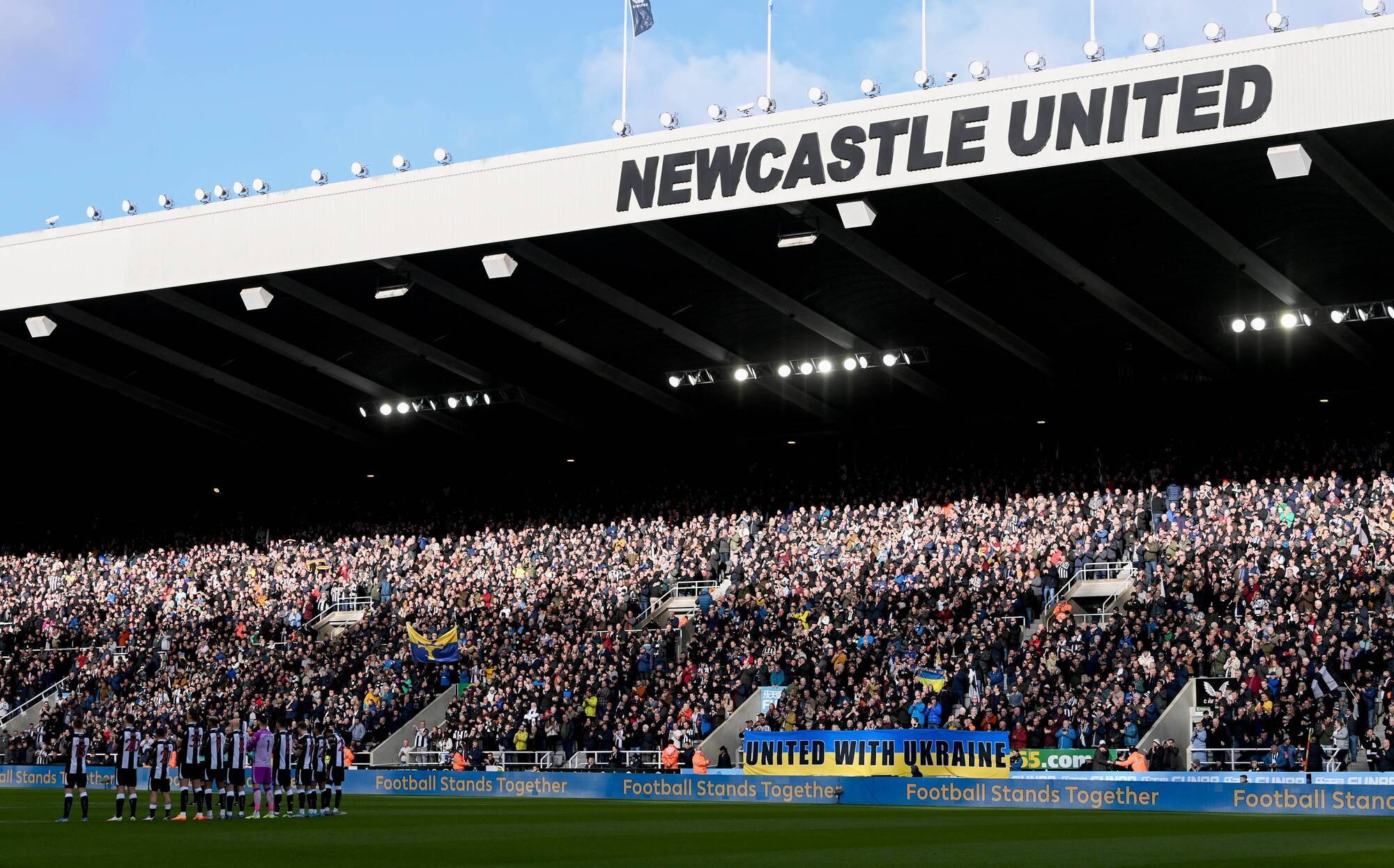
NEWCASTLE UPON TYNE, ENGLAND - MARCH 05: Players, officials and fans take part in a minute of applause to indicate peace and sympathy with Ukraine prior to the Premier League match between Newcastle United and Brighton & Hove Albion at St. James Park on March 05, 2022 in Newcastle upon Tyne, England. (Photo by Stu Forster/Getty Images)

Sport, we regularly tell ourselves, is the great leveler. It is not about war or famine. It's not about sick children or jobs that cause us smothering anxiety. It is not about broken relationships or unpaid bills. It is the opposite. It is an escape. Every kid from Burkina Faso to Burma has at some point kicked a ball into an empty goal and turned to celebrate in front of 80,000 imaginary people. Sport is transcendent and it is transformative. When the troops stopped fighting on Christmas Eve in 1914, they chose to play a game of football to forget the horror of where they were.
Sport can also be confusing. Over the weekend, stadiums around Europe united in declaring their opposition to the Russian occupation of Ukraine. Across the Premier League, club captains wore special armbands in Ukrainian colours and fans were encouraged to join players, managers, match officials and club staff in a moment of reflection and solidarity before kick-off at each game. Big screens at stadiums displayed "Football Stands Together" against the backdrop of the blue and yellow colours of the Ukrainian flag.
This was all undeniably good. But it was also decidedly selective. In Newcastle, the owners of Newcastle United showed their solidarity, too, which was more than a little ironic given that their employers - effectively the state of Saudi Arabia - has been the main actor in a brutal “intervention” in Yemen, a conflict which has led to the deaths of nearly a quarter of a million people, over 10,000 of them children. So, yes, sport is also ignorant.
It may still be the great leveler, but the continued corporatisation of sport has blurred the lines. It gets harder to appreciate the art when you know who sponsors its creation. In order to enjoy what we love, we turn a blind eye. The GAA, with its amateur ethos and its socialist values has always considered itself an outlier when it comes to the stain of money, yet, increasingly, big business sees sense in sponsoring intercounty teams to the tune of millions of euros. They even work in win-bonuses.
No matter how well it’s marketed as “growing the game” and “giving back” to communities, for the bigger companies, sponsorship is almost always about one thing - commercial opportunity. It’s a long way from what the founding fathers of the association had in mind.
Is it necessarily a bad thing? Well, consider this. All Dublin teams are sponsored by American International Group, a US insurance company, whose net worth was last week reported as $47.73B. 47 billion dollars. Cork is sponsored by the much-maligned UK retail giant Sports Direct. In late 2015, an undercover investigation carried out in a Sports Direct warehouse by "exposed how workers were being paid illegally low wages," in conditions likened to those in a Victorian workhouse. It led to a parliamentary enquiry. The deal was reportedly in the region of €2 million, with bonuses for winning an All-Ireland.
In 2018, Tipperary announced a deal with global consulting firm Teneo, an Irish founded, Manhattan-based firm that promotes itself as helping Fortune 500 CEOs maintain their pristine reputations and avoid scandals, buy influence and access to senior political figures. Teneo charges their clients (Bill Clinton and Saudi Arabia amongst them) somewhere between $250,000 and $1m per month. They also helped shape McDonald’s 2016 campaign against raising the minimum wage to $15 an hour in the U.S.
While individual county boards are free to court sponsorship from whomever they wish, the GAA itself has been marginally more selective. Only marginally. Last decade, UAE state-owned Etihad Airways sponsored the hurling championship in a deal hailed by both parties as a “long-term strategic partnership”. The deal ended prematurely at the instigation of the airline, not the association.
A different view was taken when weighing up commercial relationships with alcohol and gambling companies. Guinness fell foul to public pressure in 2012. In 2018, the association was widely praised for introducing a complete ban on sponsorship by gambling companies. Allied Irish Banks sponsors it’s flagship club competition, despite being fined €2.3m by the Central Bank for breaching money-laundering rules in 2017, and being a key player in the tracker mortgage scandal, an affair that saw them set aside €70m to meet any future fines.
In any case, it seems things will get worse before they get better. Last September, the GAA granted permission to allow sponsorship on the sleeves of player and replica jerseys. NFT’s too are on the horizon. How long before a county sells the naming right of one of its players? Crypto Clifford, anyone? Viagra Markievicz Park?
Understanding that money is a necessary evil for the games to evolve, why are we so adamant to tarmacadam over the cobblestones of our culture? The GAA’s uniquity lies in its values. Having them slowly eroded by commercial influence will see us become shills to faceless empires, whose only desired outcome is generating more income. It’s a long way from Hayes Hotel, indeed.