Colin Sheridan: Some games are best played in the dark. This was one of them
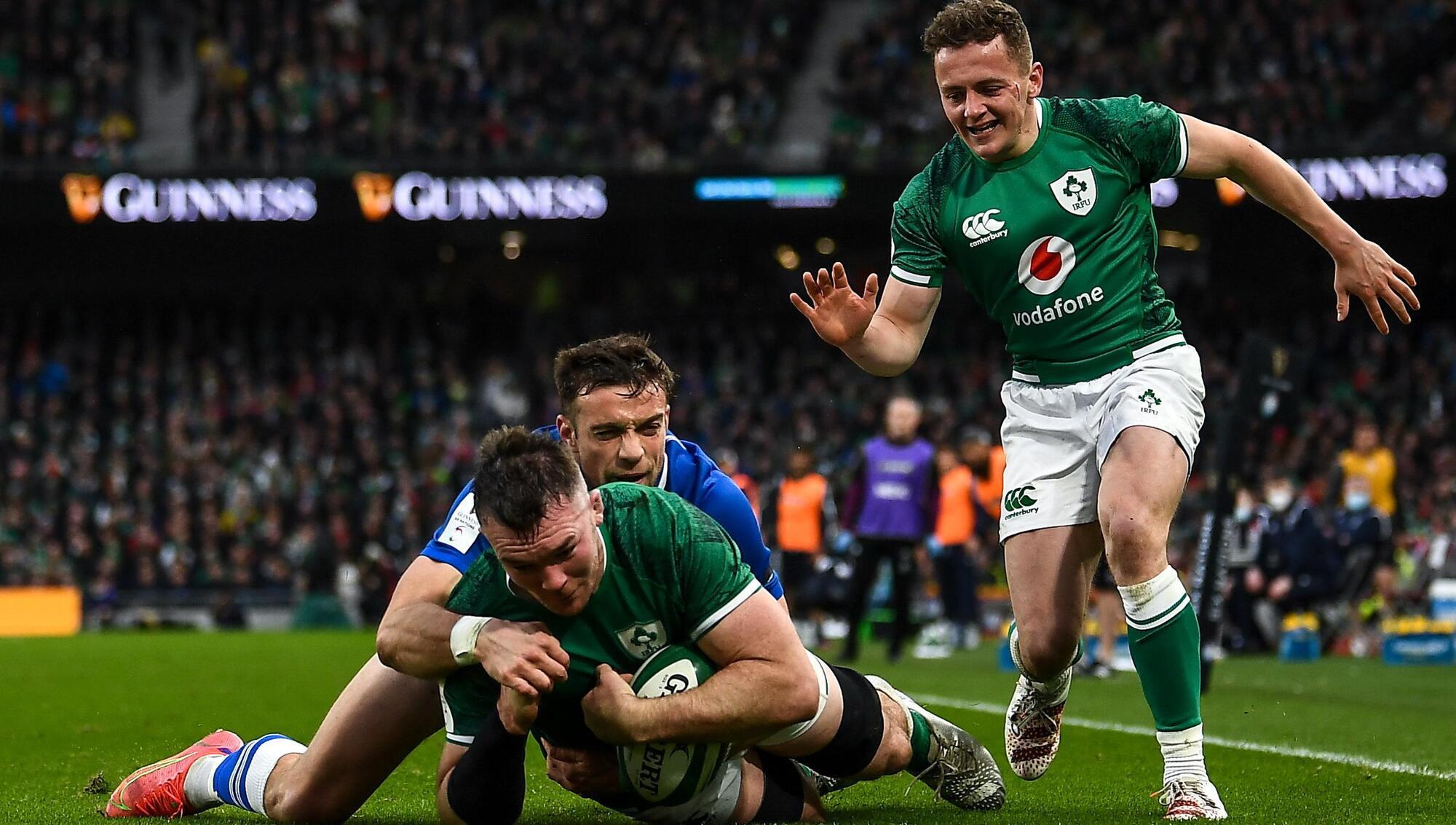
Peter O’Mahony scores Ireland's fourth try despite the tackle of Edoardo Padovani the Guinness Six Nations Rugby Championship match between Ireland and Italy at the Aviva Stadium.

If Roman emperor Marcus Aurilius had spent his days dreaming about the RBS Six Nations and not of his native Rome, this, surely, was not what he envisaged.
Ireland versus Italy on a Sunday afternoon already brought with it a sense of dread for anybody hoping for a competitive contest. Italy last won a game in the competition eight seasons ago. They've only ever won 11 in total. Once was against Ireland, nine years ago. Hopes were not high then for a thriller. Both sets of players copped it. The crowd must have known it. The tournament organisers certainly knew it. Hence the graveyard shift on a Sunday afternoon. If they could have played it behind closed doors in the dome in Bekan, I’m sure they would have. They really, really should have. Some games are best played in the dark. This was one of them.
The guys in the TV studio knew it, too. With Joe Molloy playing point-guard in the Virgin One control centre, he diligently shared the ball with Shane Horgan, Rob Kearmey, and the ever-young Mattie Williams. Each one of them worried for the Italians just as each one then looked incredibly like an Italian. There was once a time that Irish soldiers overseas were known by the locals as “the ugly Italians''. The rather tongue-in-cheek moniker came from the fact that the flags we wore on our shoulders were too similar to tell us apart from our Italian brethren, so, the easier thing to do was differentiate us by our appearances. The Azzurri had sculpted beards, tanned faces, and Armani uniforms. We were, well, we were Irish looking. In some respects, I wonder if Italy's continued inclusion in this competition is a sort of cosmic punishment for that harmless slight.
“Do you think they (the Italians) are building?” Joe asked Rob back at Virgin HQ. “Do you think they are getting better?” “No”, said Rob humourlessly, his stubble worthy of a standalone bust in the Palazzo Vecchio in Florence. “I don’t think so”.
A 40 point victory was acceptable to the panel. A 20 point victory, much less so.
So, no doubt about the result. Some doubt, however, about whether Joey Carbery is too nice a guy to push Johnny Sexton off his Spire-sized pedestal and make the 10 jersey his own. Everybody hoped the hapless Italians would provide the perfect canvas to paint his masterpiece.
Everybody except Johnny, of course.
Four minutes in, Carbs confirmed the real contest was not between the two countries, but between the two 10s, popping up on Dan Sheehan's shoulder to cross for Ireland's opening try. Much as the TV audience undoubtedly willed him to point definitely at Sexton on the bench, Joey kept a straight face and calmly slotted the extra points. We were off and running at the Aviva. Not even word filtering through of the Dubs falling to Kildare could dampen the growing excitement within the ground that this was to be a day of softer hands and dancing feet.
For the next 15 minutes or so, none of the artistry that threatened, materialised, and any hope of the Italians even offering any more resistance than a heavy-bag hanging in the gym disappeared with their second hooker Hame Faiva, who was red carded for a high hit on Sheehan. The red card was followed by many minutes (which felt like months) of confusion, as players and officials struggled to understand the rules.
Strangely, rugby is one of the few sports where the referee actually understands the rules (or laws) better than the players, supporters and commentators, even when the rules are farcical. In this instance, ludicrously, the Italians lost not one, but two players due to a quirk that aims to eradicate conniving teams taking advantage of uncontested scrums.
Whatever. This entire game was an uncontested scrum. Already an unsatisfactory endeavour, the reverse-double-jeopardy punishment bestowed upon the Italians at least diverted everyone's gaze from the general ineptitude of their play, and toward the lunacy of the rule book.
In the studio, it took a graph to explain the damned rule. Nobody does dissatisfaction like Mattie Williams. His is the abject kind, usually reserved for high-achieving fathers and their bumbling sons. In this instance, no player was the target of his wrath, only the blazers that dreamed up the folly. One could hardly blame him.
So, in the end, a bad day for hookers, World rugby and their lawmakers. A good day for debutant Michael Lowry, stubble, and every Irish soldier ever called an ugly Italian in the performance of their duties. For the Azzurri, whether the punishment fits the crime is for another day.