Colin Sheridan: Who's going to write the Super Bowl colour piece?
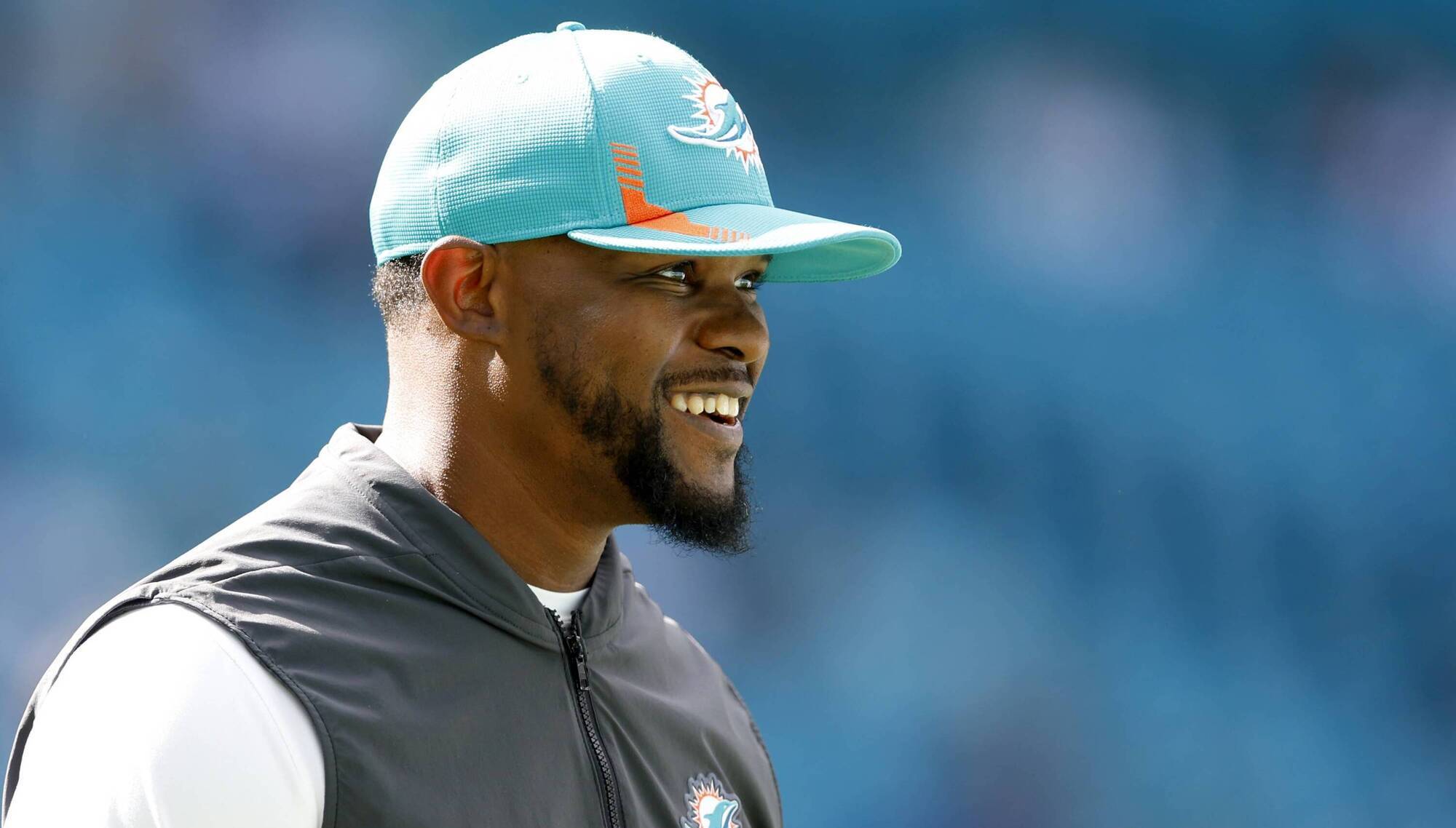
A press release from recently sacked Miami Dolphins Head Coach Brian Flores dropped, overtaking the bombshell news of Tom Brady's retirement. Picture: Michael Reaves/Getty Images

Radio Row on the week of a Super Bowl is essentially comic con for American sports.
For five days, a convention centre in the host city (this year, Los Angeles) transforms into a giant recording booth, as each morning sports broadcast, podcast and radio show with enough clout to be there, literally set out their stall in a row and make their Super Bowl predictions. What differentiates this from the regular shows is the cast of cameos from current and former players, each there to promote a vitamin water or a memory foam mattress or an insurance company.
Joining them will be random pop stars, actors and celebrities. It’s all very bright and shiny and, well, American. Like race week in Galway, Radio Row apparently peaks around Wednesday, before petering out to a soulless morass by Friday. Few of the people even stick around for the big game on Sunday night, proving that Radio Row is the media’s Superbowl. Load, brash, overstated and not for the regular fan.
Every season in the NFL is like a Mexican soap opera. Heroes, villains, redemptions, evil twins, it’s a league that has it all, and, even if you don’t care to understand the rules of the game itself, a simple introductory course in the guise of a single Hard Knocks episode would be enough to apprise a philistine on a who’s who of a franchise’s front office, and why being back-up to the back-up quarterback may not be as easy as you’d think. This season, the drama reached Himalayan heights. Week-to-week, it was impossible to pick a definitive favorite for the Super Bowl. No team dominated their division.
The league’s reigning MVP, Green Bay Packers quarterback Aaron Rogers, overshadowed his on-field excellence with a series of Covid related gaffes that were only trumped (!) by those of Tampa receiver Antonio Brown, who was suspended for four games for effectively counterfeiting his vaccination card.
A month later, as the season started to get serious, Brown stripped to the waist mid-game and walked off the field, likely ending a would-be Hall-of-Fame career in the process. Later that month, after posting the best numbers of any quarterback in the league at the age of 44, Tom Brady shocked almost everybody by announcing he was leaving the Tampa Bay Buccaneers, the team he won last year’s championship with. He has since refused to rule out returning with another team. This from a man who was born the year the first Star Wars movies premiered.
You would think the game’s greatest ever player retiring would be the biggest story of any season, but on the Monday Brady announced it, it wasn’t even the biggest NFL story of the day. As the eulogies poured forth from Stephen A Smith and Colin Cowherd and Skip Bayless, a press release from recently sacked Miami Dolphins Head Coach Brian Flores dropped, detailing a 58-page class-action lawsuit he was filing against the NFL, alleging racism in hiring practices.
In the suit, Flores accuses Miami Dolphins owner Stephan Ross of offering him $100,000 to lose games for a better draft pick, an offer he says he refused, leading to alienation by team ownership. As for the Broncos, Flores alleges they disingenuously interviewed him for a head-coaching position in 2019.
The juiciest aspect of the initial filing of the lawsuit, however, came with the publishing of a text message exchange between Flores and Patriots head coach Bill Belichick, the most monosyllabic (and successful) coach in the leagues history. The background of the exchange was Flores - recently fired from the Dolphins job despite leading them to consecutive winning seasons for the first time in 19 years - interviewing for the New York Giants top job.
In late January, Belichick, Flores’s former boss in New England, sent Flores a text congratulating him on getting the Giants gig. The problem with that message was Flores had yet to even interview.
Belichick quickly realised his mistake. “Sorry - I f**ked this up” he texted Flores. “I double-checked and misread the text. I think they are naming Brian Dabbol. I’m sorry about that.”
In getting his Brians mixed up (who amongst us has not), Belichick accidentally exposed his former protege Flores to the fact that he was interviewing for yet another job he had no hope of getting, as it was already filled.
For broader context, on the day Flores filed his lawsuit, there was one black head coach out of 32 teams in the NFL. One. In a league whose playing population is over 70% black, one team of the 32 white majority-owned franchises employed a head-coach of colour. That’s Mike Tomlin of the Pittsburgh Steelers, a team owned by the Rooney family, whose patriarch Dan Rooney gave his name to the Rooney Rule, which initially required teams to interview at least one external minority candidate for any head coaching vacancy. The rule was instituted in 2003, when, at the time, the league only had two coaches of colour. Just to reiterate, on the day Flores filed his suit almost 19 years later, the league had one.
Critics of Flores’s actions will point to the fact that the firm he hired to represent him have no black partners. That he is attention-seeking and bitter. They will also argue that the NFL is a meritocracy so obsessed with the bottom line that a team would hire anybody they think would help them win, regardless of race. That, maybe if Flores was a coach with a better record, he’d still have a job in Miami.
The NFL refuted the claims, before later flip-flopping, admitting through their commissioner Roger Goddell “there is much work to do, and we will embrace this moment to become a stronger, more inclusive league”.
The real bottom line? Brian Flores is asking a federal court to recognise a clear pattern of discrimination and hold the NFL and its teams owners accountable for it. For a day, maybe three, Flores topped the retiring Tom Brady and restarted a conversation all too quickly quietened by those who control the real money in sports. Two weeks later, on Radio Row, there was barely a mention of Flores and his class action suit.
Whether his fight will be suffocated by money and power remains to be seen, what is certain, however, is institutional racism remains as relevant today as it was 19 years ago, when the surely now unfit-for-purpose Rooney Rule was introduced. It’s unfortunately an inherently unsexy topic to discuss, meaning in a league of bright, shiny things, the next set of downs is always what’s most important.