Kieran Shannon: The story of Irish sport tells the story of Ireland
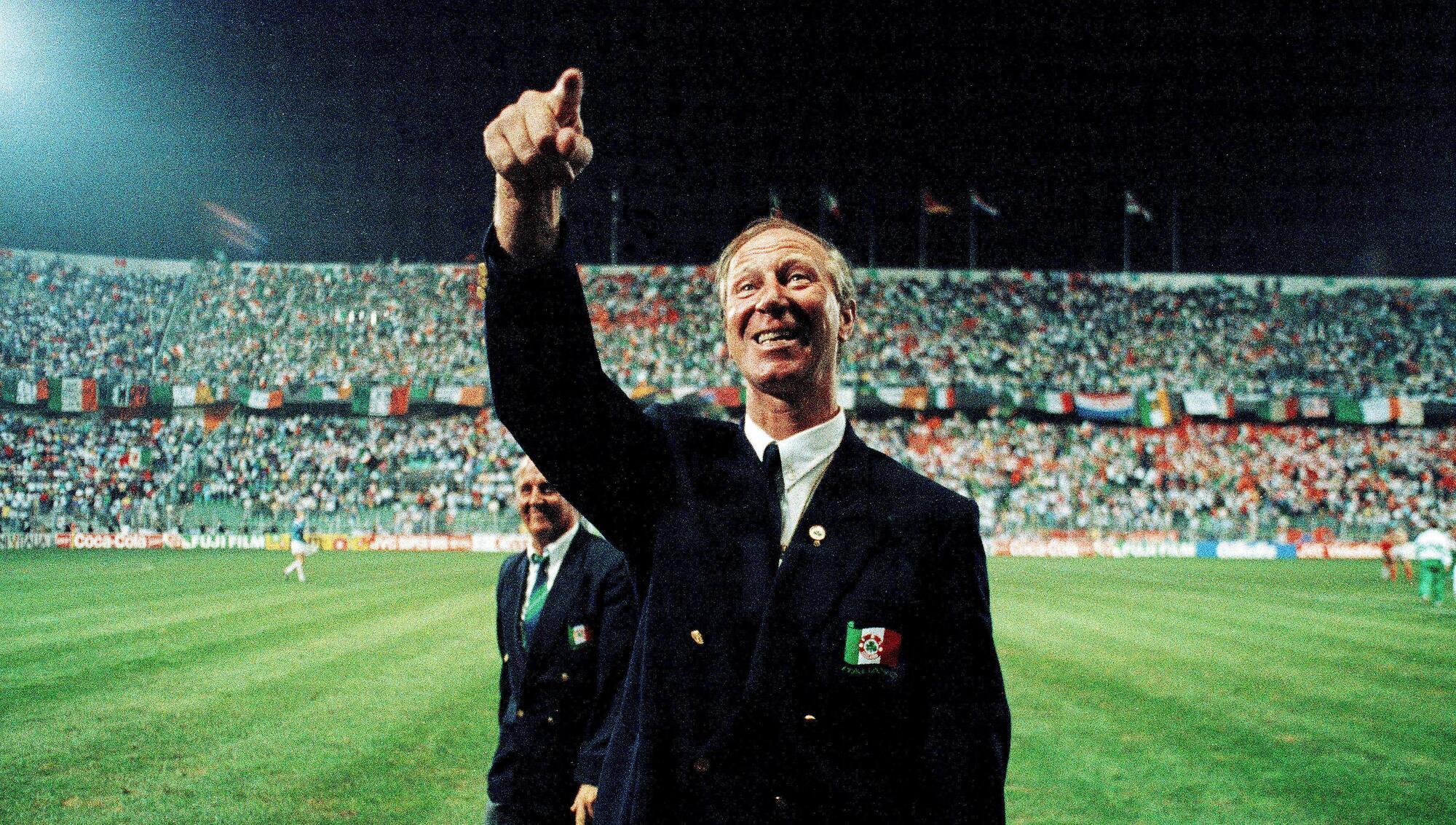
Republic of Ireland manager Jack Charlton waves to fans after the World Cup 1990 Group F 1-1 draw with the Netherlands in Palermo which sent Ireland into the last 16. Italia 90 was a watershed moment in Irish sport — and indeed Irish life, says Kieran Shannon.

For anyone who purports to writing for a living, it was impossible to read Fintan O’Toole’s We Don’t Know Ourselves over the Christmas and not be impressed, indeed astonished, by the sheer scale and achievement of it. Weaving the personal with the macro with remarkable skill and coherence, he manages to tell the narrative of how this country has evolved and transformed since his birth in 1958 in a way not even the most skilled historian or sociologist could but only a journalist of his calibre. If there was one book you’d recommend to anyone from 15 to 95 which tells the history – story – of post-war – or should we say post-emergency Ireland – then it is O’Toole’s. It is quite simply a magnum opus, magnificent, a masterpiece – and they’re just words beginning with M.
It is not, however, absolutely flawless. For those of us who (at least attempt or purport to) write about sport for a living, it is somewhat disappointing as it is striking that O’Toole himself makes little attempt to write about – or even reference – sport and the part it has played in the last 60 years of Irish life. How can we attempt to know ourselves if we don’t know how important sport is and has been in the daily lives of people here?
It’s a point Paul Kimmage, one of the finest writers on sport during that period, has also made. As he put it, “Sport either matters or it doesn’t.” And to him the most significant omission is the (unbelievable, as in too-good-to-be-true) rise and fall of Michelle Smith. “Her story was a watershed moment in Irish sport and should not be whitewashed from history.”
To be fair to both parties, you could see why Kimmage feels it should have been included and in turn why O’Toole failed to even mention her.
The Smith story was one of the biggest and most important episodes in the history of Irish sports journalism and a watershed in Kimmage’s own career: as he and David Walsh have said on a couple of occasions, they’d hardly have pursued Lance Armstrong as they did if they first hadn’t been steeled and bloodied in their coverage of Smith. And any attempt to tell the story of Irish sport over the last 60 years would have to include a standalone chapter on her.
But O’Toole was not writing a history of Irish sport. He was writing a history of Ireland. True, she should maybe at least have been mentioned (especially, as Kimmage has pointed out, it underlines Ireland’s capacity for self-delusion and hope that what is out of sight stays out of mind, such a strong theme in O’Toole’s book), but then you could say the same about Ann Lovett, who, for all O’Toole devotes to the depressing 1980s and the Church’s unhealthy influence and hang-ups about sexuality, doesn’t make the index either. But for as late as people stayed up to watch her win gold in Atlanta and for as many people who phoned into Joe to defend her honour, it wasn’t quite the carnival as other events six years earlier or stir or as divide as pointedly as another particular episode would six years later. It didn’t fundamentally alter our lives the way other sporting moments would. If O’Toole or anyone else were to have a chapter hinging on one moment or figure in Irish sport, you wouldn’t select or start with Michelle Smith-de Bruin. Which begs the question: what or who would?
In our eyes at least it would begin with Jack Charlton, who was lucky to be mentioned once in O’Toole’s book, and Italia 90, which somehow didn’t make it at all. Instead it warrants just a breezy reference, sandwiched between an extensive thesis on Riverdance and the songs of Shane McGowan: “they opened a place in Irishness for the diasporas that were, in many ways, the truest products of its history”. It’s hard to fathom that’s all he has to say about those years, and especially that summer. Yeah, the football was played in Italy, but as Con Houlihan famously reminded us, the tournament and experience happened right here at home. More than the summer of the moving statues or the hunger strikes or indeed any other, Italia 90 was the most shared national moment of the last 60 years.
Cork people will be glad to know that one sportsman of their own makes it into O’Toole’s tome; Jack Lynch’s sporting prowess, as well as his political career, is noted, albeit Fintan seems to have overlooked or forgotten his famous status as a dual player, referring him to only as a “former Cork hurler”. However, there is no mention of that other famous Glen Rovers man, Christy Ring, who brought magic and colour into the lives of the drab country O’Toole describes and those who didn’t flee it. And somehow there isn’t a word either about that other iconic northsider, Roy Keane, even though he played for O’Toole’s favourite team, Nottingham Forest, and happened to be involved in that saga known as Saipan, another placename or episode that doesn’t make the index of WDKO.
We severely doubt it, but perhaps the reason O’Toole pretty much stayed away from touching on sport is because he feels it merits a book in its own right: that you could tell the story of Ireland – and who indeed we truly are as well as how we’ve changed – through a series of Irish sporting – and social – milestones.
Just like O’Toole begins his book in the year he was born – 1958 – with TK Whitaker’s ground-breaking blueprint for economic development, a sporting equivalent would be an event that occurred in the year I happened to be born: the Congress of 1971 when the GAA removed The Ban. Like Whitaker’s document, it didn’t change everything right there and then but nothing was the same after it.
From that you could do what O’Toole does, with almost every subsequent year producing an event and a chapter. With 1972 and the fallout from Bloody Sunday you could recall the Five Nations rugby championship of that year and how Wales and Scotland opted not to travel to Dublin but a year later England would. For 1974 and the rest of the decade you could describe the sociological as well as sporting phenomenon that became Heffo’s Army and its ensuing rivalry with Kerry. For 1979 you could have the death of Ring and the end of Lynch as Taoiseach. For almost any of the first five years of the 80s, the astonishing duo of Eamon Coghlan and John Treacy, for 1982 to 1986 the North at the World Cup; for 1985 Denis Taylor and the craze that was snooker; for 1986, Barry McGuigan, the man who fought for peace yet ended up fighting with his once beloved manager, Mr Eastwood; for ’87, the other dynamic duo, Stephen Roche and Sean Kelly (who also were deemed not worthy of making it into WDK0).
The 1990s would be another source of rich material. 1991 and how the Dublin-Meath saga helped revive and inspire the GAA following how under threat it felt after Italia 1990. The Ulster football revival of the early 1990s at a time the Troubles were at its ugliest and also near its end. Windsor Park, 1993. Loughnane and Griffin and the hurling revolution years. The fleeting phenomenon that was the Formula One obsession and how Eddie Irvine and Jordan partied in 1999. The calamity that was the Irish Olympic performance at Sydney 2000 and Athens 2004. 2003 and Armagh-Tyrone in the new Croke Park. 2005 and the opening of Croke Park. 2008 and the Irish boxers. 2009 and Kilkenny’s dominance and Cork hurling’s civil war. 2011 and Dublin’s breakthrough and subsequent dominance. 2012 and Katie. 2016 and the fall of Hickey. 2019 and the fall of Delaney. 20x20 and 2021 and the breakthrough it was not just for women’s sport but Irish sport.
The story of Irish sport tells the story of Ireland. And gives a better picture of who we really are.