Paul Rouse: Changing before your eyes - The splintering of sports broadcasting is ongoing
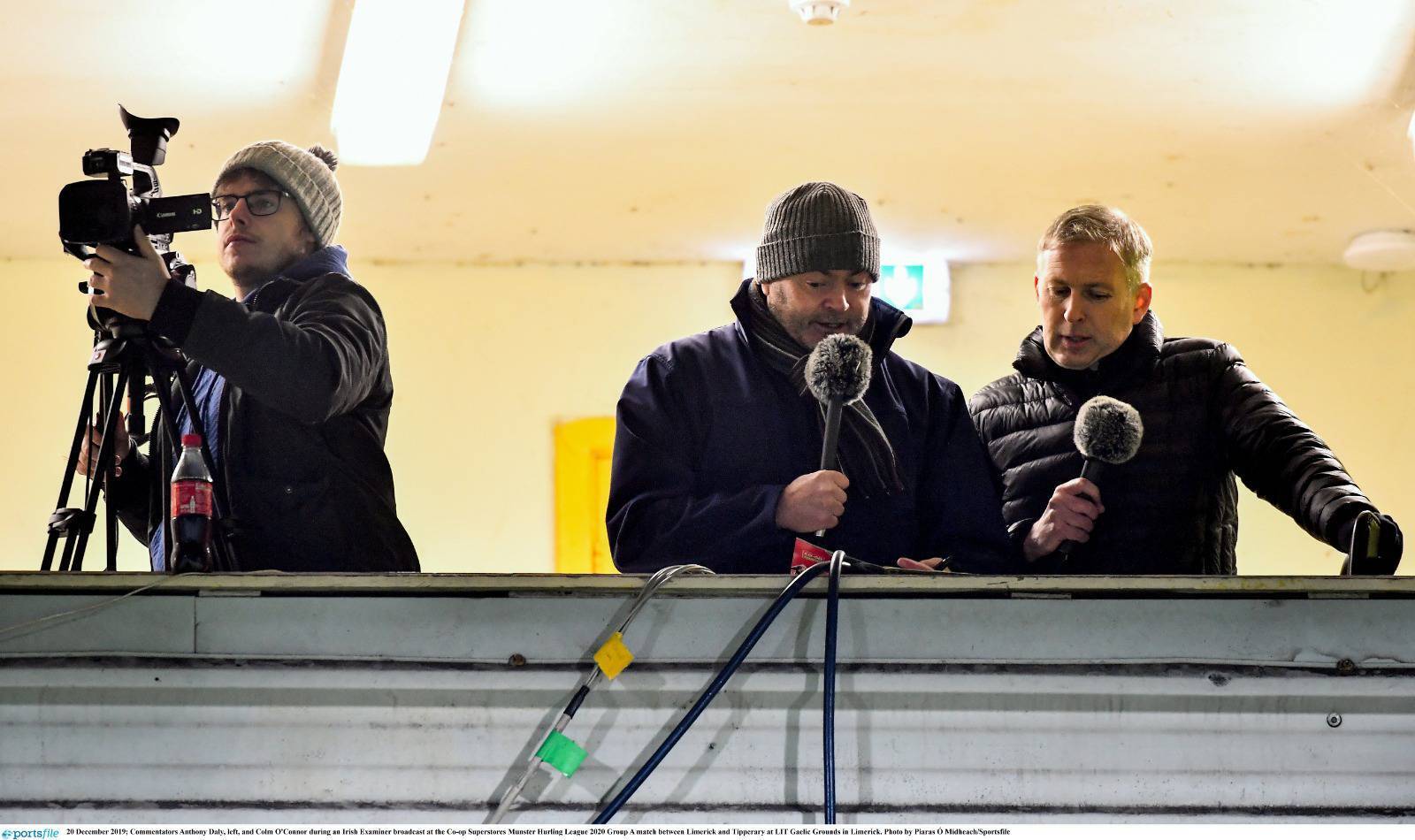
CAMERA, ACTION: The Irish Examiner commentary team of Colm O'Connor and Anthony Daly broadcasting a live-stream on the newspaper's website.
The broadcast of sport on television has entered a new era.
The market is rapidly evolving and the possibilities created by recent technological change has led to an increasing diversification of sports broadcasting. This is evident across every significant sport.
As well as sport that is shown on free-to-air broadcasters (such as RTÉ) and pay-TV companies (such as Sky Sports), sport can now be found on streaming services (such as Amazon Prime), on the websites of newspapers (such as the Irish Examiner) and on apps run by sports organisations themselves (such as NFL Game Pass) or dedicated to particular sports organisations (such as GAAGO).
The evidence of the diversity of the broadcasting market has been made plain in a couple of instances over the past month. For example, the Amazon Prime streaming service secured the rights to high-profile rugby internationals this autumn.
Indeed, it broadcast all of Wales, England, Scotland, France, and Italy’s matches in the newly named Autumn Nations Series in Britain. It is yet to be decided whether Ireland’s international rugby games will all switch from RTÉ to become part of Amazon Prime’s offering in 2022. A subscription to Amazon Prime currently costs £7.99 (€9.48) per month or £79 (€93.76) for a year.
That the IRFU this month returned a deficit of €10m for the past year — on top of a deficit of €36m for the previous reporting period — is the context they make decisions in.
At the same time that so many rugby internationals were moving to Amazon, the Tyrone County Board chose to put its own senior football county final live on its own streaming service rather than on TG4. The price charged to viewers to watch the match was £16 (€18.99).
These two developments offer further evidence of the great change now underway. Over the last three decades, the great engine of the growth in the commercialisation of sport was the purchase of sports broadcasting rights by pay-TV companies who, in turn, sold exclusive access to major sporting events to their subscribers.
This created a new market which essentially made paying consumers out of sports fans who had previously watched sport only on free-to-air television.
It would appear that this is a model that is now under significant pressure. There has been a slowdown in the value of broadcast rights and the rapid growth in rights values over the past three decades looks to have ended.
Driven by soccer, the total sports spend in the largest five Western European broadcasting markets was more than €10.5bn in 2018; this sum was more than double what it had been at the start of the decade.
But all the evidence suggests that it has now stagnated and the future for Pay-TV earnings seems uncertain.
The undying question for a sports organisation is how does it position its sport on screens, be they televisions, tablets, or phones? This is a calculation that demands consideration of revenue generation, encouraging participation, and helping to generate alternate income, not least through providing a platform for sponsors.
For a few sports — most obviously soccer — there is an opportunity to generate huge income in most TV markets for the sale of their rights. Indeed, these sales have been characterised by a sort of hyper-inflation over the past three decades.
Against the splintering of the television market and what appears to be a brake on the growth of rights costs, what happens next for soccer is vital. Will a new generation who are unbound to television and who have been born into an online world take out subscriptions and, if so, where will they buy them from? Or is the model becoming so diversified that it is going to burst?
For sports other than soccer, who did not enjoy huge increases in rights fees, diversification presents both a challenge and an opportunity. The challenge lies in making the right choices in respect of the range of options now becoming available and the opportunity lies in the sheer range of options.

But for most of these sports, it must be remembered that — unlike soccer — most of their income does not come from TV rights. Instead, it comes from sponsorship deals, gate receipts, merchandising, advertising, and hospitality. Sponsorship and gate receipts are ordinarily the most important elements in this instance.
For sports organisations that depend on their sponsorship income, the construction of an appropriate broadcasting deal to maximise the position of the sponsor is vital.
These are all matters that have been considered in a new report commissioned by the European Broadcasting Union, and undertaken by Ampere Analysis who undertook extensive quantitative consumer research, based on 21,000 interviews with European internet users across 12 markets, plus rights deal and revenue information covering over 1,000 broadcasting rights deals across Europe.
The report — “Sport on European TV: Maximising Commercial Value” — found that “when a sport moves from a free to a premium TV channel, its reach drops by an average of 68% amongst sport fans. With free TV attracting a more diverse range of sponsors, it can be more lucrative for many sports.”
Director of Eurovision sport Glen Killane, who was previously head of sport at RTÉ, drew attention to the fact that a new generation was not attracted to the model of buying subscriptions to pay-TV stations: “It’s particularly noticeable that demographic shifts mean younger audiences are especially hard to reach via traditional forms of paid TV distribution.”
A prime example of a sport that is thriving by eschewing the pay-tv model is Formula E. This is broadcast across Europe primarily by free-to-air media organisations such as the BBC, Rai and RTVE. As the report reveals, Formula E grew its global audience to around 411 million by 2019 and its revenue has increased from $21m (€18.72m) in 2015 to $162m (€144.44m). This increase was driven mostly by sponsorship and the value of that sponsorship was heightened by its presence on free-to-air television.
Ultimately, the report concluded that “brand-building and grassroots participation are best served by maximising reach through a free TV deal while also leveraging the opportunities presented by social media and other ancillary and short-form video outlets which can also form a key part of any sponsorship deal value.”
It appears certain that multi-platform offerings are the future for every significant sport. Either way, it will be fascinating to watch — as technology evolves — just how diversified and how personalised the sports broadcasting market becomes.
The end result is that in 2022, Irish rugby fans will be watching Ireland play matches on RTÉ, Amazon Prime, and most likely Sky Sports, who will probably secure the rights to Ireland’s three-test tour to New Zealand next summer.
They will also be able to watch their province in competitive action — should they support one — on RTÉ, TG4, BBC Northern Ireland, and BT Sport.
Even on a small island, the diversification of just one sport will see it broadcast in at least seven separate locations. The splintering of sports broadcasting is ongoing.
- Paul Rouse is professor of history at UCD.