Ireland must regain direction after taking turn for the worst
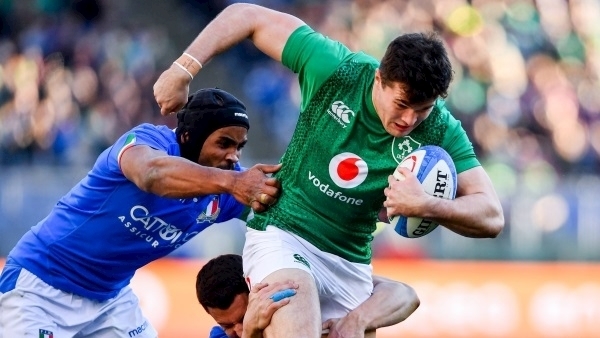
Apart from asking directions for the Colosseum or the Vatican City, the question on everyone’s lips in Rome last weekend was: What’s the problem with Ireland?
After three consecutive performances well short of anything produced last year, it’s an issue that even the players and management are struggling to come to terms with.
While it’s clear the defeat to England has impacted on confidence, that alone is too simplistic. I suspect a combination of smaller issues is taking its toll. Everything Joe Schmidt has achieved with this squad over the last few years is based on absolute clarity in terms of the way the side plays collectively and with every player’s specific role in carrying out that plan.
The problem with delivering a game plan with the clarity and consistency Ireland have produced for over the last few seasons is that, with the forensic detail of opposition analysis being carried out now, teams know what’s coming even before you start implementing it.
Ireland’s accuracy at the breakdown with every player, regardless of the number on their backs, expected to support the ball carrier and clean out at ruck time with the efficiency and accuracy of a back row forward gave us an edge in that key sector.
Schmidt’s mantra is simple. If you are the closest support player then the onus is on you to do the dirty work.
It took some of the outside backs in the selection equation time to understand that if they couldn’t perform those unglamorous tasks then, regardless of their ability to threaten with ball in hand, they didn’t get picked. As a consequence, Ireland’s ability to retain possession through endless phases stressed opposition defences to the point where they either conceded penalties or points on the board.
Given Ireland’s unprecedented success with this approach, coupled with a punishing kicking game that for some strange reason has gone missing recently, it was inevitable that teams would seek to negate or at the very least dilute Ireland’s effectiveness in those key areas.
With the World Cup in mind, Schmidt sought to expand the playing base to an unprecedented level, with Connacht’s Jack Carty the latest to be added to the out-half depth chart after Ross Byrne was exposed to the demands of the Irish set-up in Australia last June.
While the cover available in most positions is of a better quality than ever before, having to integrate a large number of changes is proving problematic, with the same levels of clarity and cohesion hard to come by. For example, 12 of the match day squad that saw game time against New Zealand only three months ago were absent in Rome last Sunday with another in Bundee Aki also gone after only 11 minutes of action.
In addition, six of Sunday’s squad in Carty, Dave Kilcoyne, Chris Farrell, Ultan Dillane, Sean O’Brien, and Josh Van Der Flier were outside the 33 man squad that toured Australia last June.
Schmidt now has an in-depth knowledge and understanding of the top 50 players in the country and knows exactly what their capabilities are.
What he now has to try and figure out is why some of his most consistent performers since assuming the head coach role six years ago — Conor Murray, Johnny Sexton, Sean O’Brien to a lesser extent Rob Kearney, who played well against Scotland — are struggling to make their normal impact. The common denominator here is that all have just recently recovered from debilitating injuries.
What this championship has highlighted is that every team is compromised by injuries to key players. The top three sides in Ireland, England and Wales, are all capable of beating each other, with injuries to players in key positions tipping the balance one way or the other.
England were superb in Dublin but lost their two best forwards in Mako Vunipola and Maro Itoje and that proved a game-changer against Wales. Both Courtney Lawes and Joe Launchbury are superb replacements to have for Itoje, but neither can match the overall impact he carries while Ben Moon is not in the same class as Vunipola.
Work rate
Likewise with Ireland, James Ryan has quickly become a key figure while the towering presence and smarts that Devin Toner offers adds a greater solidity to Ireland’s line out and creates more problems on the opposition throw.
Despite the solid work rate and carrying ability that Dillane, Quinn Roux, and Iain Henderson contributed in Rome, none of that trio matches the consistent excellence of the Leinster pairing. In Toner’s continuing absence due to his recent ankle surgery, I would love to see Tadhg Beirne get a start alongside Ryan for the game against France, with Henderson offering his ballast and experience off the bench.
With the likelihood that Ryan, Cian Healy, Rory Best, Robbie Henshaw, Garry Ringrose and CJ Stander could all be recalled to the starting line up against the French, the hope is that the fluidity and understanding that underpinned the side in recent times will re-emerge. It is also imperative, however, that Sexton and Murray find their best form. That will happen, it’s only a matter of when.
The frequency of injuries to key personnel is becoming a blight on the game and is having a devastating effect on squads without serious depth. Scotland, with just two professional teams, have discovered that to their cost in this championship.
To lose their most influential players in Stuart Hogg, Willem Nel and Finn Russell after only two games, has been catastrophic. Given that narrow club base, Gregor Townsend is happy to have a large number of his squad playing in England and France but that too has consequences.
Apart from the obvious desire to keep all their top players in Ireland, one of the central tenets of the IRFU’s unwritten policy in not picking overseas based players is their inability to control when they play.
The fact Russell had to travel back to Paris on the down week of the Six Nations to line out for Racing 92 in the Top 14 and got concussed in doing so, ironically ruling him out for the game against France while his fellow Racing 92 players in the French squad were resting up.
Likewise, Italy lost their inspirational captain Sergio Parisse for the Ireland game when he was pressed into action on that same weekend for Stade Francois and was also concussed.
With Wales the only side still on course for a Grand Slam, huge credit goes to the much maligned Warren Gatland for the manner with which he continues to get the very best from a Welsh squad shorn a number of their top performers in Taulipe Faletau, Leigh Halfpenny, Rhys Webb and Scott Williams, not to mention the premature retirement of their Lions captain Sam Warburton.
Gatland has fashioned a 12-game winning streak despite the fact that, once again, none of the Welsh regions have made the quarter-finals of the Champions Cup. Given their current poor form in the Guinness PRO14, there is even the possibility that no Welsh side will qualify for next season’s tournament.
Before Schmidt can even contemplate stopping Gatland’s march on the final day of action in Cardiff, he has to find a way to get Ireland back playing the high intensity, error free rugby we have become used to which is capable of exposing the many flaws the French have, despite that timely win over Scotland.
The Welsh will have to wait for now as Schmidt searches for solutions to the technical and mental flaws that have blighted Ireland’s 2019 championship journey to date.
Picking his strongest available side will help in that regard.