In search of the Holy Grail - A match programme from 1929
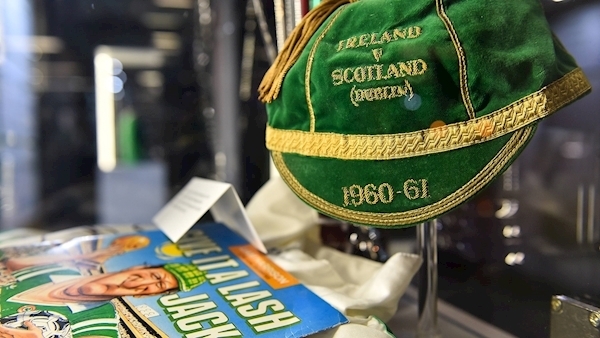
Should you ever happen to stumble upon a match programme for Ireland versus Belgium from April, 1929 then don’t hesitate to get in touch with Gary Spain. But, a word to the wise: be sure he’s sitting down when you tell him.
Having amassed a collection of Irish football-related programmes numbering “tens of thousands” and stretching all the way back to 1884 - for the record, a game played at Anfield between Stanley and Ulster — the 52-year-old Limerick man can now claim to be the proud owner of “every Irish home programme — bar one”.
The Holy Grail is the programme for that Ireland- Belgium game at Dalymount Park 90 years ago, in which the home side ran out 4-0 winners, with Shamrock Rovers’ John Joe Flood, on what was his international debut, making history by becoming the first player to score a hat-trick for the Republic.
“I’ve never seen the programme, I’ve never had a chance of getting it and, though I’m assuming it was done at the time, I don’t even know for sure if one exists,” says Gary.
“I’ve tried everything to get my hands on one: Advertising in papers, posting on internet forums. But I’ve never come close. Even an old neighbour of mine, whose father, Tony Maguire, played in that match, didn’t have one. He had his father’s cap alright but not the programme.”
In the absence of that mythical beast, Spain can still boast that he possesses something almost, but not quite, as rare.
“There are only two known copies of the programme for Ireland’s 1927 game against Italy and I have one of them,” he says. “The other guy, a collector in Dublin, got it from a rugby collector because, unusually for the time, the match had been played in Lansdowne.
That was the only known copy until about 20 years ago when a woman answered a small ad I had in the paper. I wasn’t specifically looking for that one, just for pre-1977 programmes in general. So I went to meet this woman and, when I started looking through the programmes, a lot of them I already had. But then, in the middle of the pile, I saw this one and knew straight away what it was. It’s quite a flimsy programme, just four pages, which is why not many of them would have survived.
And what was the moment of discovery like?
“It was like winning the World Cup,” he laughs. “I was just thrilled to see it.
Hence that health warning about breaking the news gently to Gary should the Ireland-Belgium one ever turn up.
“The chances of it being discovered in an attic now are probably very slim but you never know,” he reflects. “The problem is that, back in those days, people didn’t really keep the programmes and nobody collected them. They were just thrown on the ground. I know even from speaking to former players that the dressing rooms used to be so cold that they’d put the programmes down and stand on them when they’d come out of the showers. That’s why a lot of players don’t even have them.”
To tie in with build-up to the 2020 Finals coming to Dublin, Spain has donated some of his historic European Championship programmes to the National Football Exhibition.
“The earliest one was our first Euro qualifier, against Czechoslovakia at Dalymount Park, in April 1959, which we won 2-0,” he says. “It’s commonly mistaken as the first ever European Championship qualifier but it most definitely isn’t. The reason for the misconception is that, even though we played the Czechs in what was called the preliminary round, the first round had actually already taken place for a number of other countries.
“Another one that stands out for me, even though it was before I was even born, was in the qualifiers for 1964 when we beat Austria 3-2 in a very famous win at Dalymount and then went on to play Spain — who went on to win the tournament — in the last eight. So we actually reached the last eight of the European Championship as far back as 1964.”
Explaining the attraction of collecting match programmes, Gary, a life-long Limerick supporter and familiar face at League of Ireland games and Irish internationals home and away, says:
Obviously, I’m a huge football fan but I’ve also always had a huge interest in the history of the game. I only collect Irish programmes so it’s like owning a piece of our footballing history, having that direct link to the past. I do love looking through them. It’s not just about games I’ve been at but being able to read stories about great games and great players long before I was born.
Unfortunately, it appears that the digital age is proving to be a threat to the match programme as we know and love it “I don’t know if people noticed but Denmark didn’t produce a programme for our World Cup play-off in Copenhagen,” says Gary. “They’ve stopped, the Dutch have stopped and I’ve just heard recently that Belgium stopped producing them as well. Sales are declining so the digital age has definitely become a threat. Even now you can look back on programmes from the ‘50s and ‘60s and find information in them that wouldn’t have been in newspapers at the time. Whereas now everything is available on line and there’s very little you’ll read in a programme that you wouldn’t have otherwise.”
All the more reason then to value his contribution to the nationwide roll-out of the National Football Exhibition, which covers 60 years of the European Championship and Irish football, and will also include input from local League of Ireland clubs at each regional venue.
Along with a host of iconic items, from programmes to jerseys, the exhibition also offers interactive features, video quizzes and the opportunity for visitors to record their own commentary to some of Ireland’s greatest goals.
The free-to-enter exhibition’s tour kicks off in Sligo City Hall tonight (February 16, running until the 28th) before moving on to Cork (St. Peter’s, 9th-24th March) and Limerick (UL Sports Campus, June). Dates and locations for Waterford (August), Donegal (September), Dundalk (February 2020) and Galway (March 2020), will be announced in the coming weeks, before the exhibition returns to Dublin City Hall in time for the EURO 2020 kick-off. The National Football Exhibition App can be downloaded from the App Store and Google Play Store to find out more.