Commentators cautious of calling it as they see it
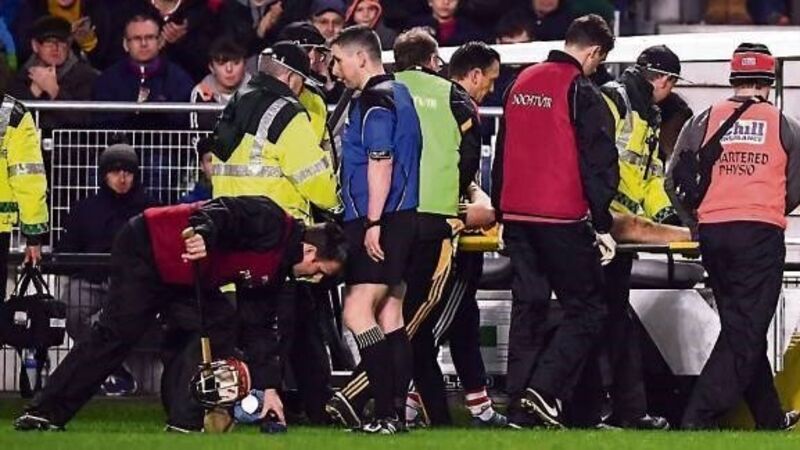
Awareness of concussion has never been higher among the general public, but for media commentators it’s a sensitive area.
In fact, the discussion of player injuries can be a tricky subject all round.
“It’s something I’d be conscious of since starting off in this line of work with local radio,” says Mike Finnerty of Sky Sports.
“You’re conscious it’s someone’s son or daughter you’re talking about.
“I remember a match going back maybe 15 years, in early January, where a Roscommon player suffered a really serious leg break in an FBD game.
I remember distinctly having to make that judgement call - how much detail, what language to use and so on. It happened that his mother was listening to the radio and knew there had to be an issue because the game was stopped. So you have to be careful and conscious of those sensitivities.
Ger Canning of RTÉ echoes Finnerty: “In my experience the commentator may say ‘oh that looks a nasty clash’, but the TV director, who’s in charge of the pictures, will have a first look at what’s happened before it’s shown - the same goes for the VT experts, who’ll look at what’s happened as well.
“In the Galway-Mayo championship game last year Tom Parsons of Mayo got a bad injury and we may have said at the time, ‘let’s not go in too close on this’ because it’d be distressing for everyone. Tom was on the ground getting attention for about seven minutes and we spoke on air about different things rather than going to replay after replay.
"You’re taking the voyeurism out of it and common sense comes into play. You’re using your common sense not to show a very bad injury and TV companies would be well aware that the injured player has relatives and the viewers tune in to see a sports event rather than some gruesome injury.”
Brian Tyers of TG4 expands on the point with an example that goes beyond the field of play itself.
“I know that obligation has always been there, to be conscious of what you’re saying, but it’s been brought into sharper focus than ever before, and concussion is one of those things you’d need to be careful of.
“A couple of years ago Tyrone played Tipperary in the U21 All-Ireland final and there were two heart attacks in the crowd. There was an injury on the field which was dealt with but there was another hold-up with something in the crowd, and we realised that something had happened.
“We didn’t dwell on that on camera, but you could see medical people and high-vis jackets in the area, and as the delay went from two minutes to three minutes to seven or eight minutes we went on to talk about other things.
“Then I got a word in my ear that it might be a heart attack so we - the director and I - decided to steer clear of it completely because there’s a chance someone hears it’s a heart attack and then they might identify someone from the camera shot . . .”
Concussion, so difficult for a medic on the sideline to diagnose, is a potential minefield for a commentator up in the crow’s nest.
Finnerty cites the case of Lee Keegan, who was concussed against Cork in an NFL clash in 2016.
“It was live on TG4 the same day, and there was a furore afterwards about it.
“Lee was groggy and dazed but you have to leave it to the professionals to make that call. It’s something to be conscious of in the business - to say what’s happening to the best of your ability while striking that balance, being sensitive.
It’s a small country and you don’t know about a family’s situation and so on. With concussion it’s something that has to be treated very carefully, it’s something the medical professionals have to call, and they’ll tell you it’s a multilayered process - they wouldn’t be advocating diagnosing it from the back of the stand or the press box.
“Last year in the first hurling league game in Cork Cillian Buckley went down and in real time it was very hard to see what happened - it was only when that was slowed down that you could see he got a blow to the head.
"That night he was stretchered off and there’s a sideline reporter who goes to find out as quickly as possible what the story was rather than the commentator speculating.
"Cillian Buckley has a family and a partner and whoever else looking at the game, so it’s also up to the producer in the truck to judge how much information to give out.”
For Tyers there’s another consideration - the very term ‘concussion’ itself as Gaeilge.
“In fact we’ve only recently come up with a word ourselves - comhtholgadh - but I’d still be reluctant to call a player’s injury on the field as concussion. I’d say he’s dazed, or unsteady on his feet, but I’d stop short of describing it as a concussion.
"I’d be very conscious of concussions because you’d be hearing from time to time, ‘oh, if you have three or four concussions you’d want to consider your future’. In that sense it’s a very serious topic and I wouldn’t want to be mentioning the word, because you could potentially get into choppy waters.
“It’s applicable to other injuries as well - rather than say, ‘oh this player’s broken his leg’ you’d say it’s a leg injury. The same with the cruciate, which is such a big injury - I’d certainly stop short of saying ‘I hope it’s not a cruciate’ because you never know who’s listening at home.”
Canning offers a story to show the development of attitudes towards concussion.
“There’s a famous story about Mick O’Dwyer’s great Kerry team, that one of the players was dazed in a game and said at half-time that he couldn’t remember who had scored a particular goal in the first half. Supposedly Micko said to him he could watch it that night on The Sunday Game, which was a humorous line then, but that has all changed.”