Why New Zealand won’t rush decision on Hansen successor
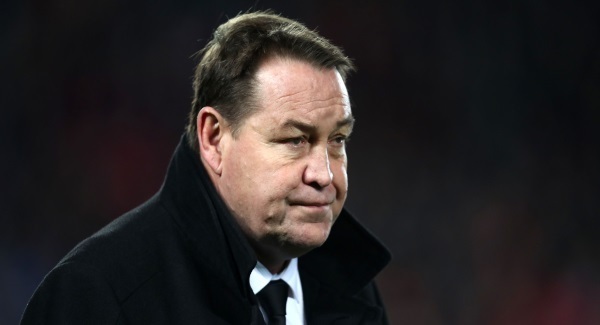
New Zealand’s rugby executives have had some time to digest the implications of Steve Hansen’s announcement here Friday that he will bring a 16-year association with the All Blacks to an end after next autumn’s World Cup, writes
They have pointedly offered no indication of who, or when, Hansen’s replacement will be confirmed and with good reason.


Hansen may come across as a dour, direct individual, but local soundings here indicate he is tremendously loyal to his players and has won their unyielding support in return over a long period of time. He has overseen the most successful era in All Black history and getting his replacement right will define the legacy of NZRU chief Steve Tew.
There is some interesting language in some quarters that the current All Black management is ‘settled and experienced’, a euphemism for stale and requiring a shake-up. That it needs some fresh-thinking. However, specific New Zealand rugby traditions have served them well - such as never appointing an All Black coach directly from Super or franchise rugby.
Hence assistant, Ian Foster’s favouritism to replace his head coach when the World Cup is done and dusted in 2019. I have no doubt that the Crusaders head coach Scott Robertson would bring the necessary energy, enthusiasm and charisma to the All Black set up, but whether he will be parachuted directly in from Super Rugby to NZ head coach is questionable.
And then there’s the Joe Schmidt factor. Media here has been very quick to seize upon his ‘never say never’ comments in Dublin this week as an indicator that he might well consider the All Black post in 2020. I personally happen to believe that Joe will return to coaching in New Zealand, but I also fully accept the bona fides of his comments that once the World Cup is done, he wants to give back his family some of the time they’ve been without him while he was in charge of Ireland.
Timing, as always, is everything. Could Joe be in charge of the All Blacks for 2023? It seems only John Delaney has the capacity to appoint coaches and their replacements, but I sincerely doubt that the likes of Foster would be prepared to keep the seat warm for Schmidt if he replaces Hansen.
Which is why I suspect the NZRU will take as much time as they need to get the succession stakes right. They are already confronted with the prospect of a mass exodus of its veteran All Blacks after next year’s World Cup, and it’s something they’re pretty powerless to do anything about. In fact, with the 2023 tournament in mind, they accept it might be a good thing to allow a rugby international head off for a season or two before returning to the fold in time for the next World Cup.
A new head coach will be tasked with developing a new tier of All Black talent. It was something Steve Hansen specialised in.
Because of its geographical isolation, New Zealand players are likely at some point to look over the horizon and see what the whole OE (Overseas Experience), as they call it, has to offer. The emergence of Japan into the marketplace offers an entirely new (and closer) vista for All Blacks who want to see some of the world and boost their pension pot in the process. Ben Smith has signed for Pau only this week, and details of others will emerge over the next few months.
There’s no Six Nations to keep New Zealand minds off the World Cup, and so the likes of Kieran Read, Codie Taylor and Sam Whitelock here at the Crusaders will be put in cold storage until the spring at least to ensure their minds and bodies are good to go in Japan next autumn. As players, Hansen’s decision to step down will have zero material influence on their WC preparations in 2019. Management structures are things that float away in the background for a professional.
That's quite a ballsy move by Johnny Sexton to finish out his career with Leinster and Ireland. The world player of the year has signed on with the IRFU until 2021 at a moment when his stock has never been higher globally.
Not just that. His decision to stay put comes against a background of eye-watering sums of money washing around the game in Europe and Japan. The salaries that elite level players are commanding now, even those well into their thirties, has moved the game as close as it may ever get to the telephone-number salaries that football luminaries can command. I chatted briefly about this with Johnny recently and it’s clear he knew what he wanted.
Whether his representatives took soundings of what could be on offer somewhere else is something I can’t say. But the fact that he had already done the Top 14 thing with Racing might have crystallised that option for him anyway.
He may be 36 by the next Lions tour to South Africa in 2021, but it’s evident that it’s very much part of his wide frame view.

Whether he will be in a physical position at that point to stave off the likes of Owen Farrell for a Lions test start is another debate, but clearly, Johnny is up for that challenge. His decision is also a renewed endorsement of the IRFU and their way of handling the entire player management debate. Plus, their willingness and capacity to put the type of package on the table that makes discussion of a move elsewhere moot.
Having your big performers fit and ready was the theme I started this week’s column with, after watching Munster entertain Castres last Sunday. Chris Farrell has had a rotten run of luck and one hopes for Munster and Ireland his latest quad injury setback does not sideline him for too long. What is clear and obvious to me, starting with his performance against an admittedly understrength Edinburgh side in the PRO14 a few weeks back, is that Munster are a completely different team with him in the backline. That conviction was only strengthened by his absence last Sunday when Munster quite literally tripped over themselves en route to a stuttering and no-bonus point win over Castres.
Has there ever been as many errors in the opening 20 minutes of a European game in Thomond Park? I took three pages of notes watching the game, and that was just for the first half. No-one seemed immune from the malaise that afflicted the home side. Conor Murray’s box kicking was unusually inconsistent, the handling was poor, the decision-making with ball in hand and tactically was well off too.
I’ll spare the individuals but as a unit, Munster could hardly go more than three phases without losing the ball. One can only presume there was blood on the floor come the Monday review of the performance.
Great that they can still come out of all that with a 30-5, but whatever about his public utterances, I’m sure behind closed doors that Johann van Graan couldn’t have been happy with the performance. The truth of the matter is that the failure to secure a bonus point allied to Gloucester’s win at Exeter’s Sandy Park has suddenly made this pool quite interesting. Munster left two points behind them in Exeter and another after them on Saturday. They should be six points clear of David Humphreys’ side, but instead, they are three with a visit to Kingsholm looming in January. And Humps will have Gloucester nicely tuned for that one.
There was a bit of needle in the Castres game on Sunday, enough certainly for it to resurface tomorrow evening. Castres are on the cusp of the top six in France now, so the threat of getting sucked into a survival battle in the bottom half isn’t an issue. That means they can go for it tomorrow night. It means they can play.
But what way will they play? They could go out and make this a seven-tries-to-five-thriller or they could get truculent and stubborn and turn it into a 9-3 arm-wrestle. It will take no longer than ten minutes to discover which.
I’d be less worried about a bonus point now and more focused on keeping their pool rivals at arm’s length if I was Munster. In fact, I reckon the result is up for debate in this game.
Round 4 games are the pivotal ones in Europe. They’re rugby’s equivalent of moving day in golf. Munster go to Kingsholm after Castres. Lose tomorrow night and they’re taking on water.