For Ireland to succeed after Joe Schmidt would be the ultimate legacy
Whenever in football it’s announced in advance that a certain manager will be finishing up with a particular team at the end of the season, the reflex in this part of the world is to reference the example of Alex Ferguson back in 2001-02.
On the eve of that season, Ferguson had declared that it would be his last. By the following January, with United enjoying a purple patch of form, he had changed his mind, but as the league table in May would prove, United had paid the cost of being in catch-up mode for most of the season. For the first time in 11 years, they finished outside the top two, having lost six of their opening 15 games.
At the time John Giles identified the crux of United’s slump: players generally flourished best when they felt a sense of permanence or at least were out to impress the man who might provide it; with Ferguson going, that certainty was gone, replaced by a slackness.
Ferguson himself would later subscribe to the Giles Theory, as virtually every punter had at the time, admitting that players in the first half of the season had “put their tools away”.
Looking back on it, he considered his premature announcement as “the biggest mistake of my career”, “an absolute disaster”.
Yet, if there is a case to be made for needing to plan in advance of the succession of a long-term manager, then the best example is again the same Alex Ferguson.
United’s post-2013 travails have been considerably more calamitous than the “absolute disaster” that was 2001-2002. The season after Ferguson decided to stay on, United were again league champions. Five years since his eventual departure and it would appear that United will be at least that long again before they win another Premiership.
In 2001, the uncertainty triggered by his likely departure led to merely a temporary complacency and slackness. Since 2013, the uncertainty triggered by a rushed succession plan and vision has led to a seemingly interminable instability.
That’s why Philip Browne’s recent comments about what an Irish coaching setup might look like post-Joe Schmidt are to be welcomed.
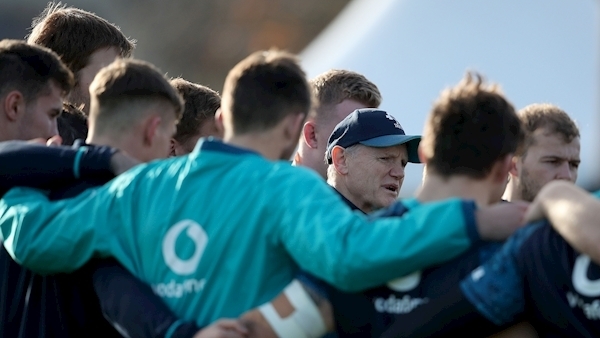
Schmidt himself has said he will be informing his employers before Christmas about his post-Japan intentions and ambitions.
If he wishes to remain on as Irish coach, as would be Browne’s and every Irish person’s obvious preference, great, but if he declares that he wishes to move on from the Irish project and seek opportunities elsewhere, including a possible return home to his native land and coach that national team, then fine.
Not great, but fine, and certainly not the “absolute disaster” which the possibility and then reality of a Ferguson departure proved to be.
For one, if Schmidt and the IRFU were to let it be known this side of the World Cup that he will not be staying on after Japan, there is no danger of the Giles Theory being applicable to the Irish players. 2019 is not just any season to them, the way 2001-2002 may have been to United’s, or indeed 2016-2017 was to Connacht after both Murrayfield and Pat Lam’s declaration he was heading for Bristol.
Japan is the culmination, the zenith, of a four-year cycle, if not of an entire career. The last thing you’ll do is slack off with the grail in sight. The focus is Olympian.
Interviewing Mike Ross last week, it was striking in our chat and in his recent book how anxious he was on the eve of both the 2011 and 2015 World Cup quarter-finals.
Here was a man who had won two Heineken Cups and two Six Nations Championships; who had endured and survived the lead-up to big games, such as Northampton in Cardiff in 2011 or France in Paris in 2014. Yet, facing Wales in Wellington in 2011 or Argentina in Cardiff in 2015 were much, much bigger to him. Why?
“Because I probably wasn’t going to get another opportunity like this.”
Any Irish player looking to get onto that plane or play in that quarter-final next October will be thinking along Ross’s lines: This opportunity may never come again. Certainly not with a Joe Schmidt. If anything, Schmidt’s imminent departure would further focus and heighten attention and energy levels over the next 12 months with Ireland, not distract or decrease them.
More importantly, Browne’s comments illustrated the options that are available to Ireland in a post-Schmidt world and that the IRFU have a vision and a plan for such a scenario. They — and the rest of us — can see the candidates that could offer a balance of continuity and freshness, and equally that ideal blend of internal and external experience.
Andy Farrell and Stuart Lancaster worked together with England in the previous World Cup cycle and, just like Graham Henry before them with both Wales and the Kiwis, have been the wiser for their mistakes. They’ve worked and succeeded within the Irish setup, either with the national team or its — and Europe’s — leading club team.
As Browne says, either of them would be “more than capable of stepping up” and being national coach, the John Allen to Schmidt’s transformational Donal O’Grady, or a Steve Hansen to Schmidt’s Graham – not Thierry – Henry.
Browne also mentioned others: Simon Easterby, Mark McCall, Conor O’Shea.
“We’re not short,” he’d say.
And there were others he didn’t name-heck. Leo Cullen, if needs be, could step up, just as he did when Leinster needed him; Lancaster and himself is a proven double act at this point. When Ronan O’Gara was invited into the Irish camp ahead of the 2017 summer tour to Japan and the US, it was to give him a flavour of Schmidt’s way and the national setup, not just Schmidt’s or the IRFU’s way of contributing to one of the most formidable individual CPDs in world rugby and coaching.
It’s more credible to envisage both Cullen continuing as a Leinster coach and O’Gara as the next Munster head coach than either of them joining the staff of the national team for the 2023 World Cup cycle; Leinster without a Lancaster would need Cullen and his knowledge of the club’s DNA all the more in such a circumstance, while O’Gara would represent and enhance Munster’s post-Van Graan — but at least they’re on the radar and real options with Ireland for 2027 or beyond.
It has been remarked that the All Blacks job would be something of a poisoned chalice for Schmidt, that the Kiwis winning another Webb Ellis with him at the helm could hardly match the achievement of him winning one — or two — with an Ireland.
That, though, is a fairly reductive way of looking at it, very-outcome oriented, the opposite to his beloved ‘process’. To be appointed head coach of his national team would be something he’d view as an honour and to win with them, a challenge.
You have to be a really good coach doing a really good coaching job to make the best even better, because if they don’t get better, they likely won’t win. It reminds of us when this column interviewed Pat O’Shea shortly after he succeeded Jack O’Connor as Kerry coach in the autumn of 2006.
Everywhere he went he kept hearing cautious warnings about poisoned chalices, but O’Shea saw only opportunity; challenge, not threat. Schmidt possesses a similar mindset, if not yet a similar situation.
Also, Browne reminded us, it’s not just about rugby. “It’s about family.”
After 10 years involved in Irish rugby and a considerably longer time away from home, he may conclude that now’s the time to return to his native shores.
Whether it’s after Japan or France, Ireland at some stage will be coached by someone other than Schmidt and Browne and David Nucifora are mindful of this and, thankfully for Irish rugby, they’ve a plan. As Browne said last month: “We can’t be dependent on one individual.”
The system has to have processes and structures that can survive the departure of any one person within it.
Schmidt himself has helped put in place such structures. He hasn’t been averse to adopting some of the All Blacks tenets as spelt out in James Kerr’s legacy. His Irish set-up has adopted the Sweep the Sheds mantra and mindset, with not even hotel key cards safe from his scrutiny. His players also speak of leaving the jersey in a better place, another motto of the All Blacks. The All Blacks also speak about planting trees you’ll never see. Of being a good ancestor. Leaving a legacy.
Schmidt doesn’t want to just preach such things, but embody them himself. For Ireland to succeed after him would be the ultimate legacy and compliment of his tenure in his eyes.
Ireland won’t be leaving this to chance like United did, where a Sven Goran Eriksson was the frontrunner in 2001, and a Guardiola wasn’t identified or secured in 2013, and instead a David Moyes tore up so many trusted and successful processes, a cycle and problem his successors have repeated and compounded.
Browne and Nucifora won’t be scrambling for the right man or the right fit. They’ll have planned for it. Or as Browne’s comments have indicated, they’re already planning for it. And planting trees. Just as Schmidt would want it.