Mark Herrick's training aid could ease heading concerns in football
What began as an idea to help improve heading proficiency in football could, in these fast-changing and uncertain times, turn out to be something which helps ensure that one of the sport’s signature but now increasingly controversial skills, can safely retain its place in the game, writes Liam Mackey.

Mark Herrick's training aid could ease heading concerns in football

Former Cork City and Galway United midfielder Mark Herrick is the man behind Headrite Sports, a new Galway-based company which is marketing an innovative training aid for teaching and improving heading skills while maximising player welfare. And although aimed at all age groups, he believes it has an especially important application in safely introducing youngsters to heading at a time when, in the United States, the old art has been banned for children under the age of 11.

It was news of the introduction of that ban in 2015, in response to growing concern about the health implications of repetitive heading of a football, which made Mark Herrick realise that what began as what he calls his “mission” to improve heading ability was now going to take that original concept into “a more complex and dangerous field”. He fully appreciated, he says, that he would have to do due diligence on all the health and safety implications.


With the support of Enterprise Ireland, the secondary school teacher was able to take the career break necessary to commit fully to the project, consulting first with the people behind a pioneering study at Stirling University which showed that repetitive heading caused short-term memory loss. His company has also been working closely with researchers at UCD to investigate the effects that heading the ball has on the brain of adolescent players, through computer simulations performed using the University College Dublin Brain Trauma Model (UCDBTM).

According to Headrite Sports’ own webstite: “The results show that replacing the soccer ball with a foam ball and reducing the velocity, results in substantially lower strains within the brain. The reduction in strain can be brought well below the proposed thresholds for brain injury.”

Those UCD tests are ongoing, with findings due to be published next year. But, having already adapted his training aid, through five different designs, to take account of the latest research, Mark Herrick says: “We believe we can stand over saying that this is a safe way to practice.” Following years of campaigning by the families of former England internationals Jeff Astle and Nobby Stiles, and with Alan Shearer’s recent documentary, ‘Dementia, Football and Me’ having brought the subject to its widest audience yet, the FA and PFA in England have now jointly launched a new study into possible links between heading and long-term brain injury. In Ireland, and across the game as a whole, the subject was also in the headlines in September, when Kevin Doyle announced he was retiring on medical advice.

“This year it has been clear to me that heading the ball was becoming problematic and causing me to have repeated headaches,” the Irish international explained.

“Two concussions this season and numerous others over the years have made this more concerning. After consulting the experts in this field, it has been decided that to avoid the possibility of these symptoms becoming more serious and permanent, I will be hanging my boots up for good.”

In far more innocent times, Mark Herrick drew the original inspiration for his training aid from watching old videos of Pele perfecting his fabled heading technique by leaping at a ball suspended from a rope. Now, with the Headrite apparatus, it’s almost as if nothing and everything has changed.

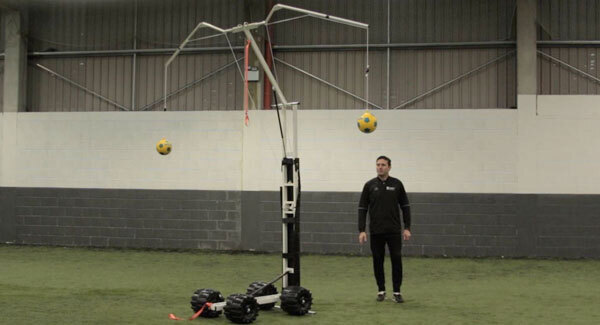
“Crudely enough you could say it’s footballs hanging from a frame,” says Herrick, before going into detail about the extensive research and development which went into ensuring the device would meet a range of testing criteria, including safety and stability when erected; ease of assembly without tools; the flexibility to be used on grass and Astroturf; adjustability for height and weight of ball; and the capacity to allow two headed footballs to return to their original positions without getting tangled up.

“As much as that all that sounds simple, it took the best part of a year to go through different iterations of the product,” says Herrick. “What we have now, we believe, is a sophisticated training aid and a robust product that, hopefully, can be used by all clubs.”

And, indeed, by players at the game’s elite level too. What he regards as one very practical application of the product was brought home to Herrick when he watched the Irish squad training before their recent game against Denmark.

“There were players throwing balls up for other players to head,” he notes. “We’d view that as half your players are redundant because they’re serving balls.” But he believes it’s younger footballers who stand to benefit most from the device which, crucially, can be fitted with a soft foam ball.

“In order to be proficient at the skill, you want your child to be able to have good timing, not only to safeguard his or her own well-being on the pitch but also others they’re playing against,” says Mark.

“It’s important to bring kids up to a certain standard. What’s worrying is that there is no set policy on heading footballs in the game and you’d be surprised at what type of careless training methodologies are out there. We believe that it wouldn’t be difficult for a governing body or a federation to step up and establish guidelines around heading practice.”

And it’s practice which is at the very heart of the current debate about heading. Because, as Alan Shearer pointed out in his television documentary, for every goal he headed in a game, he had probably headed a thousand balls in training.

While Mark Herrick knows that Uefa and various national federations, including the FAI, are aware of what he is doing, football’s governing bodies appear to be reluctant to endorse his product. “It does seem people are standing back to watch this play out,” he says. “We’re in an interesting, exciting but also lonely place at the moment.”

So what then are his own thoughts on the future of heading in football?

“I don’t think there will be a ban,” he replies. “My own feeling is that there probably is a link between repetitive heading and the risk of long-term damage – motor neurone, dementia, CTE. But I also believe that the contributors to that link are the weight of the football, the position the player is in, their sex, their age, family genetics. There are so many different contributors that it will be very difficult to determine definitively if heading footballs leads to dementia.

“We need more research but it’s our contention that while research is ongoing let’s mitigate potential damage by having safer training methodologies. And, by the way, your kid gets better at heading footballs as well. Your timing improves and it’s fun. Yes, it’s a skill which is coming under fire but we’re saying it doesn’t have to be banned.”

Football without heading? It might seem unthinkable but thinking about it is precisely what’s required if the safety of players is to be a priority and a majestic spectacle, such as that of Pele rising to head Brazil on the way to their celebrated 1970 World Cup Final win against Italy, isn’t to become extinct in the game.

“I love football,” says Mark Herrick, “if what comes from this is that there’s a greater awareness, and training methodologies change, we’d be happy our job is done.”

  • See www.headritesports.com for video demonstrations and further information.

More in this section

Sport

Newsletter

Latest news from the world of sport, along with the best in opinion from our outstanding team of sports writers. and reporters

Cookie Policy Privacy Policy Brand Safety FAQ Help Contact Us Terms and Conditions

© Examiner Echo Group Limited