The long battle towards equality for ladies' football
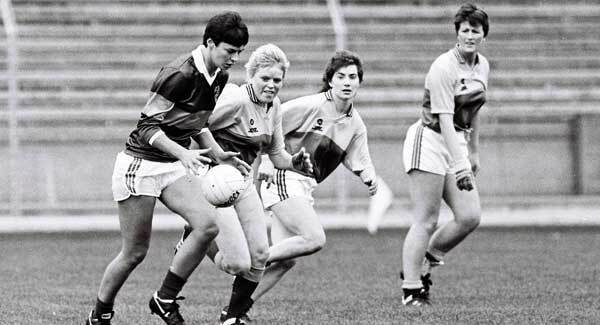
Women’s Gaelic football has made huge strides but even more must be made before there is equality, writes Paul Rouse.

The long battle towards equality for ladies' football

‘Perfume took over from embrocation as the prevailing odour in the dressing rooms yesterday when Offaly hosted Kerry.’

That was how the Evening Press began its report on what it described as the first ever inter-county ladies’ football match, played in Tullamore, Co Offaly on Sunday, July 29, 1973.


The journalist who wrote the report of the match noted that the game had initially been seen as a bit of a joke and that there were some diehards and other freestyle sneers who had turned up just to mock the idea of women attempting to play Gaelic football.

The reporter performed a neat pivot in the article, however. He claimed that by the end of the game those same sneers had been converted: ‘Two dedicated teams quickly earned their admiration, and some of the combined movements proved that these girls have little to learn from their male counterparts.’

The game in Tullamore confirmed the momentum that was clearly gathering around women’s endeavours to play organised Gaelic football.

There were some games started in the 1920s but it was only during the 1960s women that had begun to organise themselves into teams – and then into clubs — in counties such as Offaly, Waterford, Tipperary and others.

Initially, the women’s game was played almost always as seven-a-side matches organised in conjunction with local carnivals and festivals around the country.

From this tentative beginning, by the early seventies the game had evolved to the establishment of leagues and then local championships in Cork, Waterford and Tipperary.

The next logical step was the establishment of an association for women’s football. And when that did happen, the symbolism of the moment was stark.

On Thursday evening, July 18, 1974, a small group of men and women gathered in Hayes’ Hotel in Thurles, Co Tipperary. Fully 90 years had passed since the Gaelic Athletic Association had been founded under the same roof.

When Michael Cusack and Maurice Davin founded the GAA, they pledged to open its doors to men of all classes and to give men something to look forward to rather than ‘an everlasting round of labour’.

It never seems to have occurred to them that women, too, might wish to play hurling or Gaelic football.

Anyway, the upshot of the 1974 meeting was the establishment of the Ladies’ Gaelic Football Association.

Over the subsequent decades, that Association has entirely revolutionised the way in which women played Gaelic games.

Firstly, the rules of Gaelic football were modified to allow for the ball to be picked off the ground and to restrict the level of physical contact. An All-Ireland championship was established and women’s football was extended across every county in Ireland.

This belated establishment of an association to organise Gaelic football for women was, of course, a reflection on wider society and on the place of sport within that society.

In sport, the past holds a tight rein on the present and, when it comes to women, the sporting mould shaped by the Victorian world was never properly broken.

In this world, sport was to be restricted to men.

To be good at sport was to be naturally male. Sport, a weekly Irish sports paper, noted in the 1880s that playing organised sport was crucial to discourage effeminacy in an age of ‘gentleman’s corsets’ and men writing ‘maudlin poems in praise of each other’.

And so it was that 90 years passed before the world had turned sufficiently to organise an Association where women could play Gaelic football.

Through the 1970s and 1980s, the Association developed its championship and league structures, established underage structures and improved coaching.

Allowing for this, women playing Gaelic football was simply not accorded the respect or progression that was merited. The story was that of the passionate few dedicated to providing women with sporting opportunities.

It was not until the 1990s that significant growth was experienced and women’s Gaelic football grew at an extraordinary rate. This growth was characterised by the success in developing the inter-county level of the game in tandem with a huge surge in grassroots participation.

The reasons for the growth were several and largely straightforward. Financial investment allied with the simple fact of working hard, putting bodies on the ground, and coaching in clubs and in schools, began to reap dividends and the games developed in areas of the country where they had not previously been played.

The general rise in interest in Gaelic games through the 1990s was undoubtedly a help to the development of the women’s game.

This, in turn, helped the game spread and as more clubs and counties began to compete for honours, the games prospered.

This prosperity was facilitated by the availability of the GAA’s pitches and clubhouses throughout the country, a ready-made network onto which could be grafted a growing association.

As the more traditional elements within the GAA came to accept women playing football, barriers to the growth of the Ladies’ Gaelic Football Association fell away.

The extent of the progress was not confined to Ireland. Clubs were now organised in all continents and the numbers of new clubs continues to grow.

By the end of 2008, there were 132,000 players and around 1,100 clubs where women were playing Gaelic football. By any standards this is an extraordinary number. To put it in context, at the same time there were merely 70,000 registered women soccer players in England.

Year after year, initiatives such as the Cúl Camps and the development of schools’ programmes has enhanced the opportunities for girls to take up the game.

Similarly, the growth of Gaelic4mothers also brought a new dimension. It is impossible to deny that GAA clubs have not been dramatically enhanced by the number of girls and women who are now using the facilities.

That it is not to say that there are no strains. Although the development of camogie and women’s football has enjoyed support from the GAA, it remains a singular fact that both games are run by organisations which are distinct from the GAA.

Mergers have been mooted in the past, but the proposition has never generated meaningful momentum.

Within the GAA, itself, women continue to be grossly under-represented at high official levels. It is also a simple fact that no woman has ever trained or been a selector with a senior county team, no woman referees GAA matches at the top level.

It remains a singular feature of modern sport that women’s sport is undervalued in relation to men’s.

The evidence of this is everywhere: from coverage in the media to the level of sponsorship deals.

Although there continues to be change in Gaelic games, room remains for considerably more.

After all, when Dublin men played Mayo men last Sunday, the ground was full.

But when Dublin women play Mayo women next Sunday, there will be a good 30,000 seats left empty.

Is that not very revealing?

x

More in this section

Sport

Newsletter

Latest news from the world of sport, along with the best in opinion from our outstanding team of sports writers. and reporters

Cookie Policy Privacy Policy Brand Safety FAQ Help Contact Us Terms and Conditions

© Examiner Echo Group Limited