Winning, losing, and learning to keep things in perspective

There is nothing more powerful in the world of sport than perspective.
Your troubles can seem overwhelming when you’re submerged and consumed by the win and loss columns.
Losing a football match can seem like the end of days; to see something you’ve poured your life and soul into for months on end all go up in smoke because you didn’t deliver on the big day is stomach-churning.
Within a lot of counties this is a busy period for club championship football.
In the increasingly separate worlds of the club and county game, this is a rare period when clubs have access to their county players, at least in a limited context, in an attempt to cram in a few rounds of meaningful club action before the inter-county shut-down comes calling.
For a lot of clubs, their most important football is already over for the year.
With their club teams already eliminated from the championship, guys who had committed to staying around for 2017, and are now searching for flights to see how quickly they can get to the States for the summer.
When things go pear-shaped, it’s not difficult to get down about it. To question your entire process, and everybody involved in it.
Could you have done it better? If you could restart the day and go again, what would you change?
Losses do that to do, they eat you up.
But eventually, while you are knee-deep wallowing inside your bunker of self-pity, perspective comes knocking at your door and makes your problems seem like nothing more than a cloud passing in the sky.
Ten years ago last week, May 3, 2007, Madeline McCann disappeared from her holiday apartment in in Praia da Luz, a resort in the Algarve region of Portugal.
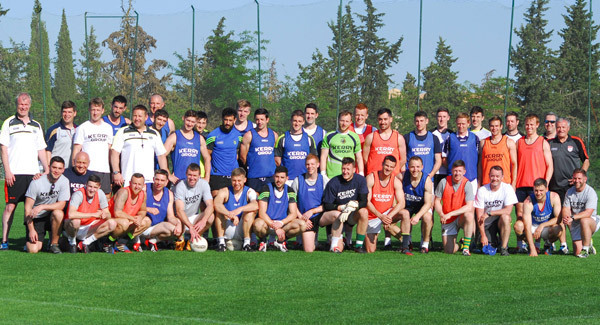
The date will forever be stuck in my head, because coincidentally, we arrived down to the Algarve the day after she went missing on a Kerry team training camp. We followed every development with huge interest for the next few days.
We even talked about volunteering a few hours to go and help with the search. Everybody seemed touched by it, moreso because of our proximity to Praia da Luz.
When it’s on Sky News it seems a million miles away, but it becomes a lot more real when it is on your doorstep.
You expected her to be found quickly, but as the days turned into weeks, and months into years, it continues to be a haunting reminder of how bad things can really get, and how little wins and losses actually matter.
Years of economic turbulence saw some counties start to prioritise and look for closer-to-home alternatives to those foreign training camp.
It turned into more of a cold-weather staycation. Breaffy House, Fota Island resort, and Carton all saw a jump in the number of inter-county teams looking to use their facilities as a more cost-effective way of having a domestic camp.
They could provide everything you’d need to put in a great week’s work. Well, everything except the 25-degree temperatures and the sunshine on your back.
But house prices are increasing, car sales are up, and possibly the most accurate indicator of Ireland’s financial growth – the sale of jumbo breakfast rolls a re all indicating the country is apparently rallying again.
Will we ever learn?
With that notion of a better financial climate, county managers will look to push the boat out again, and warm-weather training camps in sunnier climes are a way of giving your players the perception at least, of leaving no stone unturned in your preparation for the championship.
Of course, a well-run training camp can provide a wide array of benefits.
Thinking back specifically to our 2007 camp, I recall doing four days of four sessions a day, and a fifth day of only two sessions.
ay five was heaven.
That camp was particularly demanding. A mixture of early morning speed endurance work, football in the early afternoon, a supervised weights session in the evening and video analysis that night.
Four collective sessions squeezed in between sleeping, eating, physio and pool recovery. As well as blisters, air-conditioning and Factor 30.
We had about 18 sessions in total, with 14 of those being of a physical nature. We were hardly able to lift our legs high enough to climb the stairs onto the airplane to get home after the week.
Kildare head to the Algarve later this month apparently and I’m sure Cian O’Neill will maximise their time under the Portuguese sun. A lot of teams use foreign camps like you would do a microwave. They cook you faster.
You want to get fitter, sharper, more in-tune with one another, so you pack a serious amount of work into a much more condensed timeframe.
Fourteen physical sessions, either on the pitch or in the gym, would take most county teams about three to four weeks to complete at home. That regular oven just takes too long at this time of year.
Championship is only around the corner.
Some managers use the camp to have a proper one-on- one sit-down meeting with every player in the squad.
Accurate feedback is such an important part of the coaching process but when you’re at home and rushing with 20 other things to do, it becomes difficult to find the time.
In the more relaxed camp setting, it’s a great opportunity to do those player interviews and make sure everyone knows exactly where they stand. It’s incredible how they can build one’s self-esteem and make everybody feel more a part of the group and boost morale.
Obviously, the physical, technical and tactical benefits coming out of a camp are huge.
Everybody is going away with great clarity about their specific role within the team, or what they need to do to push into the top 21.
But for all those boxes ticked, the greatest benefit is probably just the time everybody gets to spend away from the normal pressures associated with time, work and family.
Dry bonding, I think they call it — Irish men actually talking to each other in the absence of alcohol and social media. But whether it’s an arduous training camp to endure or a tough defeat to stomach, bear in mind, there is always somebody somewhere, who would gladly swap their burden for yours if they could.