Munster should really try to put a Cork in it
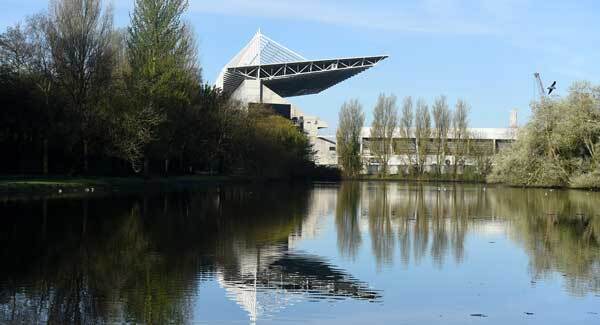
If the big matches are confined to Thomond Park then a sense of detachment is encouraged, particularly if a larger facility is available in Cork, writes Michael Moynihan.

Munster should really try to put a Cork in it

Hiked it to Limerick last week for the launch of the Munster Rugby High-Performance Unit at the University of Limerick, a ceremony which, as you might imagine, was as Limerick-centred as a Richard Harris retrospective held under the river Shannon itself with The Cranberries providing the soundtrack.

At times, I wondered if someone had money on the word ‘Limerick’ being mentioned as often as possible, and found myself inspecting the crowd enjoying the finger food in case there was cash exchanging hands, or anyone saying out loud, ‘I told you we’d break three figures, pay up’ etc. No joy, unfortunately. My conspiracy theories remain unproven.


On the way home, I rolled past the fast-growing Páirc Uí Chaoimh, and it struck me, as I am sure it has struck others, that the latter venue would be a far better location for a Munster v Saracens European Cup semi-final than the Aviva.

Fine stadium though it is, the Lansdowne Road location is, after all, located in Dublin.

And Dublin, while it has many attractions — Toner’s bar, Cathach Books, the road back out of it — is, when all is said and done, in a whole other province.

Speaking to Munster boss Garrett Fitzgerald at the event mentioned above in UL, he stressed the fact that because the Munster players train in one particular place (Limerick), that doesn’t lessen the fact that they represent a far bigger place (five other counties as well). A fair point. After all, the team must train somewhere.

However, moving the whole shooting match to one location on the western fringes of the province, far from the most populous urban area in the team’s catchment area, can’t help to strengthen its traditional ties to the — you know — entire eastern fringe of the province.

I’ve written here before about the Limerick-Cork matter, provoking exactly the kind of response one might predict.

But thinking objectively, playing high profile games attracting large attendances on Leeside isn’t really a matter of choice for Munster.

If the big matches are confined to Thomond Park then a sense of detachment is encouraged, particularly if a larger facility is available in Cork. The possibility of big European knockout games in Cork should be.... facilitated is the wrong word. Actively pursued would be a better term. Otherwise the message is a discouraging one.

The stars look like aligning. The Rugby World Cup bid is all very well, but that’s a once-off party years in the future. The new stadium by the banks of the Lee is here now, more or less. It surely would be more attractive a proposition for the passionate Munster Rugby followers of Limerick to see their brethren in Cork benefit from games than it would be to see those games go to Dublin.

It would also be hugely beneficial to businesses in Cork to have that kind of trade arriving into the city, albeit a couple of times a year. Having a few thousand Munster supporters pop up in Dublin the odd time hardly makes a dent on tourism figures in the capital, but — as no doubt Limerick business can attest — having those thousands of spending customers rock into a smaller metropolis can have a stimulating effect on the relevant economy. As I mentioned money, obviously cost wouldn’t be a factor if games were arranged for Cork. After all, the loyal Munster fans from Cork still make the trek north on a regular basis without complaint; it isn’t asking too much for their Limerick equivalents to visit the southern capital on occasion in return.

Is it?

Was Cooper the greatest of them all?

You may have noticed the retirement of Colm Cooper last week (hard not to, says you).

In the well-earned praise for the Kerry forward it was fascinating to see people reveal not so much their biases or prejudices as their ages when it came to ranking Cooper in the pantheon of great attackers.

To be precise, the age of those observers when certain players made an impact on Gaelic football. For instance, Peter Canavan (above born 1971) seemed to rank very highly among those of a similar vintage while Cooper himself (born 1983) enjoyed top billing with younger viewers.

For older cohorts, the likes of M. Sheehy and J. Barry-Murphy (both born 1954) would be hard to dislodge.

Why the silent treatment?

The Republic of Ireland women’s soccer team took a stand last week which was well organised, strongly supported, and hugely apposite in its timing, for all sorts of reasons.

Only last Monday I was rambling on here about the US women’s hockey, who had a similar disagreement with their ruling body before resolving matters ahead of their world championship.

What struck me was the widespread support for the US women’s hockey team not just from their male equivalents in hockey but across the male professional sporting spectrum.

I have to confess I thought it remarkable there was so little support forthcoming from Irish male sporting organisations for the Irish women’s soccer team last week, or indeed from individual male sportspeople. I spoke to Amy O’Connor of the Cork camogie team last week — herself a former underage soccer international — and she supported the Irish team, and I note that rugby referee Joy Neville backed them.

But a silence from men in general. Why is that, I wonder?

Spending this chapter of my life in Donegal

A reader writes to tell me he read Nic Pizzolatto’s Galveston a couple of years ago and found it outstanding. I liked it but I can’t say I enjoyed it that much: maybe my tolerance of the laconic killer is decreasing in old age.

Said reader also gave a strong recommendation of A Gentleman In Moscow, which I may root out when I come back from Donegal, where this week’s column is coming from (and a fine county it is).

Finally, that self-same reader confessed to ploughing steadily if slowly through Ron Chernow’s Hamilton, hovering around page 200, and wondering if the journey is worth it: old timer (his/her term, not mine), I think so when the final section comes into view.

I wonder too if the hours lost to 18th century fiscal policy were entirely well spent, but I certainly saw a side to Thomas Jefferson I never expected to encounter, and if I ever get back to New York I plan a pilgrimage to Fraunces Tavern based on Chernow’s research.

Anyone with me?

x

More in this section

Sport

Newsletter

Latest news from the world of sport, along with the best in opinion from our outstanding team of sports writers. and reporters

Cookie Policy Privacy Policy Brand Safety FAQ Help Contact Us Terms and Conditions

© Examiner Echo Group Limited