Michelle O'Neill is always putting her reputation on the line
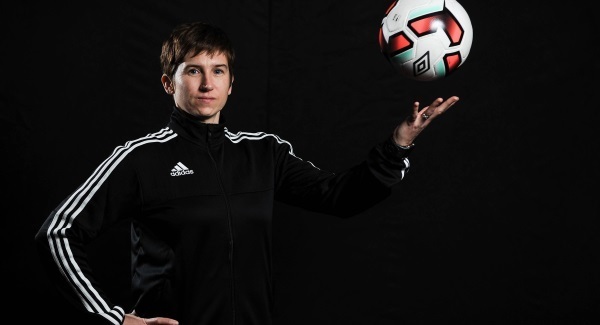
The reason she came to play a prominent part in the programme’s highlights package was because referee Derek Tomney consulted her to get to the bottom of a brawl which erupted late in the game, the deliberations of the officials resulting in two Pat’s players being sent off.
But the super-charged atmosphere of the night didn’t bother O’Neill one bit.
“Personally, I love being in the thick of it,” she says. “Getting in there, getting the decision correct. Without the extra antics of the red cards, I love a battling game with loads of decisions to make. That was one of my busier lines in a while and you feel so alive in the middle of it.”
Now one of Ireland’s most high profile match officials, the 38-year-old’s infectious passion for a job many would regard as thankless was born out of her own playing days in her native Wexford.
“The first thing that attracted me to it was that, when I was playing, it was at a stage in the development of women’s football when we never had the good referees, as such,” she says.
“I always said that when it came time to give up playing, I’d show these people how to referee a match.”
Indeed, she reckons that, as a striker, she was just the sort of handful that, as an official, she now knows to keep a close eye on.
“I was one of them, yeah,” she laughs guilty. “I knew how to push it with the referee so that you got a yellow card but you never got a red card. I’m very happy to say I was never sent off! I really think it was an advantage for me being a player because I knew what to look out for when I became a referee. The big change was discovering all these laws of the game that you never knew about — ‘so that’s why I got that yellow card’ (laughs).”
It was an observation made by the ref after one of her last games as a player which gave her the final impetus she needed to take up the whistle and flag — he told her she had the “right temperament” for the job.
He was probably referring, she reckons, to the “thick skin” she had as a player and which, not surprisingly, she needed even more in her early days as the woman in the middle.
“When I started off, at the men’s junior level, there was an awful lot of abuse from the players — they just couldn’t handle a woman on the pitch being an authority figure,” she recalls.
“So they felt they could shout at this person — because what was I going to do about it? What I did was use my cards, my reports, and my language correctly. And suddenly there were guys getting seven or eight-match bans. And the word quickly spread around: ‘Don’t open your mouth to her’. The other thing I did was push my own fitness levels up to match theirs. I wanted to show that I meant business here.”
When she proved just that by speedily rising through the ranks to become an assistant referee in the senior men’s game, the new problem she faced came with exposure to the bigger attendances in the League of Ireland.
“You were getting more abuse from the crowds or at least a minority of them,” she says. “But I think it kind of turned around for me in 2013 at the Sligo-Drogheda FAI Cup final at the Aviva when I made a big call. I disallowed a goal because the ball had gone out of play before the cross went in: you could see my face up on the big screen. I was 100% sure and then I got the thumbs-up at half-time to say I was correct. I think the perception of me changed then. I was always treated as an equal by my colleagues but now I feel like players and managers just see me as another official. And I think in the awareness has grown that female officials are just as good as any male officials in the game.”
’Neill’s high profile both here and overseas has undoubtedly helped in that regard. In the role of referee she has officiated in the Women’s National League, in the Men’s U19 National League and at the Women’s FAI Cup final. But it’s with her superior qualifications as an assistant referee that she has won some of her biggest appointments in the game, including the aforementioned Sligo-Drogheda Cup final, a Europa League game in Estonia between Levadia Talinn and Slavia Prague and, most prestigious of all, two matches at the Women’s World Cup finals in Canada in 2015, one of which was the quarter-final between the USA and China.
“One of my dreams was always to officiate the USA,” she says. “Since I was a kid I loved them. So there was a little bit of ‘am I really here?’ at the start but then you’re totally focused on the game and it’s only after the tournament that you can really enjoy the excitement of it. The feeling then was, ‘I want another one of those’ so when I came home I was straight into training for the next one, hoping I get picked.” Balancing work, football and family is, she admits, a “juggling act”, and last summer she made the decision to go out on her own as a swimming instructor in Wexford, to facilitate her commitments to the game.
“I wouldn’t want to miss the chance to do a Champions League match because I have to go to work, that will not happen,” she says. “I train every day, before and after swimming lessons. Then you have a nutritionist, a personal coach, you get regular massages. It costs a lot of money so you have to keep up the day job.”
Upcoming major appointments as an assistant referee for Michelle include a Women’s Champions League quarter-final between Lyon and Wolfsburg later this month and, starting in July, matches at the Women’s European Championship finals in the Netherlands.
Meantime, there’s the bread and butter of the domestic game to keep her busy. Last night, just one week on from the ructions in Inchicore, she was due to run the line in Drogheda for the visit of — who else? — St Pat’s.
Out of the frying pan, into the fire. You suspect that Michelle O’Neill wouldn’t have it any other way.