The GAA needs 2020 vision
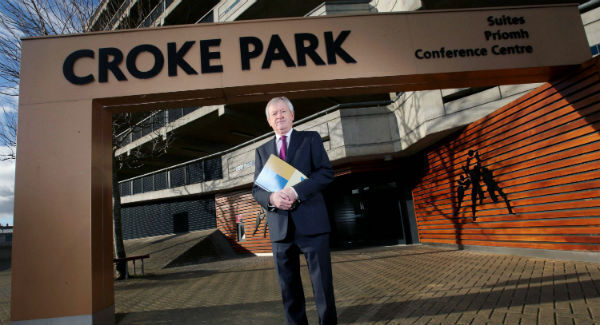
Hours before facing the national media in Croke Park, the GAA’s director general would have learned the Club Players Association had called on him to withdraw his blueprint for a reformatted football championship ahead of Congress next month.
Duffy put an awful lot of thought – and indeed imagination – into drafting that proposal. He put even more time and thought into advancing a strident case for it, with the Croke Park press office issuing a slickly- presented 40-page document for all interested parties illustrating how the new fixtures could be rolled out and impressively answering some concerns or criticisms his proposal might prompt.
In recent months he’s travelled all around the country, meeting county boards and other relevant bodies. No wonder he described himself as being “disappointed”, whatever about “surprised”, by the CPA’s call to basically shelve his proposals.
Think of when or if you were a college student and being told that thesis you invested so much time and energy into should be “parked”, probably never to be marked or approved. You wouldn’t like it. Actually, you’d be quite thick about it, a bit like Duffy was yesterday.
But the CPA are right. He should withdraw it. Or if he doesn’t, it should be defeated.
Leave aside the CPA for a moment. The GPA has just appointed a new chief executive, Dermot Earley. They could not have appointed a more respectable and measured individual. At his first press conference in the role Earley made it clear the biggest issue for him would be helping devise a significant change to the football championship structure. He would be canvassing players for their views. His own personal opinion was Duffy’s proposal didn’t go far enough.
Clearly, Earley and the body he represents want to revisit the championship format, regardless of what happens at Congress next month. So surely it would be better for them to have some more time to consult or be consulted instead of Duffy’s proposal being pushed and rushed through and institutionalising another ad-hoc measure for them and all of us to be burdened with?
Take Duffy’s proposed Super Eight format – our term, not his – where All-Ireland quarter- finals are replaced by two round-robin groups of four teams. If Duffy’s proposal is passed at Congress next month, the GPA and the GAA and everyone else are tied – married – to that Super Eight format for at least five years; even if there were to be further adjustments to the championship format in the intervening years, it would be deemed too soon to judge the success of that Super Eight format.
Yet such a series of games would take a month to complete, when right now the CPA are internally considering the possibility of a schedule of inter-county games in which all counties would play the same number of games up to the All Ireland semi-final stages. That’s the other thing: just as Earley has just been appointed, the CPA has just been founded. A fundamental premise it and the GAA has to establish is whether there should be separate seasons for the inter-county game and the club championship.
Many CPA members are in favour of such a demarcation. Paudie Butler isn’t, instead favouring something like how rugby has a club window followed by an international one followed by a club one again. (The journalist and Cuala hurler Shane Stapleton is of a similar viewpoint, yesterday tweeting an outline of how it could work. February – inter-county provincial competitions. March – club only. April-May – All-Ireland series with two groups of seven in hurling, four groups of eight in football. June – club only. July to mid-August – All-Ireland quarter-finals, semi-finals, finals. September to mid- November – club only.)
It’s a necessary – and healthy – dialogue the CPA has to have with its own members and the GAA itself. Yet, in a way, Duffy is already restricting that debate by implying it doesn’t really matter; if his proposal is passed, then his way is the way it’ll have to be.There’s a more fundamental reason why Duffy’s proposal should be parked. You can’t just review and alter the senior football championship format in isolation because of how it impacts on so much else. The bigger picture needs to be looked at. Virtually every competitive structure needs to be looked at.
At the moment the Hurling Development Committee is not just looking at ways to improve and reformat the senior hurling championship but a complete vision for the game, from when a lad goes into a local development squad right through to playing senior hurling with his county. Instead of tweaking this competition and this competition, they’re looking at an overall holistic approach to the game: what do we want for that young lad?
At the moment, if he’s playing Fitzgibbon and senior inter-county hurling, he’s being dragged every which way. The Munster Council is telling his county still have to fulfil a Waterford Crystal game. Derek McGrath has pointed out the current league format overburdens young players involved in third-level competitions. Should there be league hurling in February? Should there be any league hurling at all? Would championship hurling be better off being played on a round-robin format?
Recently Colin Ryan outlined one of the reasons why he’s enjoying playing soccer this year instead of committing another year to the Clare hurlers.
“There is no three-month build-up and three-week post-mortem; when the game is over, we know we have another one the following week, so win or lose, we move on quickly,” he explained to the Sunday Independent’s Marie Crowe.
One of the key learning points the HDC have taken from the Celtic Challenge for U17 players is players, coaches and administrators prefer having a schedule of games in which they know when they’re playing, who they’re playing and when they’re playing. It’s why they’re likely to recommend some form of round-robin system within the provinces.
Duffy’s proposal has been a worthwhile discussion document, further advancing and legitimising the idea of a more condensed season in which the All-Ireland finals would be played in August. But instead of trying to railroad it through, he would be best taking another piece of advice from the CPA. Set up a fixtures think tank, a high-powered, over-arching committee.
Have Earley there representing the GPA. Have, say, Liam Griffin, the fixtures co-ordinator for the CPA, a man who will look to improve the county game and not just the club game, and as someone who both managed and played for his county footballers as well as hurlers, appreciates both codes.
Have representation from third-level. Have someone representing the provincial councils but on the understanding the provincial councils are there to serve the game and the competitions are not there just to serve the provincial councils.
Ask basic questions. Can we reform the football championship without looking at the league? What is the purpose of the league in 2017? Are we still working off the assumption it is basically warm-up for championship or that for many counties it is just as important as championship?
Can we guarantee a better series of meaningful games for all county players, when Duffy’s proposal advocates that 16 football counties are finished by the second week of June? Challenge all assumptions. The primary reason we had a knockout championship for over 100 years wasn’t because the founding members of the GAA had a considered debate about the respective merits of a do-or-die format and that of a more league-based, round-robin system.
It was largely because transport was so limited in those early days. Does that apply now? The GAA needs a 2020 vision. Better to take another few months to see that bigger, better picture rather than institutionalising the ad-hoc once again.