Player safety being compromised

Last Saturday in the Aviva Stadium felt like that. Not just for 60 seconds, but for 80 minutes and the rest. When it was done and the interviews dusted yours truly hailed a cab, made for home and climbed into bed for a deep nine-hour stretch.
If Ireland-New Zealand could do that to an onlooker, what must it have felt like for the players?
Intensity is a word bandied around and even mocked but over 51,000 people were gripped in the embrace of that game and it is a contest that refuses to disappear from our radar screens even as tomorrow’s meeting with Australia slips centre stage.
“There’s too much at stake,” said Rory Best to the referee at one point. Best was talking about the last pass to Malakai Fekitoa that looked somewhere between flat and forward before the Kiwi centre dotted down for the try that would finally put the game beyond Ireland.
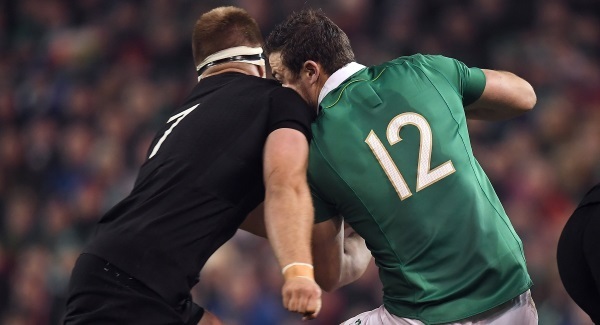
The captain’s words would have been more apposite had he delivered them after either of the challenges that floored Robbie Henshaw and Simon Zebo. Forget mere wins and losses. The stakes for rugby and its practitioners have never been higher when it comes to the debate about concussion and head injuries in general. What we experienced from officials last weekend, and in the disciplinary sphere earlier this week, was nothing less than a dereliction of duty towards players and their welfare.
We should start by stripping away the emotion of nationality from all this: the torch and pitchfork element to some of the accusations made against the All Blacks as well as the accusations from New Zealand that Ireland have taken over from England as rugby’s big ‘whingers’.
This is bigger than all that guff, so let’s state a few truths. Sam Cane escaped a citing as his high tackle on Henshaw was deemed accidental. Fekitoa, who received a yellow for his forearm smash on Zebo, had it upgraded to a red but for an action the disciplinary chiefs decided was reckless rather than deliberate. That’s bull. Cane’s was the reckless act, Fekitoa’s was not and it merited more than a one-week sitdown. “Sacrosanct” was the word World Rugby used for the head and neck areas.
“When it comes to foul play, the game is cleaner now than ever before but referees must constantly be alert to head-high hits,” said World Rugby match officials selection committee chairman Anthony Buchanan. “By taking this strong approach, we are saying to players that tackling an opponent above the shoulder line will not go unpunished.”
It was made clear that this was an edict directed not just at the professional game but at all levels and that is what makes the events and the failures of referee Jaco Peyper, TMO Jon Mason and the people in attendance at the disciplinary hearing all the more frightening. That’s three layers of the most trusted officialdom that had the chance to get this right and all failed.
World Rugby are using 26 referees across 33 Tests in this November window and they made it clear before Ireland and New Zealand kicked all that off in Chicago that they were being used for “the further development of elite match officials” and specifically with an eye on the longer-term goal of the next World Cup in Japan, in 2019.
That’s fair enough but certain standards are still non-negotiable, particularly when it comes to player safety, and neither the referee nor the TMO in Dublin last weekend can lean on inexperience as an excuse for their failures.
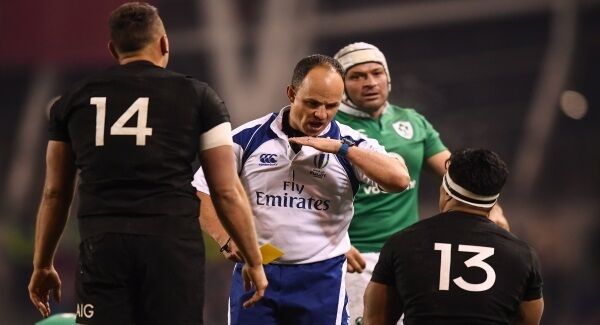
Peyper is an international referee since 2012 and Mason a TMO who has experience of officiating both at Sevens and 15s levels.
World Rugby’s referee chief is Ireland’s Alain Rolland. Edicts like the one issued this month on contact with the head and neck areas stem directly from him and a perception that certain rules are not being applied strictly enough.
They are fairly irregular but they can relate to any aspect of the game as he sees fit. Adhering to the offside line, for example. Rolland clearly didn’t like what he was seeing when it came to the officiating of hits around the neck and head area. That’s why he brought the world’s best referees to London before the November Tests to drive that message home. So it’s hard to square that with Peyper, Mason and the hearing’s findings this last six days.
A great game, then. But a bad week for rugby and its players.
- Email: brendan.obrien@ examiner.ie Twitter: @Rackob