Dundalk win hearts and minds
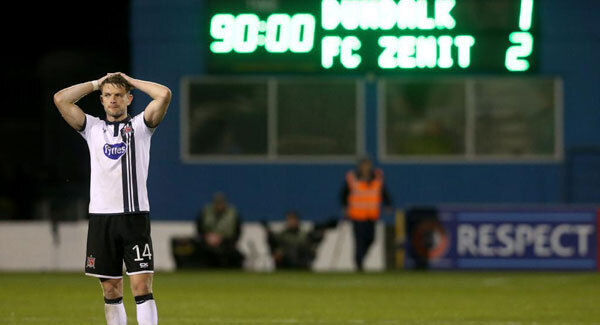
And that was even before a Russian journalist almost casually accentuated that perception by asking striker Artem Dzyuba at the pre-match press conference how it felt to be facing a team “from a different…” — and, here, the translator, in deference to her host audience, perhaps, offered an almost embarrassed little smile — “…stratosphere.”
Something else which would seem, at first glance, to mark Zenit out as an entity from a galaxy far, far away — yet one with serious designs on colonising the football world we all live in — is that the club operates a comprehensive English language website and Twitter account.
Now, in common with all my colleagues, I have no hesitation in saluting the Dundalk press office for the professionalism of their work — genuinely, their output is among the very best in the League of Ireland — but, last time I checked, they hadn’t yet quite gotten ‘round to providing a Russian language service for all those Lilywhite fans out there towards the Urals and beyond. Something to be addressed as a matter of urgency, surely, now the big bucks are rolling in at Oriel Park.
Meantime, it was to the aforementioned Zenit website I turned to find the following interesting exchange between Belgian international Axel Witsel and a Russian journalist in the aftermath of Thursday night’s game.
“Yes, they can play with this fighting spirit, and with this motivation they can qualify from the group.”
“We know kick and rush, but no, they played good football and tried to win the game. It wasn’t the Irish style, not just long ball and fighting for every ball. We knew what to expect, we watched the videos before the game.”
“When you’re on the pitch it’s not about money, it’s about motivation and in football anything can happen. You saw in Tel Aviv when we came back from 3-0 down to win 4-3 in 20 minutes.”
Later, Witsel — one of the architects of Ireland’s 3-0 loss to Belgium — took to social media to reinforce the point, hailing Zenit’s 2-1 comeback win in Tallaght as “a very tough win against a strong Dundalk team”.
With every fresh outing in Europe, Dundalk are winning more hearts and minds — and, crucially, winning enough matches too to still give them more than a fighting chance of progressing from Group D. That’s why manager Stephen Kenny’s dominant emotion following the narrow defeat to Zenit was one of pure disappointment. Dundalk have long since passed the point where their performances against superior opponents can be described in purely charitable and almost condescending terms — brave, spirited, gritty, plucky and the like.
Certainly, all those qualities are there in a side of immense character but what stood out again on Thursday was that, even in the face of technically sophisticated opposition who could comfortably dominate possession, once Dundalk did break up the play and get on the ball, their own first instinct was to make creative use of it.
With Chris Shields and Ronan Finn always willing to show in midfield, Dundalk’s defenders rarely had to resort to hitting it long, instead happy to seek out feet in the middle of the park where, with a little lay-off pass here or a creative turn there, the play could be developed in such a way as to maximise the chances of game-changing talents like Daryl Horgan and Patrick McEleney getting to work their magic.
Jack Charlton used to talk about his Irish team playing football that was “not pretty but effective”.
Stephen Kenny’s Dundalk play football which is both pretty and effective — as well as all the other things — and, for that striking achievement alone, the manager and his players deserve all the good things which have been coming their way.
When Kenny, having parked his initial disappointment at losing a match Dundalk should at least have drawn and might well have won, began to speak in glowing terms about his team in the company of a handful of local journalists an hour or more after the final whistle in Tallaght, you could really only take issue with his proud comments on the grounds that he might be a tad guilty of understatement.
“We’ve shown over the nine games we’ve played that we are more than a match for any of the teams really,” he said. “I thought our energy levels were low in the first half compared to what they normally are and we did look like a team that had played a lot of matches recently.
“But we still have the ability to pass the ball like no other team has and (the players) have the level of courage to take the ball in any area of the park — that differentiates the team. We have courageous players, fellas with character who just really get through it and push themselves.”
Character, yes. Courage, certainly. Confidence and composure too. But most of all, class. Sheer class. That’s why Dundalk’s European adventure is one of the greatest Irish football stories ever told.