Standing up for the big No.9

No longer fit for purpose. More or less an embarrassment.
And yet tomorrow, it is almost certain that two of us will be out there. Representing.
Still disrespected. Still scoffed at. But hanging in there. A poorly-protected species that has just about survived.
The big man up top lives on.
After Spain humiliated Italy in 2012 fielding six midfielders, they thought it was all over for the target man, the leader of the line, the lighthouse, the big big man.
They certainly weren’t breeding any more. When Luca Toni finally hung up the boots in May, at 39, Gazzetta called him the “last great Italian centre-forward”.
The English regard Andy Carroll suspiciously, drawn to him like some class of freakshow curiosity; yet fearful, as if he is primitive weaponry that can no longer be legally discharged.
On this one issue, at least, England is on the same page as the rest of Europe. While the great Enda McEvoy took charge of this page lately, I was diligently observing all the glorious traditions of the sun holiday by playing football tennis with the Germans.
It soon earned me a new nickname, what is clearly an international term of amusement. A byword for the ungainly. Crouchy. How quickly they forget Carsten Jancker.
He is nakedly disrespected now, the big man, a great betrayal of a rich culture of holding it up and chesting it down and laying it off. And especially of flicking it on. Because, of course, there is nobody to flick it on to anymore.
Before they tried to kill him off, they imprisoned the big man in isolation. In their hunger for possession, for ‘numbers’ in the middle of the park, they pushed him up there at the top of their 4-5-1 or at the point of their 4-3-3 and asked him to put in a shift.
And the defences showed him the high line, laughed in his face and asked the impossible of him, the one thing he hadn’t in his locker; they asked him to run. They teased him with all that green space in behind, but it was a tantalising mirage in the big man’s arid new existence. Because he didn’t have the legs.
And then everyone gave up on him. Declared him obsolete. A clanking irrelevance when you had a state-of-the-art, swivel-hipped, jet-heeled, five-foot-eight midfielder for every position. The big man was gone. And up top was gone.
But perhaps it was the philosophy shift that came with this new reality that will eventually save the big man, even if it cost him in the short term.
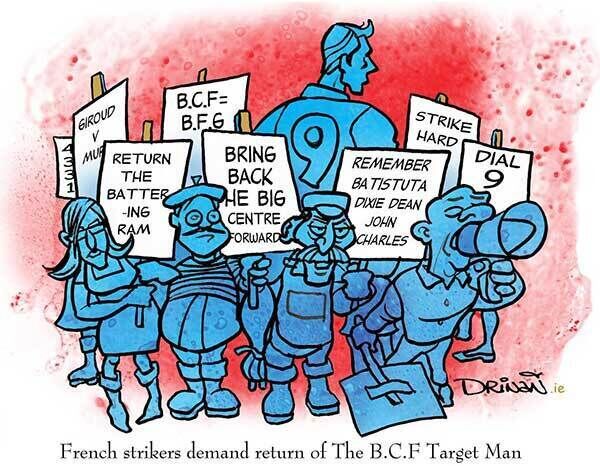
Because when they came for the big man up top, when they told him his time was up, they came for the small man too.
For a time, it seemed goals weren’t something that necessarily needed to be scored anymore, in the old-fashioned sense; they would just happen naturally, organically, as a consequence of circulating the ball long enough.
Even the crude imprecision of the shot was set to be phased out altogether in favour of one final goalscoring pass.
There would be no need for opportunism when opportunities would be created systematically. And there would be no more need for the finishers, the specialists who couldn’t run or wouldn’t press or who put possession of the ball at risk.
Lean goalscoring. Inefficiencies eliminated. Synergies achieved. No Six Sigma Black Belt for the big man. Only redundancy.
At this point, we should briefly pay tribute to one visionary big man who saw the writing on the wall earlier than most.
In another era, Marouane Fellaini would have been born to be a big man up top. But seeing no future in that trade, he somehow smuggled himself into the midfield. And has since spent his career gradually elbowing his way up the pitch to his natural habitat.
But not all big men were so ingenious. And paid the price.
But then, when defences dropped a bit deeper and more buses were parked, and people looked around for the odd goal to be scored in an old-fashioned way, they found there was nobody to rely on. That there are no great strikers left.
Except maybe in England, where theu are certain they have lots of great strikers who can’t be relied upon to score.
And since the craft of goalscoring had been discredited and discontinued, and no new goalscorers were being bred, there have been reprieves for veterans long ago discarded, as we have seen in France. The likes of Pelle and Aduriz and Eder.
And in their desperation, they have even had to go back to the big men: Janko, Dzyuba, Szalai, Seferovic. Even Germany have turned to their in-betweener, Mario Gomez, who looks bigger than he is. And older. Possibly because he’s even slower than he looks.
And tomorrow France and Ireland will almost certainly turn again to Giroud and Murphy.
In many ways, Giroud is not your traditional big man. He is not Mick Harford. And is determined he will never look like Mick Harford. But he brings a certain set of bespoke tools; a knack for the flick and for getting across his man for the one-touch finish.
Murphy has pared his offering down into an even leaner package, stripping out the goals. He is more of a platform, a stopping-off point for the ball, en route to where we hope it might eventually go.
It is not necessarily an efficient business, the work these men do. It won’t always be appreciated. Indeed, it is often reviled.
But when it comes down to it, the old adage still applies; a middling big ‘un always beats a middling little ‘un.
Heroes & Villains
STAIRWAY TO HEAVEN
Half-time against Italy, he finally threw in the towel, gave up on “getting hold of it”, and figured we might as well play this way all the time. Heartbreaking, that he would abandon his life’s work right at the death.
Nice touch, big man, but no need to overdo it, let’s keep this thing on the down-low.
Is Brexit the big break it has been waiting for all its life?
HELL IN A HANDCART
Belt up with your whingeing about Italy taking a fall and consider this overdue revenge for the mugging of Big Cas.
Worrying times for the GAA. Never mind the minor inconvenience of shifting throw-in times, with this UEFA caught up in the last area of Gah dominance: Debate about the competition format.