There’s good reason for Ireland to drop debutants in at the Six Nations deep end
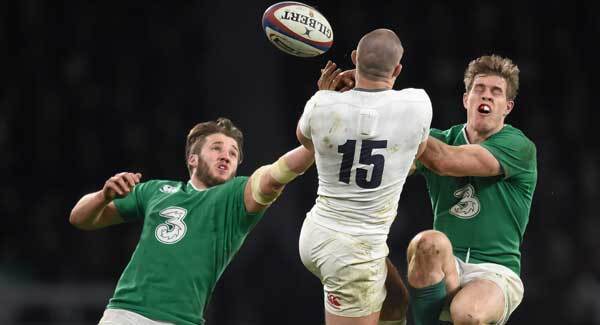

There are some players you just know are destined for a long career in international rugby, and therefore when it comes to selection, it’s not a matter of if, but when. Inevitably, results dictate the course of action taken but in my experience, talented young players, by and large, suffer no inhibitions and rise to the challenge more times than not. Josh van der Flier, Stuart McCloskey, and Ultan Dillane offer the most recent example of this.
Back when Warren Gatland, Eddie O’Sullivan, and I bit the bullet and introduced a Famous Five of international debutants in Ronan O’Gara, Peter Stringer, John Hayes, Shane Horgan, and Simon Easterby on the same day against Scotland, it was recognised that, after demoralising defeats to Argentina and England, the team needed a fresh impetus and an injection of youthful enthusiasm.
A theme being expressed at present by a variety of former players and journalists was encapsulated by one of the latter last week when declaring “you don’t give cheap caps in the Six Nations. They can be doled out in the November game against the Tier 2 nation.”
Quite what the management team is expected to learn from playing the likes of Garry Ringrose in the Guinness Series against Canada on November 12 intrigues me. You would glean infinitely more watching the likes of Ringrose, Van der Flier, and Luke McGrath in a Champions Cup outing for Leinster against Toulon, Bath, or Wasps than you would against the Canadians.
Contrast that view with the route taken by the New Zealand management leading into last year’s World Cup. Head coach Steve Hansen wanted to consider his options at out-half at a time when Dan Carter was struggling with his form and Aaron Cruden was ruled out of contention due to a serious knee injury.
Bear in mind that already sitting behind Carter and Cruden as highly credible options for Hanson in the No 10 slot sat the experienced duo of Beauden Barrett and Colin Slade. However having stuttered through the knockout stages of the 2011 World Cup on home soil after a disastrous series of injuries to Carter and Slade left Graham Henry scrambling to drag fourth choice Stephen Donald back from a fishing holiday to start a World Cup final on the bench, Hansen was leaving nothing to chance this time out.
The fact that Donald came on in that final and landed the crucial winning penalty after Cruden hyper-extended his knee after only 34 minutes to finally deliver an overdue Webb Ellis trophy misses the point. New Zealand dodged a bullet. Donald was not quite up to international standard and Hansen was adamant he would not find himself in that position again if history was to repeat itself in England last October.
Lima Sopoaga was a significant factor in delivering a first ever Super Rugby title for the Otago Highlanders last season and looked a serious prospect for international honours down the line. The only question on Hansen’s mind, however was, in the event of another injury crisis, could he deliver for New Zealand in the white heat of a World Cup semi-final or final. For him, there was only one way to find out.
In the history of New Zealand rugby, the only opponent they have struggled to beat with any degree of regularity is when facing South Africa in Ellis Park, Johannesburg, a venue 5,700 feet above sea level that Ireland will discover next June is one of the most hostile and energy-sapping on the international circuit. The previous season we were treated to one of the greatest contests of the professional era when the Springboks accounted for New Zealand in a 27-25 classic in the Rugby Championship at the same venue.
Chasing another Rugby Championship title was the last thing on Hansen’s mind when he opted to pitch Sopoaga straight in at the deep end for the most demanding of all international debuts. With injury also impacting on the depth of his resources in the second row due to ongoing issues surrounding his back up pairing of Jeremy Thrush and Luke Romano, he opted to bench a stitched-on World Cup starter in Sam Whitelock and offered a second test debut to Hurricanes second row James Broadhurst. That selection was the equivalent of Joe Schmidt benching Paul O’Connell in order to cast an eye over Ultan Dillane in a Six Nations title decider against France in Paris. Not one coach in the Six Nations would go down such a route. It just wouldn’t happen.
Despite risking all, New Zealand won another epic encounter by 27-20 with Sopoaga more than proving his credentials, converting five of his seven kicks at goal and making the decisive line break that resulted in a crucial try for Ben Smith before the break. That still wasn’t enough for him to make the World Cup squad but with Carter and Slade now plying their trade in France with Racing 92 and Pau respectively, Sopoaga now enters the equation as a contender for Carter’s No 10 jersey along with Cruden and Barrett.
Not everything was plain sailing for Hansen that day as Broadhurst struggled on debut to cope with the physicality of the massive Springbok pack. No worries. Hansen just withdrew him at half-time and sprung Whitelock off the bench to finish the job. Broadhurst also missed out on World Cup selection two months later.
With Thrush still struggling with injury, Hansen took another risk and selected just three locks with the recovered Romano joining Whitelock and Brodie Retallick in the squad. When compromised, he just switched Kieran Reid or Victor Vito from the back to the middle row to shore the gap.
It is only a matter of time before Ringrose and Stuart Olding, now thankfully recovered from the latest in a series of injuries, join the likes of CJ Stander, Van der Flier, Dillane, and McCloskey as the latest of the exciting young talent coming through the ranks to make the full international side.
Quite how a cap in such an historic tournament as the Six Nations could somehow be classified as cheap in comparison to one against a Tier 2 nation in a November friendly baffles me.
A cursory glance at all those games against Tier 2 nations hosted by Ireland in the recent November window have ended up with comprehensive wins for the home side.
Following this Six Nations, Ireland face South Africa on three successive Saturdays in June, New Zealand twice within a three-week period next November along with Australia. No cheap caps there.
After that, Schmidt will have a fair idea which of the latest crop of international graduates will be good enough to stay the course all the way to the 2019 World Cup in Japan.