Nitpicking with rulebook over McCann affair discredits GAA

Most of us have seen the photos and the computer-generated 3D images of Tyrone’s £7m-plus Centre of Excellence just off the Ballygawley-Omagh road and read more besides about the 43-acre site, the six pitches, the Celtic T-shaped nerve centre and the beautifully finished ball wall to name but some of its attractions.
And yet driving in to the completed project for the first time on Wednesday evening was still an education. With the sun just beginning to wax and wane over the undulating countryside, and the area carved up between splendid rays here and subtle shadows there, it took on an idyllic sheen that no promotional video could hope to replicate.
It was simply stunning.
Seven years had passed since this column’s last visit to that very area. Back then, Garvaghy was just a collection of fields and the then county chairman Pat Darcy stood at the entrance to one of them and explained to this newspaper their vision for the future just weeks before the county would claim a third All-Ireland title, at Kerry’s expense.
The bricks and mortar are undeniably impressive, but it is the small touches, the attention to detail, that really stand out.
One window poster, decorated with a shot of a packed Croke Park, catches the eye as you walk towards the entrance and asks: how will you achieve your dreams if you turn to drink and drugs?
Inside, inspirational quotes from Mickey Harte and others are sprinkled around the building. A panel tells the story of Tyrone GAA as well as the county’s geological and man-made histories and there is one section reserved exclusively for the speaking of Irish. It isn’t just a centre of excellence, it is a repository of so much that is good about the community and its people.
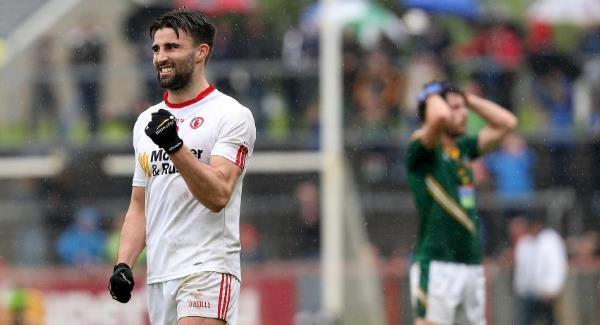
Inside the auditorium two evenings ago, Mickey Harte spoke about how so much good has been overlooked in the wake of the Tiernan McCann affair and the various other controversial incidents that have trailed Tyrone into their latest tilt at an All-Ireland title as they prepare to face Kerry in the last four on Sunday week.
Harte was talking about the good work of his team rather than that which created Garvaghy, but it is still worth saying that, for all the opprobrium directed at him and his players, this remains a county that does the vast majority of things far, far better than most others could even dream. It’s not for nothing other administrators make the pilgrimage to Garvaghy to see it for themselves.
The same could be said for Harte’s sides.
Winning three All-Irelands in five years remains one of the most noteworthy achievements in the history of Gaelic games and Harte will add an extra layer to his undoubted greatness should he do what so few managers have been capable of and win the biggest of all prizes with what is virtually a new team.
Don’t forget about all the good stuff, he told us.
The thing is, that was hard to listen to last Wednesday. It was hard to listen to him defend his player on the BBC earlier in the week when he pointed the finger of blame at Darren Hughes for merely chiding McCann with an unthreatening gesture. It was hard to listen to him rail against the coverage Tyrone have received in the wake of all this.
It’s been equally difficult to listen to the nonsense sprouting from some observers up north about a perceived anti-Ulster bias in the ‘southern’ media, as if journalists and pundits were convening in regular conclaves in a cave under Hill 16 and plotting the grand strategy that would bring Tyrone down once and for all.
Then again, as Joseph Heller wrote in ‘Catch 22’: just because you’re paranoid doesn’t mean they aren’t out to get you’ and the decision by the Central Competitions Control Committee to advocate an eight-week ban for McCann on the back of ‘Rufflegate’ will give Tyrone a legitimate excuse to circle the wagons as the Kerry game approaches.
Nobody disputes the fact that McCann was wrong to feign injury as he did, but the optics of such a lengthy suspension would be even worse on the basis that, as many have pointed out, earlier examples of the practice have come and gone without the GAA authorities cracking down in such a fashion.
Just three weeks separated Michael Shield’s feigning of injury during the drawn Munster final and McCann’s ‘Swan Lake’. Same offence, same competition, less than one month apart and yet only one of the offenders subsequently faced a proposed eight-week suspension.
That is simply wrong.
If the GAA does feel that the act of feigning injury needs to be combatted with a punishment more punitive than a yellow card, then by all means it should act by drawing up specific rules and regulations to address that very matter.
It should not be dusting off a catch-all rule about discrediting the association in the middle of the championship, as it is attempting to do now.
Doing so discredits the GAA more than anything McCann did.