Damien Duff will be at home with Shamrock Rovers
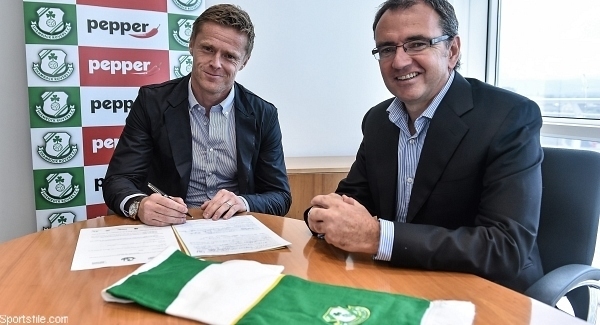
Everybody loves Duffer, as his gaffer was never slow to remind him when he was one of the outstanding talents among Brian Kerrâs kids. And somehow, as Duff progressed to the highest levels of a game thatâs hardly uncontaminated by cynicism, he continued to command a public affection that had almost as much to do with his unspoilt personality as with the dazzling talent which made him the kind of wonder winger football fans never tire of seeing.
Even those of us in the media who would have grown frustrated with any other Irish player who declined the dubious charms of our company on a regular basis, were prepared to make a special allowance for Damien.
As friendly, engaging and, perhaps surprisingly, as opinionated as you could wish him to be on those rare occasions when he was press-ganged into sitting in front of a mic, it was always clear that he had nothing against us per se but rather simply couldnât quite see the point of spending any more time than was strictly necessary in the sport doing something, anything, that wasnât directly related to his ability to manipulate a spherical piece of leather.
Hence his characteristic response after listening for some time when an FAI official once tried every means at his disposal to persuade him to do a promotional gig: âBut how will it improve me as a footballer?â
Itâs probably a bit unfair to regard Raheem Sterling as a lightning rod for all that ails football at the highest level, yet despite the fact that thereâs only 16 years between the two players, the circus surrounding Man Cityâs new signing seems almost generationally removed from how Duff was always seen to conduct himself for club and country.
That, and the manner in which he hugged the white line and, with that stooping run of his, gave numerous defenders twisted blood, is what prompted me to suggest to Pat Fenlon this week that there was something of the throwback in the player. The Rovers boss didnât disagree.
âYou look at where heâs been and what heâs done,â he reflected. âAnd then you read some of the stuff this week about players in England and think âfucking hellâ. Itâs not for him. He just wants to play.
âThe key at the moment is to hold him back and stop him getting on the pitch. Itâs about making sure heâs right to get on the pitch. He just has a love of playing. Thatâs a real key. Thatâs great from our point of view. Not that thereâs no managing in it but heâs here to play football.â
Duff had long maintained that he was determined to finish his playing career on home soil and, six years ago, when Shamrock Rovers hosted Newcastle United in a friendly, I recall the Tallaght faithful amusing themselves by baiting the then Magpie with a repeated chant of: âYouâll never play for Rovers.â Well, theyâve even more reason to smile now. As has the rest of the league, even if Liam Buckley at Pats will be disappointed that he lost out in a bid to get their man.
Given the upheavals at Sligo and Bray, which have only added to the impression of a league more or less permanently flirting with some sort of debacle, Duffâs arrival is a good news story thatâs both timely and without qualification. Of course, there will be those who donât play close attention to the Irish club game who will all too readily dismiss the playerâs signing as some sort of promotional stunt or, worse, the despairing last gasp of a washed-up old pro. The league as retirement home for fading or faded stars is not an unfamiliar jibe.
ut those in the know already have plenty of evidence to blow that accusation out of the water. Ex-internationals Keith Fahey and Stephen McPhail have both been significant players for Rovers while , in Cork, few will find fault with the contributions to City of Liam Miller and, in particular, Colin Healy. But even if those four hadnât already alleviated doubt, Duffâs sheer love of the game would in itself be enough to convince that his input to Rovers will be wholly committed. The only significant issue could be to do with how he recovers from what was, after all, the serious injury he sustained in Australia.
Certainly age wonât be a barrier. At 36 he may not be the athlete he was in his prime but, in light of this weekâs Europa League action, itâs worth pointing out that a regular missing through injury from the Odd BK side which beat Rovers on Thursday was one Frode Johnsen, a striker who is still banging them in for the Norwegian club at the age of 41.
Indeed, Pat Fenlon was still playing when Frode featured in the Rosenberg side which inflicted a Champions League defeat on Shelbourne 15 years ago. And while the Duffer was a mere 33 when he bowed out of international football with 100 caps at Euro 2012, one year later Johnsen was becoming the oldest player in his countryâs history when he came off the bench against Iceland for the last of his 34 Norwegian caps, aged 39 years and 212 days.
At the other end of the age scale out in Tallaght, thereâs young Luke Byrne who this week recalled, with some residual boyish wonder, that he was all of nine years old when he watched his new team- mateâs celebrated goal celebration at the World Cup in Japan in 2002. Dufferâs final bow might be on a more modest stage but thereâs every reason to anticipate it too will be a cause for real celebration.