Might Ireland be stronger for Brian O’Driscoll’s absence?
1. The scale of the turnaround
In trying to appreciate what happened in rugby three days ago, it’s worth recalling where things stood two years ago.
Any assessment of Saturday’s glorious tryfest has to be qualified by just how poor and porous Scotland and Italy were — until you remember something else: in 2013 both of them beat Ireland. Both of them finished above Ireland in that year’s table. We’d just three points for the entire campaign, propping up the table along with France.
Or look how our Six Nations finished the previous year. We were the whipping boys, taking a 30-9 hammering to England in Twickenham on St Patrick’s Day.
Combine our last two Six Nations campaigns under Declan Kidney and Ireland’s record read P10 W3 D2 L5, a win-loss percentage of 40%. In the past two under Schmidt it has been 80%, translating into back-to-back championships.
The turnaround has exceeded all expectations. For sure you expected improvement from that dismal 2013 campaign which was ravaged by injury as much as staleness.
But you certainly didn’t think Schmidt was inheriting a better set of players than either of his two predecessors.
The golden generation had passed or were in the final years of their careers.
Now? There may have been better Irish XVs, but never deeper Irish squads. Last year Andrew Trimble was the hero of Paris and the IRUPA player of the year while Simon Zebo and Luke Fitzgerald were either out in the cold or out injured.
In this campaign Trimble was the one sidelined; by the late summer he could provide a wave of freshness that Zebo and Fitzgerald did this spring, a necessity in as gruesome and vital and prolonged year as a World Cup one. The depth of that squad, or Cavalry as this group likes to call his bench, is something Schmidt has uniquely cultivated.
2. The absence of Brian O’Driscoll
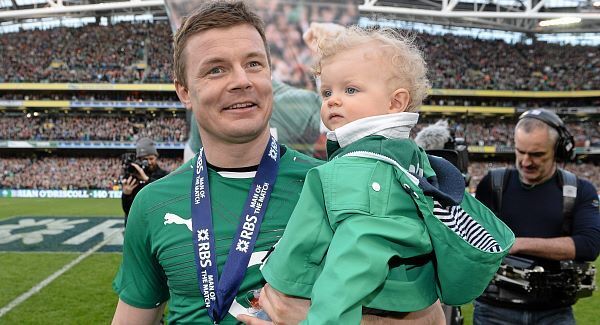
Twelve months ago the story wasn’t so much that Ireland had won the Six Nations as they had won it in Brian O’Driscoll’s last game in green.
He was nearly as big as the team, or at least his story was, and understandably and even rightly so.
It might seem blasphemous to say this, but are Ireland now a better team in 2015 without O’Driscoll, and for being without O’Driscoll? For sure any team would have wanted him in his pomp, but the 2013 or 2014 version? The man himself would admit in his book that if he were to have tried to squeeze out another season and a bit to make another World Cup he feared he wouldn’t make the starting lineup.
“I know I’d feel... like I’m undoing — just a little, but enough to matter — whatever reputation I managed to build in my best years,” he’d write. He wanted it to be his idea and call to have the jersey passed on to someone else.
Up until that book, no-one else dared to speak about possible slippage on his part. Only he did — or could.
“I’ve been on the wane for a couple of years now,” he’d write. “I can still make the halfbreaks and the offloads and put other people through holes. I’ve evolved and learned new skills, but I look at how I used to change direction and accelerate and that has been leaving me. I’ve begun feeling a bit blunt...”
But now that he’s broached it and he’s gone, maybe Ireland are sharper in 2015. That said...
3. Legacy of Brian O’Driscoll and peers
It was welcome to see George Hook last Saturday evening sing the praises of the visionary Irish administrators of the late 1990s but another crop of people need to be remembered too. In 2000 Irish rugby was transformed with the influx of a golden generation of new Irish players straight into the national team, namely Horgan, Stringer and O’Gara to go with O’Driscoll. Now they are no longer playing, or at least not with Ireland, yet it was watching them fearlessly take on Scotland that campaign and many others through the rest of the decade that would have inspired a team of former schoolboys to do just the same to the Scots last Saturday.
4. Class and humility: Mana
In his book O’Driscoll talks about the importance of “dignity” and “respect” in victory and how impressed he was to watch Paul Scholes shake hands and commiserate with every single Chelsea player after the 2008 Champions League final.
Last Saturday night those virtues were apparent again; note how genuinely complementary — as opposed to condescending — both Schmidt and Paul O’Connell were of England’s effort and performance against France.
Ditto Declan Kidney in 2009 in Cardiff in immediately acknowledging the contribution of Eddie O’Sullivan.
That’s another reason why rugby has been so vibrant in this country for over a decade. For all we now hear that sportspeople have no obligation to be role models, our rugby players and coaches are.
This column before has spoken about seeing Paul O’Connell wait in nightclub queues rather than use his VIP status to jump it. In the past autumn international series Schmidt used a Maori term from his homeland to describe O’Connell: mana. According to James Kerr in his study of New Zealand culture and the All Blacks, it is the ultimate accolade: To be a leader that possesses not just charisma and strength but gentleness and humility.
Not for the first or last time, Schmidt in his choice of language and captain nailed it, and last Saturday he and his captain did again.