US ‘commissioner’ model a worthy idea

I noted last week that there was a position vacant on the Kilkenny hurling team — that of full-back, given the departure of JJ Delaney into retirement. I think there might be even more significant vacancies in Irish sport, however.

US ‘commissioner’ model a worthy idea

Damien Hopley is the head of the professional rugby players’ association in England, the Saxon version of IRUPA, and he made a couple of interesting observations last week, including this, while discussing the difficulties of effecting change in rugby.

“I actually have a lot of sympathy for World Rugby,” Hopley told British media outlets. “Because they’re governed by the very unions they’re supposed to govern. I look enviously at the commissioners in America who make decisions in the best interests of their sport. Funnily enough, American sport looks pretty successful to me.”


Clear the decks. Dust off that CV. The concept of an overall czar for a major Irish sport is irresistible (even if the default term smacks unfortunately of feudalism, oppression and, eventually, a bloody revolution). The notion of a commissioner standing aloof and independent of a sport, yet with the power to sanction and to dictate terms within that sport, came about in the States with the Black Sox scandal, when members of the Chicago White Sox were implicated in fixing the World Series of 1919 but were found innocent in court. The owners of the baseball teams appointed Kenesaw Mountain Landis as commissioner, and he promptly banned the players for life.

The inherent problem with a commissioner is obvious if you read that paragraph closely. Landis was appointed by the owners of the baseball teams, so the perception that he was doing their will stained his tenure from the start.

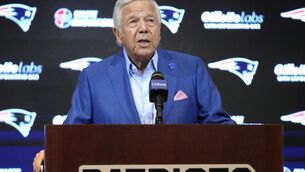
Some things, it appears, never change — after a horrible year in professional American football, with off-field scandals being mishandled and on-field controversies also coming under the microscope, the performance of NFL commissioner Roger Goodell has been criticised, with plenty of questions asked about his closeness to New England Patriots owner Robert Kraft.

(In a similar vein there’s been a lot of huffing about Goodell’s pay packet. In 2013 he collected $35m (€30.7m), for instance.) Still, the role has attractive features. A GAA commissioner would be able to move swiftly on disciplinary matters and could knock heads among administrators and managers to set fixtures, for instance.

At present you’re stuck with the president of the association: when there’s a controversy, he either says he can’t comment for fear of prejudicing the case, or he comments and thereby prejudices the case.

In Irish rugby a commissioner would have plenty to fill his in-tray as well — the continuing challenge of supporting the club game, for instance, while he’d also be able to address the issue raised by Munster chief executive Garret Fitzgerald, that of provincial games clashing with internationals.

One sport does have a commissioner of sorts, of course. On a global basis, soccer looks to the smirking creep that is Sepp Blatter, head of Fifa, a man who embodies the anti-commissioner argument in and of himself, while domestically a lot of power seems vested in John Delaney of the FAI, who has become synonymous with the beautiful game here.

What do you mean by saying the GAA and IRFU wouldn’t like a John Delaney figure involved in their sports?

O’Gara’s display of nervous energy

Ronan, Ronan, Ronan.

I won’t revisit last Friday night in too much detail. There’s been enough of that, though I notice the event lacks the -gate suffix (Nervousgate?) which bestows true immortality on a minor controversy.

In fairness, knowing the man as well as I do, I detect a selflessness to his actions. Bear in mind that it was on the eve of St Valentine’s Day, traditionally a time of year when service stations all over the country do a roaring trade as they flog wilting roses and just-in-date boxes of Heroes to the absentminded men of Ireland.

By taking the flak the way he did, O’Gara offered many a husband or boyfriend facing a week of recriminations a flattering comparison (“Don’t worry love, I’d never say anything like that about you”).

There’s a lot of nonsense spouted in rugby analysis, but if you wanted to see a guy putting his body on the line for his teammates, the lad from Bishopstown took a shoeing for everybody on Friday evening.

Time to take women’s sport out of dark ages

Disappointing doesn’t quite cover the experience of the Irish women on Friday night. Losing the game was bad enough, but it goes without saying that having the lights fail at a significant point in the game was a fair indignity.

Strides have been made in the recognition of women’s sport, and there are bright signs for the future, pardon the pun, but Friday night wasn’t one of them.

Having to decamp to a back pitch to complete an international isn’t good enough.

These things happen, obviously — there was darkness at Monaghan-Tyrone in the McKenna Cup a couple of weeks ago — but that doesn’t make it acceptable. With any luck, this will become as much of a milestone as the same Irish women’s team winning the Grand Slam in 2013, though for a different reason — by which I mean whatever inevitable hiccups occur along the way for women’s sport, there won’t be anything like being plunged into darkness, as happened in Meath on Friday.

Carr was a hero to hacks worldwide

In Nobody Asked Me, But... the passing of David Carr of The New York Times last week sparked real sadness among journalists.

Carr transformed himself from a crack addict (see his memoir, Night of the Gun) to a super-sharp media commentator for the Times, only to pass away suddenly — in the newsroom — last week.

One of the reasons he was a hero to hacks everywhere was his exchange with a representative of the website Vice, someone who’d chosen to disparage traditional media by saying: “Most of the time when the mainstream media reports on something, it never tells the whole story,” before going on to praise Vice’s coverage of the war in Liberia.

Carr’s response? “Before you ever went there, we’ve had reporters there reporting on genocide after genocide. Just because you put on a fuckin’ safari helmet and looked at some poop doesn’t give you the right to insult what we do.”

In a business which can often feel besieged by know-alls, it was refreshing to hear someone puncture the aura of the self-satisfied.

Rest in peace, David Carr.

x

More in this section

Sport

Newsletter

Latest news from the world of sport, along with the best in opinion from our outstanding team of sports writers. and reporters

Cookie Policy Privacy Policy Brand Safety FAQ Help Contact Us Terms and Conditions

© Examiner Echo Group Limited