Presidency of Liam O’Neill defined by vision and achievements
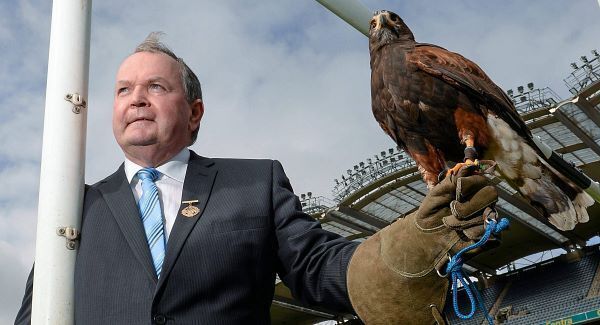
Three years ago, the role of the GAA president couldn’t have been more vague. Just where the parameters of the office’s powers ended and those of the director general began nobody knew. Not even the incumbents if they are honest.
Liam O’Neill told this newspaper last month of the deal he made with Páraic Duffy upon taking office. “My agreement with Páraic is that anything that stretches beyond three years is his business, such as negotiations with public bodies etc. Anything that goes beyond my time. The leadership role of the president is now defined, he’s front of house and that leaves the CEO the chance to do his work.”
The irony of that statement is that the true extent of O’Neill’s legacy may not be felt for a generation or two to come. The establishment of the Football Review and Hurling 2020 committees will have an impact on Gaelic games for years too, but by opening Croke Park for thousands of children to play, O’Neill has succeeded in handing them each a piece of magic.
As a teacher, he would have recognised how a game, if promoted right, can enchant a child for a lifetime.
When we put this achievement to another GAA observer recently, he replied it was “mere window-dressing”. Such cynical thinking. As someone who, as a child, had the opportunity to play competitively there on two occasions simply because of geography, we can vouch for the abiding power of Croke Park.
O’Neill’s profession may also have informed his safety concerns regarding the penalty in hurling, which prompted last year’s new interpretation of the rule — as well as his abhorrence of bullying, evident in the anti-sectarianism/anti-racism motion passed last year.
In time, he will also be recognised for the work he has done in bringing ladies football and camogie as well as the GAA’s other games in from the cold.
The gathering of all codes under the association’s governance is some way off but the “one club model” he espouses appears to be a sound one.
Setting in stone a date in the calendar for the ladies football final — after it was moved following the 2012 All-Ireland hurling replay — was a statement of intent.
His decision to recognise only women in last year’s President’s Awards wasn’t universally welcome, but it was consistent with his policies.
Considering most of his presidency ran concurrently with the economy’s downturn, O’Neill has shown a sensitivity to the financial difficulties of GAA members and patrons. After the drawn hurling final three years ago, it was he and Duffy who proposed a reduction in ticket prices of almost 40%. The equalisation of central funding so that smaller counties can receive more and the pending changes to the GAA calendar for the benefit of clubs were long overdue, but still point to his sense of fairness.
His unvarnished, colloquial style has often been complimented but it has also landed him in a spot of bother. His response to criticism of the decision to move last August’s Kerry-Mayo All-Ireland semi-final replay to Limerick did not go down well in Mayo.
“There was a comment made about going deep into Munster territory. We are not talking about the days of Brian Boru and that you are going into someone else’s territory and you are in danger. We are talking about modern society here where we go on motorways and we travel the country.”
The words only inflamed passions. In truth, he could have handled the matter better.
Some of his comments last April about the Sky Sports deal weren’t reflective either of sentiments at grassroots level. He was roundly criticised for suggesting on RTÉ that people without Sky Sports packages could “in many cases go to a person who has Sky”.
O’Neill wouldn’t have been a stranger to such difficulties. He found himself on the back foot just two days after taking office when one national newspaper ran the headline: “Gaelic football is ‘boring’ — O’Neill”. His use of the adjective was open to interpretation. He was referring to the overuse of the hand-pass which he claimed was “slowing it down and it’s boring”.
Undaunted by that setback, he commissioned the Football Review Committee he’d promised in his manifesto. Under the leadership of Eugene McGee, it succeeded in having a number of proposals introduced, such as the black card and the advantage rule.
O’Neill’s delight after that Congress in Derry two years ago was palpable. It was he, in conjunction with the GAA’s director of games Pat Daly, who had come so close to introducing the sin -bin in 2009. The black card mightn’t have been the same solution, but it addressed elements of the cynical play he and Daly had recognised.
The FRC and Hurling 2020 were two groups that worked well for O’Neill. The same might not be said of one or two of the disciplinary committees who, it is felt at central GAA level, dropped the ball in a number of cases. The Patrick Horgan and Henry Shefflin dismissals in 2013, for instance, as well as Lee Keegan’s last year. As a chairman of the disciplinary task force, that will disappoint him.
But O’Neill more than kept the peace with the GPA, even inviting chairman Dónal Óg Cusack onto the fixtures work group and endorsing his Super 11s concept.
He also oversaw the introduction of Hawk-Eye, which looks set to be made permanent next month. His apology last year to Limerick for the technology’s mishap in the 2013 minor hurling semi-final was the mark of a statesman.
The Trumera man’s refrain throughout his term of office was “trial and error”.
The Sky Sports deal stands alone as the best example of that. It shouldn’t necessarily be what he is remembered for but it’s what most people will associate with him.
As with every president, some issues remain. The might of county managers, a personal peeve of O’Neill’s, remains unflinching.
His attempt to clean up the sidelines, at first effective, seems to have been largely forgotten about as they became repopulated last season.
As ever, it boils down to the one question: did O’Neill do enough? He did plenty.