Horror of Hillsborough disaster still resonates today
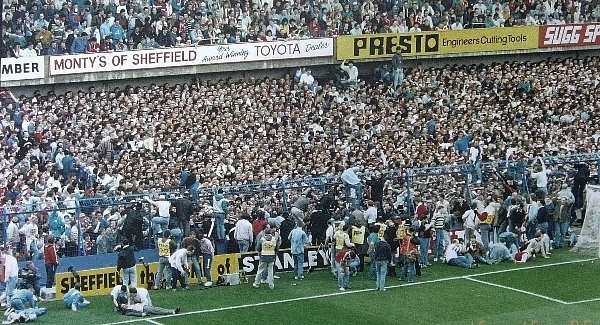
Derby defeated Manchester United, City lost at Blackburn and Chelsea at Leicester. Arsenal beat Newcastle on the way to the most dramatic league triumph in history. And in an FA Cup semi-final, Everton beat Norwich.
Results and scorelines were irrelevant. The news from Hillsborough was already coming through before half-time. As people left for home, the words on the lips of radio and television reporters were of horror and disbelief.
The horror was shared by all, but not the disbelief.
Football fans, particularly those who travelled to follow their team, knew that the disaster which struck Liverpool was waiting to happen. Like the Liverpool supporters, they had experienced that sickening feeling of rising panic in a crowd penned in with nowhere to go. They too had fought to stay on their feet as a heaving crush began to squeeze the life from their lungs.
So the words on their lips were: “It might have been us.”
There were sombre conclusions on Match of the Day that night. Jimmy Hill led the way with a call for all-seater stadiums, like the one he had pioneered at Coventry City. Football had to change, they all said.
In truth, it ought to have changed after the Bradford City fire four years earlier. Fortunately there were no perimeter fences at Valley
Parade, but the Popplewell Inquiry nevertheless recommended that wide exit gates should be available for use in an emergency. At Hillsborough all you could see was desperate fans clambering the wire and one pitifully inadequate doorway.
Stadiums in England have changed out of all recognition over the past 25 years. For the better in terms of comfort and facilities, but at a price. Terraces and terrace culture have gone, although you still can get a taste in lower league grounds where standing is permitted.
The standing ban on standing is enforced with varying degrees of severity, depending on the club and local authority, but going to a match and supporting your team is fundamentally different. Partly that’s because a lot of people have been priced out of football — especially the youngsters — partly it’s because after Hillsborough the Premier League reinvented football as more of an experience for spectators than supporters. The prawn sandwich has not yet replaced the hot dog, but the smartphone has definitely replaced the transistor radio.
For the rest of Europe the Hillsborough disaster was not the landmark event that it was in England here, although it certainly undoubtedly helped to convince Uefa to reinforce the stadium and crowd regulations introduced after the tragedy of Heysel.
“It must never happen again,” said an Italian TV commentator four days later as the entire crowd in the San Siro stadium paid tribute to the Hillsborough victims at the European Cup semi-final between Milan and Real Madrid. Yet Italy still has its fences and fans are still penned in.
Italian stadia are much the same as they were in the 1990 World Cup, with the notable exception of Juventus. Crowd behaviour has improved, but clubs have nothing like the stewarding there is in the Premier League and there is still a ominously threatening feeling at needle matches. Relations between police and supporters are still reminiscent of how it was in England in 1989 — “a police culture where soccer fans were considered almost subhuman”, in the words of Bob Westerdale, crime reporter for Sheffield paper The Star at the time of Hillsborough.
But there may be another way. German stadiums rock to the enthusiasm and noise of tens of thousands of standing spectators and their facilities are as good as any, at a far lower price than in the Premier League. Safer standing, with rail seats, is the way forward, according to the Football Supporters Federation, and some Premier League clubs are starting to give the idea cautious support. It gives supporters the freedom to stand without the risk of a mass crush. For European games the seats are unlocked to conform to regulations.
Yet understandably, many of the Hillsborough families are opposed to the idea. As Jimmy Hill said that night 25 years ago: “I wonder if those who were there would ever want to stand again.”