A picture of self-indulgence
“It is difficult to know yourself,” Van Gogh once wrote, about self-portraits, “but it isn’t easy to paint yourself either.”

A picture of self-indulgence

It is straightforward enough to take a photograph of yourself, though, as we notice all around us.

To recap; we have had the year of the selfie, we have recently seen the reinterpretation of the selfie as an awkward group photograph, and now we witness the rise of the sporting celebration selfie.


By and large, we can excuse our sporting heroes this epidemic. This is society’s problem. A virulent cocktail of narcissism and mistrust.

In better times, any gathering struggling to take a photograph of themselves would attract the kindness of a passing stranger who would offer to take one for them.

They’d make a bags of it, of course. Even after lengthy discourse about which large, unmistakable button they should press.

But now that loss of control is unthinkable. If it is difficult to know yourself, it is harder for someone else to know your good side.

Until now, the sporting selfie was easily avoided, unless you were minded to seek out that kind of thing. But last Sunday, not content with having his exuberance captured by dozens of television cameras and press photographers, Arsenal goalkeeper Wojciech Szczesny hauled the selfie onto centre stage when he produced a smartphone in the moments after the north London derby.

The natural evolution of the genre; it is not enough to take a photo of yourself, for everyone to see; you must now be photographed taking a photo of yourself, for everyone to see.

As a way of showing your passion, catching easy crosses just can’t compete.

“He could have started a riot,” fumed Spurs ‘legend’ Micky Hazard afterwards, showing the customary regard for the tolerance levels and civic spirit of football supporters.

A riot might have been a little bit strong, but even the Gooners must know, deep in their hearts, that they had seen something deeply suspicious.

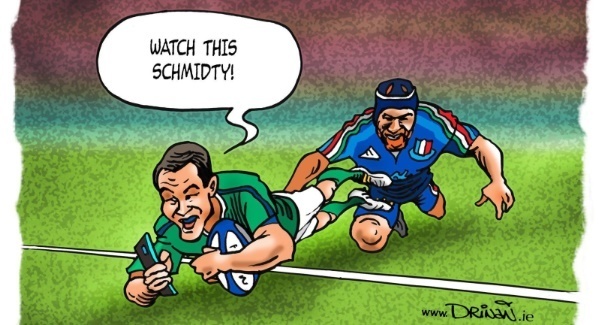
They had greater excuse for selfies in Paris the day before, with something tangible to celebrate.

And there may have been no more fitting way for Rugby Country to celebrate; liking and retweeting snaps of Church and Drico and Darce and their wives and girlfriends, taken by Church and Drico and Darce or their wives and girlfriends.

Looking at other people’s photographs of themselves to mark the final takeover of the game hardly anyone plays but everybody now loves.

We have seen lately the temptation for experts to link epidemics. In this regard, the rise of the selfie has recently been blamed for a fresh infestation of head lice among teens. All those heads pressed together to get in shot.

Maybe we can’t blame the selfie for the infestation of rugby overload, or vice-versa, but both have similar roots; social network climbing and social climbing.

And why wouldn’t an aspirational culture look to rugby when you see the frightening levels of hysteria around the farewell tour of Brian O’Driscoll? Essentially deified. Crowned, along with Amy, our king and queen. The competitive grief over his departure paused only occasionally so we could canvass other nations about how much they would miss him too.

Ideally, we should all have snapped morning selfies every day this week, to document the coping process.

At least it is nearly over now, the sporting selfie fad. We can be confident of that much because every sporting fad finishes up soon after the GAA lads get hold of it. Just as the last known case of anyone doing the Harlem Shake was a Meath Gaelic football team, the Portumna and St Vincent’s selfies from Croker last Monday should close this chapter.

Alas, the celebration selfie already has a successor. It is no great surprise that one of the great narcissists, Thierry Henry, would be a step ahead. When he scored for the New York Red Bulls last weekend, Henry leapt the advertising boards, elbowed a cameraman aside and began shooting — poorly — the celebrations from his own viewpoint.

The Selfless, as Thierry would doubtless like it to be known.

Majority rule a dangerous way to go

In an age when everyone can dispense an opinion as easily as a selfie, perhaps it was inevitable that we would soon arrive at the first crowdsourced refereeing decision.

That seems to be what happened in the Millennium Stadium last Saturday when Scot Stuart Hogg was eventually shown a red card.

Predictably, if you listened to the Marian Finucane’s radio show last Sunday, Hogg’s acceptance of his punishment for an attempted decapitation of Dan Biggar was yet another indication of the culture of respect in rugby, compared to, say, soccer, where a similar challenge by Harald Schumacher has earned more than three decades of revulsion.

Rather betraying his compatriot Patrick Battiston, French referee Jerome Garces initially regarded the incident as only a minor overindulgence in the natural rough and tumble of The Ugly Game and gave Hogg a yellow. But as replays of the incident were shown on stadium screens, the groans from the stands seemed to niggle Garces’ conscience and he upgraded Hogg’s censure.

So, is this another example of how football should follow rugby’s lead in using technology to eventually arrive at the right decision, however long that should take?

Or evidence of yet another complication video technology might bring; baying home fans influencing a key call?

Pool’s surprise perfect match

We might be waiting for a selfie of Suarez and Sturridge together judging by the body language between them during the demolition of Manchester United.

It is one of the most impressive aspects of Liverpool’s renaissance; the way Brendan Rodgers has spearheaded a team with two players whose priorities appear to be themselves.

Suarez and Sturridge do set each other up, but it always seems like a last resort, a disappointed passing of the buck.

In his book, Stillness and Speed, Dennis Bergkamp remembered dealing with Ruben Sosa at Inter Milan, a strike partner who more or less considered the Dutchman a rival.

“Jeez, come on man, look around you! I’m there as well.”

It broke Dennis in Italy, that kind of thing, but these two seem energised by the competition.

“They are not going to be a classic partnership because they are very individual,” John Barnes told us, earlier this season.

At Ajax, Suarez’s individualism was an example to Bergkamp’s youth players.

“That’s one of the things we try to do with the training now in the youth — give players the chance to develop themselves into creative, special, unique individuals.”

Bergkamp found it a refreshing antidote to robotic ways of Dutch youngsters, always “looking at the bench to find out what they should do.” Liverpool’s unique talents certainly don’t look to each other for guidance.

Heroes & villains

STAIRWAY TO HEAVEN

John Joe Nevin: Off the mark in the lonely pro game.

Willo Flood: Off the mark in the trophy game.

HELL IN A HANDCART

The Second Captains’ ‘Good Wall’: Lads, how can you have spots for AP McCoy and Rory McIlroy, yet no place at the top of the list for George Best?

Bill O’Herlihy: Quoting ludicrous, made-up statistics as fact — too many years hanging round with politicians has finally taken its toll.

Tyson Fury: All sound and fury. Come on son, surely the WWF lads have done table-throwing to death.

More in this section

Sport

Newsletter

Latest news from the world of sport, along with the best in opinion from our outstanding team of sports writers. and reporters

Cookie Policy Privacy Policy Brand Safety FAQ Help Contact Us Terms and Conditions

© Examiner Echo Group Limited