Gnashing of teeth at a goalkeeping menace
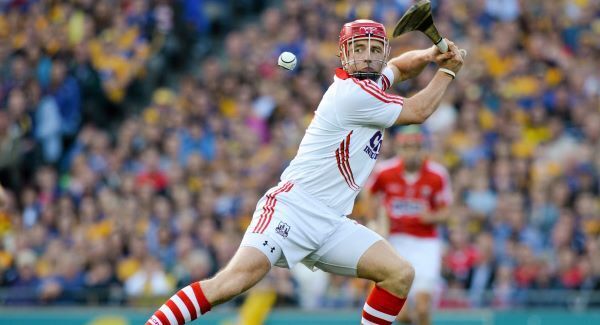

The Cork hurling goalkeeper is rapidly becoming a bigger enemy of modern democracy than SMERSH, if you were to judge by the rush to condemnation.
An exaggeration? Consider this swift recap.
The Kanturk man’s free-taking technique is under scrutiny because he lifts the sliotar too far forward before striking it, with quite the rumbling about the unfair advantage this affords him. Then there’s the concern he hits the sliotar so hard there may be health-and-safety concerns for his opponents.
A club in Galway is seeking to amend the rules of the GAA to outlaw hurleys which have an outsized bas, such as Nash’s.
Seriously, this man is a menace to society.
This is a fallow period, traditionally, for GAA news, so I’m glad to help everyone by pointing them in the direction of some other crimes that Mr Nash is responsible.
Namely: the recent IT glitch in Ulster Bank; the non-selection of Darren Cave, and other rugby players from Northern Ireland, for the national side, a matter covered elsewhere on this page; the terrible decline in the number of snow leopards in the mountains of Afghanistan; the disappointment with the most recent Star Wars movies, and the inclusion of the character Jar Jar Binks in particular; the impending strike by ESB personnel; the hole in the ESB pension fund causing this strike.
And the weather.
To be balanced, a swift rebuttal.
Technique: Where in the rulebook does it say Nash is doing something wrong? There were rumblings on occasion about DJ Carey and Eoin Kelly’s lifting of the sliotar for frees, but legislation? Please.
Power: contrary to popular belief, Nash doesn’t hit the ball so hard it can’t be saved on occasion. Witness the All-Ireland finals.
We’ve kept the best for last, though. Clarinbridge, the Galway club looking to have Nash’s bas shaved down, have a good reason for doing so: “Why should he or any goalkeeper be give an advantage over the likes of Joe Canning?” asked one of their officers.
Thanks for the best laugh of the day. Seriously.
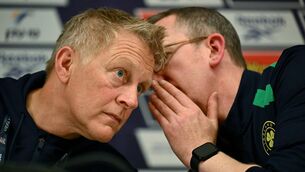
Surprise in this quarter, if nowhere else, with Joe Schmidt’s comments last week. The newish Ireland rugby coach was asked about Darren Cave of Ulster’s remarks, which raised a few eyebrows earlier in the week.
If you missed it, Cave said: “Unfortunately for me, internationally, the last few years haven’t gone that well and sometimes you wonder does the face not fit.
“I’ve read that I’m not established for Ulster or inexperienced at international level, or for some reason not good enough to be an international rugby player.
“I don’t know how these people see that, as I’ve never really had a good crack at doing it.
“I still wonder sometimes: does the face not fit? If you don’t know what I mean, ask Roger Wilson how he has one Irish cap and Jamie Heaslip has 60 and two Lions tours.”
While your immediate urge may be to plant a listening device in Carton House for the next time Darren sits down for a game of Playstation with Jamie at Ireland camp, hold back. Hear what Schmidt had to say.
“I think the media sometimes vent those [ill feelings] more so than the players,” Schmidt said when asked at a press call about the comments.
“I had a phone call from the player who was pretty disappointed with [the article]. Like anyone, you can have things taken out of context.”
Oh dear. Where do you start?
Blaming the media is a rookie error. Not because the media is spotlessly clean and never gets anything wrong, but because suggesting that something may have been taken out of context is always a poor substitute for dealing with an actual issue.
No one expects Joe Schmidt to say, “Yes, frankly Darren’s face doesn’t fit. That jawline. Seriously. That’s why I’m not picking him.”
But you’d expect something more than shooting the messenger.
Imagine for a second you’re at your sports event of choice. Unless it’s golf or snooker, you are working your tonsils hard, until a card is handed to you with this written on it.
“You are being issued a warning that the comments, gestures and/or behaviors that you have directed at players, coaches, game officials and/or other spectators constitute excessive verbal abuse and are in violation of the NBA Fan Code of Conduct. This is the first and only warning you will receive. If, after receiving this warning, you verbally abuse any player, coach, game official or spectator, you will be immediately rejected from the arena without refund.”
The three initials are the giveaway. Last week a US basketball fan tweeted a picture during the week of a red card headlined WARNING and carrying the text you see above.
It is happening in America. Can Ireland be far behind?
I note that the latest candidate for shaking-the-nation-to-its-foundations, the revelation of match-fixing in soccer across the pond, is distinctly underwhelming.
I had a scan around the interweb a couple of days ago and the closest thing to scandal I could find was the fact that “two footballers from Whitehawk FC, a Conference South team in Brighton, had been charged over match-fixing allegations.”
With all due respect to Whitehawk FC of the Conference South, nobody is considering that news for the front page, not even the Whitehawk Gazette & Inquirer.
As a friend of mine surmised, isn’t it amazing that the only match-fixing and drugs busts in soccer tend to happen down the leagues or in the reserves...
Still, smugness and complacency aren’t appropriate in response, even if they appear to be irresistible.
Here is how betting coups can be manufactured even here, where corruption is all but unknown.
Take a GAA county final. Reporter calls manager of one of the teams a week before the game. Bad news, says the manager: star inter-county defender a major doubt. Reporter writes up injury news and when local bookie takes bets on first goalscorer, obviously defender is a way down that list.
Come county final Sunday, though, the defender lines out. Not only that, his team-mates spurn goal chances and try to win penalties. When they succeed, early on, the defender comes up to take it.
What nobody has realised is that his team-mates have lumped big bucks on him for first goal. Unfortunately for them, he’s a defender for a reason. His shot is saved.
The reporter finds out years later, thanks to one of the players making a confession in his cups. No regrets, though.
“We made one mistake,” the player says. “Should have gotten the other side’s keeper in on it.”