Think a bad call is tragic? Try having to retire at 25
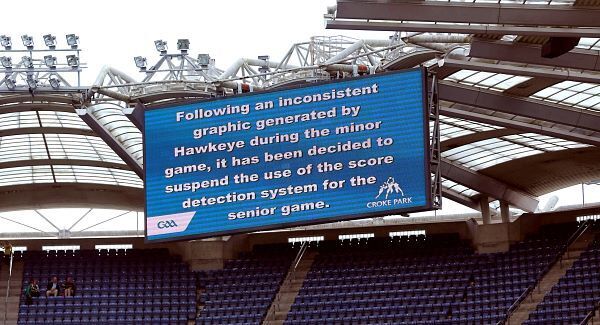

For Croke Park early last Sunday afternoon read Stamford Bridge on Wednesday night. Both stadiums witnessed obvious miscarriages of justice: Limerick’s minor hurlers denied a point by Hawk-Eye’s malfunction and Aston Villa sent back to the midlands without a point by Chelsea thanks to a pair of awful decisions which owed nothing to the whims of technology.
The ripples left in the wake of both games have been visible all week with the Limerick County Board and Villa manager Paul Lambert enjoined by an understandable sense of misfortune at events that undid what were commendable efforts by their teams to claim victory in contests of considerable import for both.
Here are two separate sporting codes which have recently introduced technology to minimise the scope for human error in their elite-level contests and yet both find themselves marooned in the same manner of maelstrom. Unfortunate though both sides were, what that tells us is, try as we might, sport simply isn’t meant to be stripped of its capacity to toy with our emotions.
Sport is often lauded as a glorious irrelevance but the creeping influence of technology into our cherished games can never hope to fully cocoon us from the whims of pastimes that mean as much as they do by dint of the fact they leave us wounded, seething and sometimes even bitter far more often than they do wildly exuberant or blissfully content.
Hawk-Eye and refereeing decisions have been merely the most remarked-upon examples of that vicariousness but this was a week which gave us real pause to reflect on just what should be deemed disastrous with the news that Leinster centre Eoin O’Malley was forced to call time on his professional career aged just 25.
O’Malley emerged from Belvedere College as a Leinster Senior Schools Cup winner and a possible successor to Brian O’Driscoll for club and country and, though he displayed his brilliance on a number of occasions, he was ultimately undone by a compromised knee ligament.
You can talk about players who were denied trophies or personal honours – or teams undone by the failings of others — but there is no more cruel example of sport’s indifference to emotions and ambitions than injury at such a young age and we would do well to remember that when the temptation is to overstate the relevance of results and other fleeting considerations.
O’Malley spoke eloquently about his unfortunate predicament when the news was announced and his words brought to mind something once read in Ian Botham’s autobiography Head On and which was somehow dredged up from the back of a bookcase after surprisingly little effort just yesterday.
“For many sportsmen, coming face to face with irrefutable evidence of their mortality is the moment they dread above all others,” he said. And this from a man whose England first-class career spanned 15 years through three decades and who is still regarded as his country’s greatest ever cricketing all-rounder.
O’Malley’s story demonstrates just how fickle the life of a sportsman or woman can really be. Long is the list of those who have been forced to sit out tracts of their careers, both long and short, whether that be Robbie Keane who once damaged ligaments stretching to pick up a remote control, or Dublin footballer Michael Darragh MacAuley who missed a game after a piece of chicken got lodged in his throat.
Such quasi-comical happenstances are only one side of the spectrum. At the other are men like O’Malley and Derek Dooley, the English footballer whose burgeoning career was ended in 1953 at the age of 24 when he collided with Preston North End goalkeeper George Thompson and broke his leg while playing for Sheffield Wednesday.
Broken legs were even worse news back then than they are now but Dooley’s problems were only beginning. A subsequent x-ray revealed a double fracture but he was all set to be discharged until a small scratch was discovered on the back of his leg. Gangrene had set in and the limb had to be amputated.
Dooley’s story stands out not just because of the bizarre nature of it but his reaction. “I’ll stay in football,” he was quoted soon after. “I don’t mind if they stand me up and use me as a corner flag.” He did, too, not as a corner flag but as manager of Wednesday for a short time and then managing director of Sheffield United until the mid-1990s.
Suffice to say, then, that there are worse things that can happen as we pursue our frivolous sporting hobbies than disallowed scores, unpunished fouls and, heaven forbid, defeats. A little perspective can go a long, long way.
Email: brendan.obrien@examiner.ie
Twitter: @Rackob