’Football is not a math problem to be solved...’
Strength, speed, endurance are the original must-have tools of the trade. Everything has a number, a target, a goal.
Every session must be improved upon. Your every movement is tracked by GPS, your every collision rated. Then there is the mental aspect. Temper, discipline, reaction, lack of reaction — everything matters.
Have we lost what is the true point of management? Is management not about bringing out the best from a bunch of individuals? To get them to work as a unit which stereotypically is stronger than the sum of its parts? In Gaelic football this means producing a performance on the field of play, the ability to replicate what you have been trained to do under intense competitive pressure. By extension, then it is our duty as management to ensure that, when under this intense pressure, individuals do not revert to a default mode which is contrary to the one the team has been conditioned for. The difficulty is doing all this while allowing enough room for individual brilliance to thrive.
Donegal and Laois both resemble teams which have bought into the ‘everything must be measured’ mind-set. The net result is a game devoid of creativity, freedom of expression, individual flair and risk-taking. The opening passage of play was exactly this. Strength, pace and passion aplenty but what both teams needed was someone with creativity, the vision and composure to look up and tread a ball into an inside forward or draw a scoreable free.
For the opening 11 minutes this madness continued before Marty Duffy awarded Colm McFadden a scoreable opportunity. It is not that either team were incapable. Laois, with the opening move of second half, illustrated this point when Conor Meredith finished a lovely passage of play with a well-taken score. Indeed Donegal worked a number of opportunities for Patrick McBrearty throughout the match, some which resulted in scores.
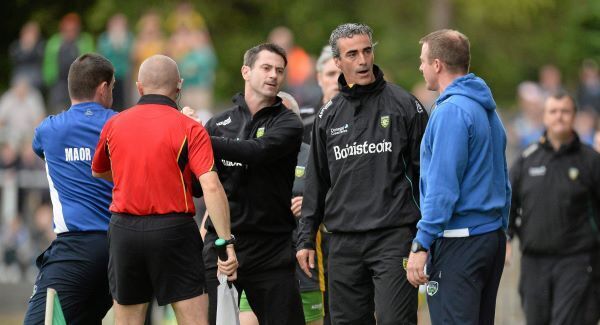
Spectators and the pre-match atmosphere can have a strange bearing on games. I’ve played in many matches where the anger was palpable but this is the first match I attended as a spectator where there was anger everywhere. It was initially a nervous apprehension emanating from the Donegal supporters but when the game started Laois played on this and heightened the on-the-field physical and verbal stakes. Soon it had spilled over to the sideline and onto Jim McGuinness and Justin McNulty, over an off-the-ball incident. Then beside me a band of five Donegal supporters entered the stand looking for their pre-bought seats which had been occupied. They were 15 minutes late for a game which had been deferred by 30 minutes. The signs were ominous. By the end of the half Donegal supporters were jeering at Laois’s shooting inaccuracies. Need I remind you that after 22 minutes of play the score was one point each?
The second-half was as confusing as it was frustrating. The standard of play from both teams left a lot to be desired. Misdirected fist passing, slow play and indecision were key aspects.
In fact the Donegal supporters in the stand were shouting at the players to make more forward progress while attacking and for Jim McGuinness to substitute their captain Michael Murphy.
Another aspect was the decision-making going forward. There is no doubt that skilled scoring forwards should be the ones teams try to give the final pass to. This is true whether it be in Kerry with Colm Cooper or Donegal with Colm McFadden but the player in possession behaved like he wasn’t allowed to shoot on Saturday. If this is true then we have succumbed to a level of player control beyond what I believe is necessary.
There is a principle, christened Einstein’s razor, which states that “everything should be made as simple as possible, but no simpler”. Now isn’t that a novel idea. The issue as I see it is that changing a traditional outcome-centred ethos into a purpose-driven ethos requires a shift in perspective that is challenging but not impossible. The great advantage in such a shift is that the direction feels natural and meaningful to people, once they get past their engrained cynicism about change. That purpose-driven ethos takes account of the enjoyment of playing and the enrichment we get when playing to potential. Even if the result is less than favourable.
Do you think Galway or Donegal are happiest today? I would suggest Galway as they had success this year which is not rated by medals or trophies but by personal achievement and performance.
Football is not a math problem to be solved. It is not about who the fastest, strongest, fittest player is. It is not about who hits hardest or about who can spout the most verbal insults. Maximising any one thing is at the expense of many other important things. This deficit can be fatal. Gaelic football is a complex, evolving living entity and we need to have the requisite skill set, mind-set and heart-set to do so. As managers we must never knowingly allow the concepts of ‘enjoyment’ and ‘performance’ to be harmed just to benefit one of the outcome-centred stakeholders in the short term.
Laois have come as far as they are capable of this year. Many adjustments are required if they wish to progress to the quarter-finals next year. Donegal may have one last performance in them and now is the time for it.