Trap’s biggest mistake
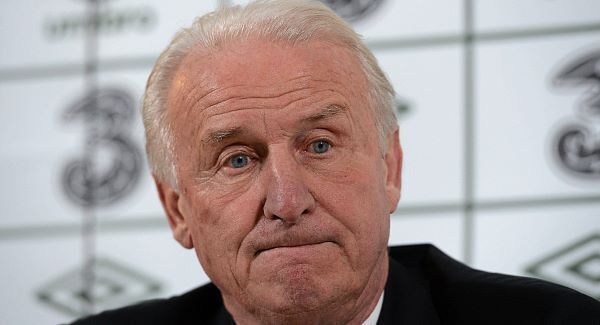
The conventional reading of ‘Love Minus Zero/No Limit’ is that it is the bard’s ode to a loved one but methinks that’s far too literal an interpretation. Ponder the thing a little while longer and it should become obvious that the line quoted above has been designed to cut right to the heart of the debate about Giovanni Trapattoni’s stewardship of the Ireland team.
With Trap having walked the tightrope between success and failure for over five years, it’s becoming increasingly clear his biggest mistake had nothing to do with tactics, selection, the fact he used to spend too much time holed up in Milan with his DVDs or any of the other brickbats routinely hurled at him from armchairs, barstools and studio seats.
Nope, the Italian’s biggest mistake was to guide Ireland to the finals of Euro 2012.
I mean, the cheek of him.
True, he had his critics all the way through qualification but by the time the Irish were running in four against Estonia in the first leg of the play-off, the unhappy voices off could hardly be heard above the euphoric din of a nation going mad with anticipation of a glorious summer to come. Even those of us who worried Spain, Italy and Croatia might very easily make it a summer to forget, we found ourselves being diverted into dreamland by that old devil called hope, the heart plotting a seemingly viable path through the group — beat Croatia, lose to Spain and, confounding the odds, nick a win against Italy — even as the head sought to remind us that these were among the top teams European and world football and that, by stark contrast, the Ireland side has long been one of relatively modest talents.
Actually, beating Estonia out of sight away from home was probably Trap’s first big mistake, since it merely permitted everyone to point out how lucky the Irish were to draw such inferior opposition, conveniently ignoring the point that if the Estonians really were the hopeless cases of popular portrayal in this neck of the woods then they shouldn’t have been able to manage a second-place finish in their own qualifying group, just like, eh, Ireland.
Far better, surely, if we’d drawn a bigger gun and, ideally, crashed out to a hotly disputed goal in the final minute of the second-leg,
But we didn’t fail, we succeeded and, therein, lay the seeds of our downfall. And when a nation’s dreams turned to ashes in Poland, it was obviously all Trap’s fault for picking Simon Cox and sending Kevin Foley home and had nothing whatsoever to do with an ordinary Irish side being outplayed by three superior teams, two of whom would go on to contest the final.
Yes, Trap’s default setting is conservative and, agreed, some of his selections and substitutions have been baffling-bordering-on-eccentric but if he hadn’t overseen Ireland’s first qualification for the finals of a tournament in 10 years, then he could never have suffered such a precipitous slide in popularity. This was success as failure, with bells on.
And it would get worse before it got better. The shiver that went down the spine in Kazakhstan turned into a full-blown case of pneumonia against Germany, a humiliating home defeat from which it seemed there was no way back for manager or team — and especially not when an FAI man of mystery seemed happy to let the dogs in the street of Torshavn know that the cat was for the sack irrespective of how the team fared against the Faroe Islands.
But, after a jittery start, Ireland responded with vigour up in the North Atlantic while Trap remained dignified and defiant in the face of no little provocation. And, since then, bar the crushing disappointment of the late concession of two points against Austria, the whole project has regained enough momentum for that old devil called hope to start popping his head around the door again.
That said, this week’s friendly against Spain in New York was a reminder that there is a brand of football being played on this planet to which Ireland can only aspire in their wildest dreams but, still, all were agreed that the spirit shown by a makeshift 11 in what was largely a damage-limitation exercise was heartening. However, at the end of this international season, the biggest reasons for optimism are to be found in Trapattoni’s belated but still welcome promotion of Seamus Coleman and Marc Wilson as full-backs, his increasing investment of trust in the still developing James McCarthy, the growth in confidence and authority of David Forde and, most of all, the fact that Wes Hoolahan seems, finally, to be winning the manager over to the idea that the latter’s safety-first tactics can still accommodate a player whose primary business is construction rather than destruction.
Add Shane Long, Robbie Keane and — fingers crossed — Richard Dunne into that mix and, suddenly, the Irish team has a bit of pep in its step again. Not that Giovanni Trapattoni will get any of the credit, of course, but if success turns out to be failure again, you can be sure he’ll get all of the blame.