John Fallon: Euros forecast rift should keep Casement conundrum away
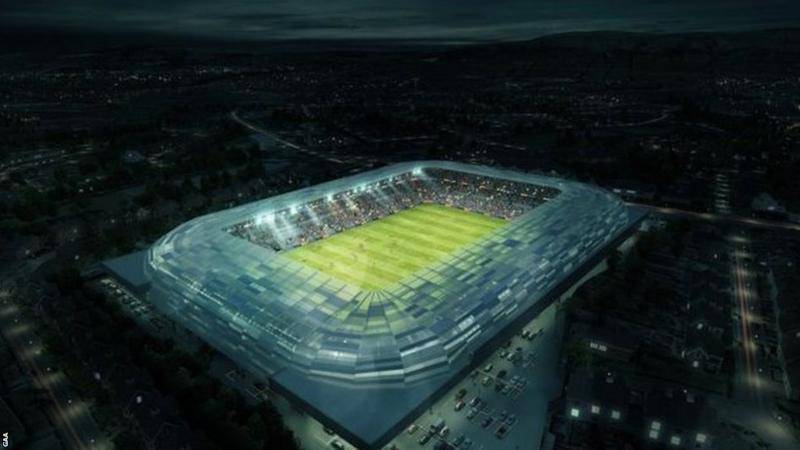
How Belfast's Casement Park will look once completed.

WELL, at least we finally know the cost. Just 14 months on from the FAI reaching peak circumspection on the price of pitching for, and winning, the Euro bid, a figure of €93m has emerged.
That's the overall outlay – inflation included – to be spent on Ireland's behalf if chosen alongside the UK to secure hosting rights for the 2028 showpiece.
UEFA's executive committee go into conclave in October to decide on the shootout against Turkey.
England, the centrepiece Ireland are relying on, haven't been shy about citing their financial muscle to sway the vote so soon after the European body's coffers were raided by cash-starved affiliates during the barren Covid-19 period.
Before the UK and Ireland rack up a bonanza from tickets and hospitality, the issue of outgoings, rather than income, will dominate.
Throw in a dose of party politics up North and the mechanics of Lansdowne Road and a rebuilt Casement Park forming part of the finalised 10-stadium tilt make for a murky few years ahead.
That's all we've known in the country when it comes to major football tournament hosting.
If this quest goes with form and is successful, it will be held 20 years after Ireland first harboured delusions of being a co-host.
Their coalescing with Scotland was sold as the Celtic bid but by the end the only thing they shared was shipping ridicule for missing the shortlist.
"We've now got absolute assurance to have two stadiums in Ireland by the end of May," said John Delaney, then the FAI's Treasurer, in one of his early Comical Ali renditions.
"As yet, we don't know which two but rest assured we'll have them."
Delaney was bullish about two other bids to stage international festivals. The first, part of the pan-Euro finals in 2020, got the nod, only to perish due to medical advice on public gatherings but his second, to co-host with the North the Under-21 finals this year, never left the ground following the financial malaise uncovered after his 2019 exit.
Ireland are all in for this project despite conflicting noises emerging from Leinster House over the weekend.
Government ministers approved the plan prior to the official submission deadline of last Wednesday but caution being preached by Paschal Donohue justifies more than usual attention.
When the Minister of Public Expenditure, chief bean counter in everyday parlance, challenges the economic case, then a cold hard look at the figures is warranted.
That €93m cost forecast is actually €25m less than the figure, had Croke Park not been ditched to facilitate the inclusion of Casement on the island but in a different jurisdiction.
Chief within the allocations are €27.5m apiece for security and transporting fans to the six matches at the Dublin 4 venue, with nearly €3m budgeted for promoting the spectacle.
That's even in the event Ireland somehow don't feature among the 24 teams, either qualifying on the pitch or by snaffling one of the two hosting tickets across the five-member bid.
Minister Donohue's worries centre on the accuracy of the €189m economic gain contained in the feasibility report furnished to Cabinet by Catherine Martin, the Green Party deputy with responsibility for tourism and sport.
June and July constitute optimal demand for hotel rooms anyway, negating the boon in revenue attached to the rosy estimate.
Tuesday's latest Exchequer figures, predicting a €10bn surplus for this year rising to €16bn in 2024, illustrate the time is rife to earmark funds for ventures portraying the country in a positive light but all the indicators are the corporation tax cash cow will recede thereafter.
Minister Martin and her colleague in the sports portfolio, Thomas Byrne, have been leading the verbal niceties but a colleague previously in that area, Jack Chambers, learnt of its place in the hierarchy late last year when pleading for €170m extra to fast-track paused projects such as Leinster's RDS Main Arena and the FAI's training centre in Glanmire.
"You know the pressures the Government, Minister Donohoe and myself will face in the Budget: cost-of-living pressures; Ukraine-related expenditure; Brexit; Covid; any public service pay deal; the health sector; housing needs. These are only the most obvious. There are many others," read prepared speaking points for Finance Minister, Michael McGrath.
An inter-party spat over line items doesn't threaten to derail the bid, yet injects the reality of doubt behind the collective approach being presented in the various soundbites projected last week.
It also demonstrates that the Irish public purse is already strained without getting dragged into the controversial Casement bill.
Of the three parties involved in a reconstruction project spiking to over £100m, the GAA have declared a ceiling on their contribution at £15m. Stephen McGeehan of Ulster GAA reaffirmed this stance last week, hurtling the shortfall issue back on the Irish and UK governments to fill.
Unsurprisingly, the Democratic Unionist Party have been quick off the mark in expressing their objection to additional funding from Westminster to bridge the chasm of £20m.
A prominent Northern Ireland supporters' club voicing their disapproval, on the basis of GAA being the long-term winner from the investment, applies another complication to reaching the endgame.
Doubtless the powerbrokers in London hold a contingency of reassigning those games back 'home' should push come to shove and further delays render Casement unviable.
A problem, a major one at that, but in terms of those precious personnel and financial resources, not amongst the collection consuming the FAI and Irish Government over a lengthy five-year journey.
Weighing up the benefits of income from artificial pitches against the cost of losing players to associated injuries is the dilemma that Dundalk and Derry City are torn by.
Dundalk boss Stephen O’Donnell took the opportunity after the meeting of the two teams on Sunday to correlate their respective lengthy list of absentees.
Derry didn’t have a choice in a 4G pitch being laid when their local council refurbished the Ryan McBride Brandywell in 2020, a decision factoring in use of the facility by community groups beyond City’s matchdays.
Since 2005, Dundalk’s Oriel Park has been without real grass, not hindering their most successful period under Stephen Kenny, and the revenue gained from rental is a cornerstone of their cashflow.
A European Union law ban on microplastics will eventually affect their continuation but Dundalk may act before they're pushed, if O’Donnell’s alarm is heeded.
Colin Healy, whose Cork City side welcome Derry on Friday, isn’t a fan of synthetic pitches, adamant the quality is compromised.
“I don’t like them and, for me, it should be all grass pitches,” said the former Ireland midfielder.
“As a player I had knee injury problems and couldn't really play on those pitches anyway. I watched Dundalk’s game against Derry on Sunday and the ball just doesn't move correctly, does it? It’s too slow.
“What happens is that you get ankle, back and groin injuries, even in training. We do very little on Astro - I don’t take a risk.”
Full-timers Galway United and Waterford will duel for the First Division title but Athlone Town are among the surprise packets so far.
Having finished last season one spot above basement side Cobh Ramblers, beating the fourth-placed Cork side on Friday leaves them occupying the final playoff berth of fifth.
There’s been a cosmopolitan hue to the resurgence of their league’s oldest club, influenced by a partnership with Boston-based Valeo FC confirmed at the start of the season.
Valeo's aim of being a “world-class, internationally recognised, soccer training academy that develops elite youth athletes for collegiate or professional play" has translated into a deluge of their players arriving in the Midlands. They range from faraway places like Haiti, El Salvador and America.
The new stakeholder has also imported coaching personnel, for Dario Castello led the team in their previous match against Bray Wanderers.
The Portuguese remains on the backroom staff following the return of former player Gordon Brett to the club as head coach. He began the season assisting Dermot Lennon, who has since moved ‘upstairs’ into the Director of Football role.
After Athlone’s last brush with foreign investment six years didn’t end well, this collaboration looks a whole lot better.