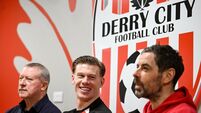
John Fallon: Derry City and chairman Philip O'Doherty have every right to dream again
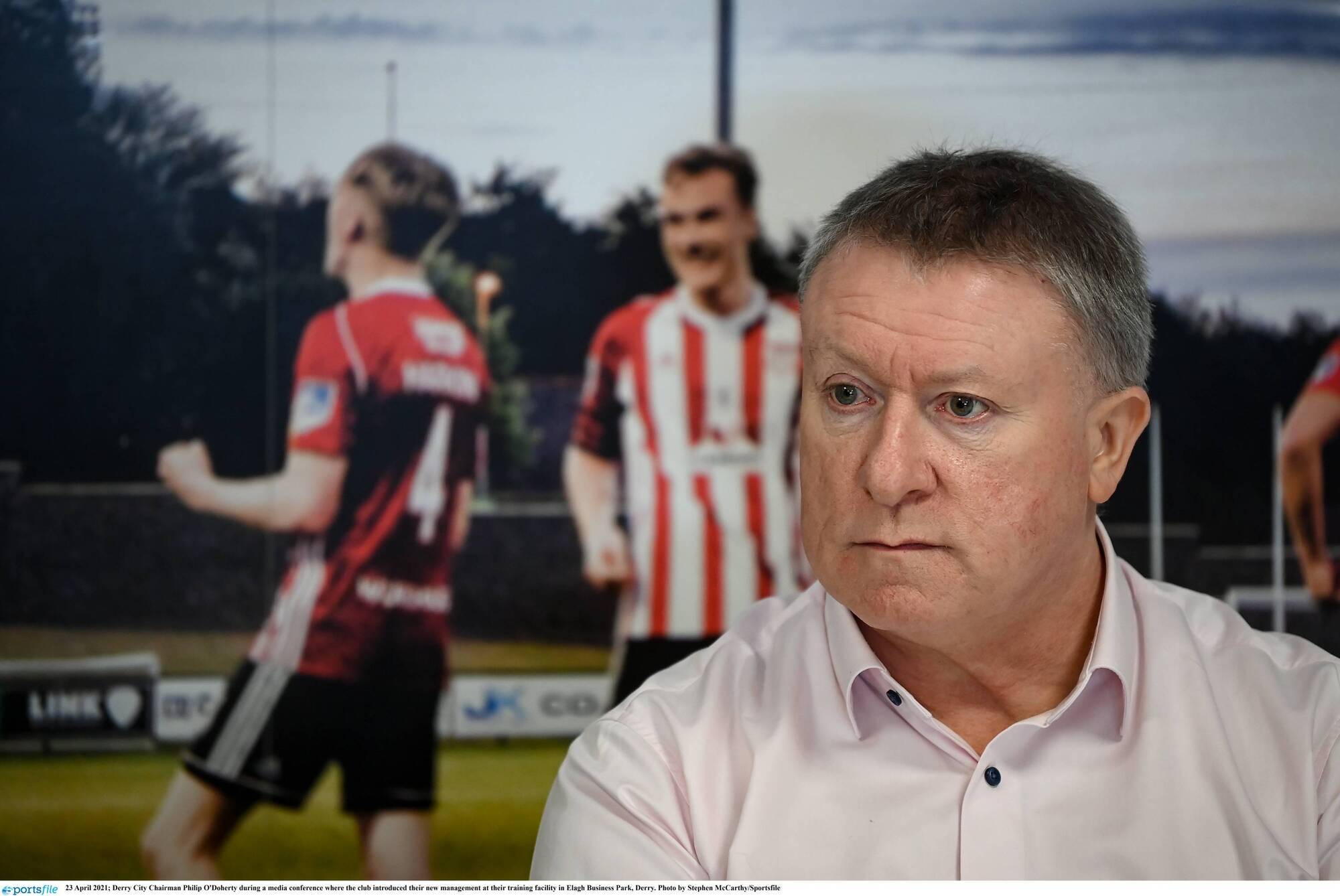
Philip O’Doherty: Lamented the lack of long-term thinking.

At last, we have a stable, sustainable and financially supported team to challenge the superpower that is Shamrock Rovers sprinting out of sight. It’ll make for an intriguing 2022 League of Ireland.
Whereas Derry City, in reality, travelled to Tallaght for last Friday’s game against the Hoops more in hope than expectation, there’ll be demands upon the players to at least match the champions in next year’s sequel.
Exactly how many of the team that lost 2-1 are retained to mount that charge will be one of the subplots over the close season but acquisitions on pre-contracts of Dundalk duo Michael Duffy and Patrick McEleney confirm the premium market Derry have entered. Further marquee signings are imminent.
That financial muscle was made possible by the faith of the Derry board in manager Ruaidhrí Higgins, not necessarily by Philip O’Doherty hitting the jackpot last month.
The Chairman himself insists the budget increase was board approved before the company he owns 60% of, E&I Engineering, was sold to American conglomerate Vertiv Holdings for $2bn.
Wherever the money is coming from, Derry’s fans have reason to believe the means are at the manager’s disposal to recapture past glories.
Not since the final season of Stephen Kenny’s first spell at the club, 2006, have the Candystripes finished in the top two. Their last title came in 1997, eight years after their first.
That initial championship was gilded with the addition of the League Cup and FAI Cup – distinguishing Derry City’s class of ’89 as the sole side to ever achieve a domestic treble.
Not even the great Dundalk side could replicate it, the sloppy handling of Chris Shields’ suspension for the 2019 FAI Cup final and subsequent penalty shootout against Rovers denying them history.
Derry’s feat – and the journey to reach those heights – was the subject of a recent documentary aired by both BBC and RTÉ entitled “Different League”.
Of course, the name is a play on the club representing the town, which Phil Coulter loves so well, joining the League of Ireland in 1985.
They’d spent 13 years in the wilderness, expelled from the Irish League amid growing tensions of the northern troubles and found refuge in the welcoming arms of the FAI.
What followed was a four-year surge from the bottom of the First Division to the summit of the Premier, supported the length and breadth of the country by a fanbase with few equals.
Without official records, estimates vary on the crowd Derry brought to Flower Lodge for the 1986 FAI Cup quarter-final against Cork City.
Yet Eddie Mahon, among the ‘Gang of Four’ stalwarts to resurrect the club, put the figure at 19,000 who were ferried on a fleet of buses and the first-ever express train from the northwest to Kent Station.
Against the backdrop of violence and oppression, football provided an escape route for the community to unite towards a common goal.
Plenty of domestic clubs enjoyed decorated eras but Derry’s was unique, not least for the portion of female followers, calculated at 30%.
This reporter witnessed the phenomenon firsthand as an early teen; droves of red-and-white striped fans outnumbering the hosts at Tolka, Dalymount and Oriel Parks.
In keeping with the League of Ireland tapestry, off-field competence couldn’t keep pace after they’d clinched that second title under local hero Felix Healy.
Tax bills weren't serviced in the early noughties, triggering fundraising efforts by John Hume that included friendlies against Barcelona and Real Madrid.
Charity couldn’t save them from another financial crisis in 2009, as a new company had to be formed and, for the first time in their 24-year League of Ireland, through non-football reasons, Derry were relegated.
Into the void came O’Doherty, along with like-minded fellow Foylesiders determined to apply sound business principles regardless of the consequences.
Kenny’s comeback for two seasons worked a treat too and two of his coaching protégés, Declan Devine (twice) and Higgins, occupied the seat at various stages since.
Only a handful of the sugar-daddies that invested in League of Ireland clubs have thought better of persisting with annual losses.
Just because his bank balance has swelled exponentially doesn’t turn O’Doherty into a wasteful dreamer either, for he’s lamented the lack of long-term thinking at the core of the league’s financial ills.
His review of recruits, for example, concluded due diligence was substandard. An overreliance on loan players was abandoned.
Equally, the self-made billionaire who started out as an engineer is conscious of the macro-environment they’re operating in.
He and St Patrick’s Athletic Garrett Kelleher were the only figureheads to publicly admonish the FAI in 2016 for offering a derisory €5,000 grant to clubs, branding it "disgraceful".
The post-John Delaney regime wasn't spared his scrutiny either.
When Derry were charged by the FAI with failing to fulfil last season’s fixture at Shamrock Rovers, owing to public health advice around Covid-19, he deployed a barrister to combat “victimisation”.
No sanctions were imposed and the game was refixed.
An All-Island League, in his view, is the preferred method for creating a viable business model across Irish football and he’s identified a site to develop their academy, tapping into the nascent well of talent Derry has become renowned for.
“I’m involved with Derry for 10 years and hopefully I’ll be here for another 10 years,” O’Doherty told the at the start of the season. “But I would like to have a model which doesn’t depend on any one person. It is too risky.”
Steeped in the locality as benefactor and major employer, O’Doherty is no Roman Abramovich but is willing to at least launch the canoe down the Foyle that Derry can eventually paddle for themselves.
Allegations of “sexual coercion” against coach Paul Riley have rocked the National Women’s Soccer League, with the Englishman fired by North Carolina Courage.
Revelations in by two named players Sinead Farrelly and Mana Shim about his conduct while boss at Portland Thorns caused ripples across the professional game, leading to league commissioner Lisa Baird resigning.
She had been accused by the US World Cup winner Alex Morgan of failing to fully investigate a complaint lodged by Farrelly in April.
As the turmoil deepened, the NWSL cancelled their weekend schedule of matches while the US Soccer federation appointed former Acting Attorney General Sally Yates to lead the independent probe.
Portland Thorns have only in the past week confirmed that Riley’s departure stemmed from an internal investigation.
When Riley took over at Courage, among his signings in 2017 was Cork native Denise O’Sullivan. He acquired another Irish international, Diane Caldwell, in January of this year.
Sean Nahas has been installed as the club’s interim head coach for the remainder of the campaign and they are due to resume their top-flight campaign tomorrow against Racing Louisville.
Given Ireland begin their World Cup qualification on October 21 against top seeds, the less distractions the better for the US-based pair.
Riley denies the allegations.