Colin Sheridan on Lionel Messi's Barcelona exit: All the best love affairs end in tears
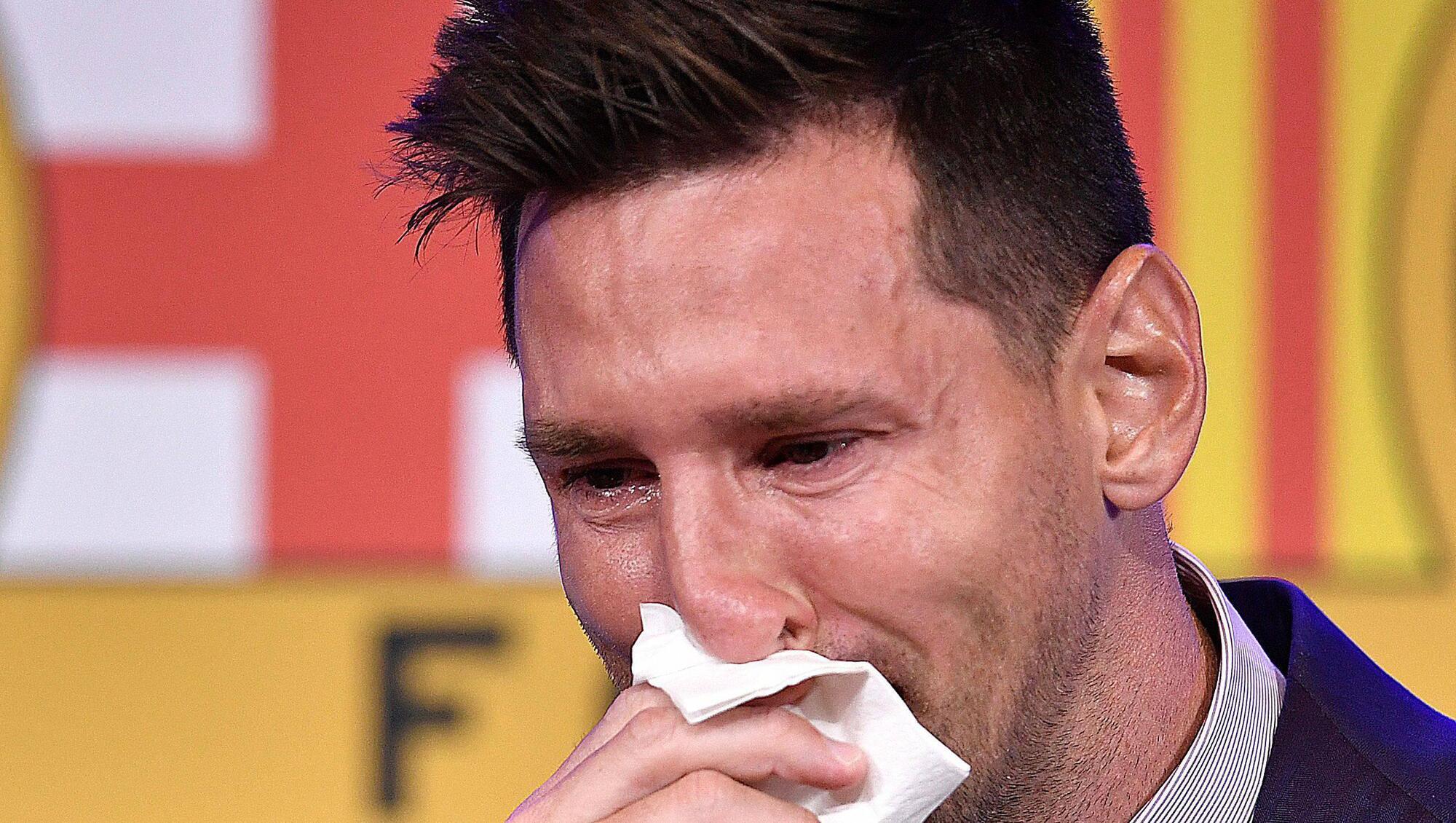
SAD GOODBYE: Lionel Messi cries at the start of a press conference at the Camp Nou stadium in Barcelona on Sunday. The six-time Ballon d'Or winner Messi had been expected to sign a new five-year deal with Barcelona on August 5 but instead, after 788 games, the club announced he is leaving at the age of 34. Pic: Getty
One couldn’t help thinking of Lionel Messi on Sunday morning, as images of the jubilant scenes from Portland Row in Dublin’s inner city circulated following Kellie Harrington’s gold medal victory in Tokyo.
Harrington, who works on the cleaning staff at St Vincent’s psychiatric hospital in the city, will no doubt receive a hero’s welcome when she flies home next week. Tears of joy will be shed. Murals painted. Girls will watch from their daddy’s shoulders and dream of it being them someday.
Meanwhile, in Barcelona, a soap opera involving the world’s greatest footballer, hundreds of millions of dollars, and a pesky set of financial fair play rules was playing out in front of TV cameras, most of them pointed at an empty podium inside an empty stadium.
Some fans loitered about the Camp Nou, offering their tuppence worth on how they felt about potentially losing a player who had defined a club already steeped in a glorious tradition. Crucially, there were no riots on the streets and no weeping children. Only fatigue and borderline indifference. From everybody.
That was until Messi took to the stage. Dressed in midnight blue, his wife and three children in the front row, the world’s greatest footballer broke down in tears before he even spoke.
There is something jarring about watching a man cry as the eyes of the world are on him — more jarring still to watch him being offered a single tissue from his supportive wife. The tissue seemed as useless as an Oviedo defender trying to stop him scoring. He exhausted every corner of the damned thing. For minutes, he just wept like a kid after losing his favourite Pokémon card.
With no prepared words, he gathered himself and spoke to the media, explaining in a hoarse voice that, despite both the club and himself wanting the same thing, there was no solution. Messi was leaving Barcelona. Despite his willingness to accept a spectacular pay cut, the club could not afford to keep him.
Oddly, there seemed to be no anger, or bitterness, just palpable sadness.
Nor were there any bonfires lit in the 6th Arrondissement, down by Saint-Germain-des-Prés. If Paris is likely one of Messi’s destinations if he actually leaves Barca, I’m guessing Messi’s press conference made little difference to Parisians as they sipped their morning café au laits on the banks of the Seine, reading their copies of Le Journal du Dimanche. In the city of lights, Messi would only be another work of art on display.
Brought there by Qatari money, he would ply his trade like he always has, except this time it would be as if he were hanging in a museum. Ligue 1 is hardly the MLS, but PSG are a behemoth club with a near-monopoly in a league that — with the exception of PSG — is increasingly being stripped of its best players by clubs from wealthier European leagues. We may never find out if he could have done it on a wet Tuesday night in Stoke, but we can be fairly certain he can do it on a Monday night at Metz.
Maybe we won’t care or will not remember next March, as he wins a classic Champions League tie all by himself. Maybe the colour of the jersey he wears and the people who pay his wages don’t matter when it comes to him practising his alchemy.
Prisoners to the moment, it may seem that football finally lost its soul as this love affair dramatically came apart at the seams. Of course, the reality is that its soul was squandered long before Messi took the tissue from his missus.
For all the protestations about the ‘unbelievable turn of events’ at the 11th hour which has forced Messi’s hand, the writing was on the wall for both the player and club for some time.
Barcelona has been on a kamikaze course for years. Messi, who has been there since he was a child, has undoubtedly been aware of where all of this had been headed. Maybe, just maybe, both parties felt La Liga and its ‘financial fair play’ police may turn a blind eye or make an exception because the league would understand the player and club were too big to fail. This gamble, though morally dubious, would hardly have been the most outlandish one, given the selective application of rules and laws across big money sport.
As of noon on Sunday, the gamble hadn’t worked. Whatever your view of Messi’s over-valuation of his own, otherworldly talents, it is ludicrous to say the blame lies with him. Football has been awash with more money than it knows what to do with for decades; why should he, its greatest exponent, play for nothing as some have suggested? Imagine Michaelangelo continuing to paint and sculpt for nothing all because the Medici’s mismanaged their coffers?
Breaking up is never easy. There will be little romance in the next chapter, that is certain. There will be no going south to Sevilla, say, to build something. There will be no standing ovation as he leaves the Nou Camp field in rival colours, after breaking Barca hearts with a hat-trick straight from his highlight reel. There will be no late-career conversion into a playmaking left back for Betis. No player-manager role at struggling Alaves.
Messi and Barcelona was the last great love story. The club may have had the financial morals of an alley cat in the last few years but, in an increasingly murky market, it gave the hopeless romantics something to believe in. There will likely never be a club-for-life player again. Jack Grealish did well to get to 25. Messi and Barca were once a lover’s young dream, a couple of fools looking to grow old together, whatever the cost.
That dream is over. Unless…