Michael Moynihan: How did the European Super League fail to follow example of previous breakaway leagues?
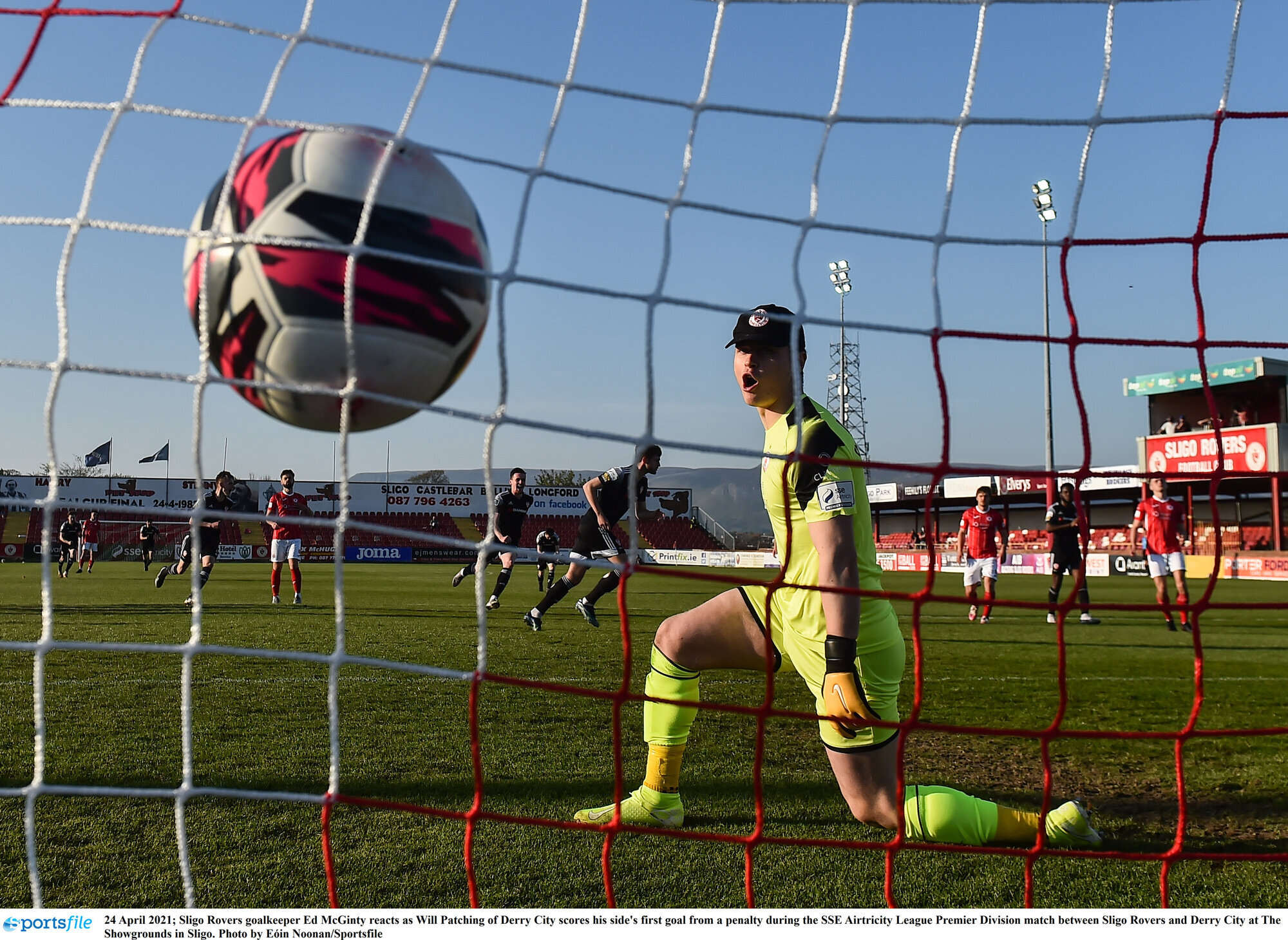
Sligo Rovers goalkeeper Ed McGinty reacts as Derry Cityâs Will Patching reels away after scoring his sideâs winning goal from a penalty during the SSE Airtricity League Premier Division match at The Showgrounds in Sligo at the weekend. Picture: EĂłin Noonan/Sportsfile
The background noise you picked up on last week was a gentle weeping, tears of relief flowing from sports writers, general reporters, political columnists, right reverends and wrong reverends of every stripe.
The gift, however brief, of the European Super League was welcome enough, but the real gratitude was inspired by how unusual the announcement and subsequent flurry of resignations, embarrassments, and announcements were.
For once, here was something everybody could agree on.
The traditional challenge for the professional purveyor of opinions â the viewpoint wranglers, the hot-take jockeys â is to find the other side of the argument. To pick out the angle and the attitude which will yield a different perspective: âWait a second, is the European Super League really a bad idea?â
That kind of thing.
Not here, though. Hence the relief at being able to pile on the opprobrium. Everyone is against it, and as nothing human is alien to me, I too oppose the ESL without the weary business of opposing the prevailing wisdom.
(Weâre a low people. What can I tell you?)
I am not here to locate some good news in the European Super League myself, just to express my surprise that more has not been made of the example of previous breakaway leagues.
The usual namecheck was offered to Kerry Packerâs flying circus â the Australian media mogul organised a separate cricket competition in 1977 to much tut-tutting from the cricket establishment.
(Many thanks to the reader who forwarded on The Cricket War by Gideon Haigh recently, which is a terrific account of the matter.)
Fewer people mentioned the American Basketball Association, a short-lived professional basketball league which was in direct competition with NBA in the States from 1967 to 1976.
The interesting lessons from those leagues include the gradual absorption of the rebel leaguesâ innovations.
For instance, the cricket world learned to live with quite a few of Packerâs innovations: its âcoloured clothing, white balls, floodlights, and innovative television coverage paved the way for one-day cricket as we know it 30 years laterâ, reported the Guardian some years ago.
As for the ABA, one of its most famous ideas was the red-white-and-blue ball, supposedly introduced at the behest of its first commisioner, basketball legend George Mikan. The commissioner was so short-sighted he wanted a ball he could pick out when it arced through the often-smoky stadium interiors.
The NBA looked down on their competitors: âWe thought it was a bunch of guys trying to become pests. I felt, âLet âem rot,ââ was a typically gracious comment from the Boston Celtics boss Red Auerbach. But the three-point line was an ABA invention that crossed over to the NBA, as did its flashier style, as exemplified by great players such as Julius Erving.
Something that both breakaways had in common was the advantage they gave players. Itâs a basic premise of the open market that competition for services gives the service provider an advantage. Cricket and basketball players alike had a choice and, unsurprisingly, tended to go for the best-paid option.
Bear this in mind even as the players of (insert now-disgraced multinational organisation works team here) make their dutiful mouth-noises about the fans; expect a different tune when theyâre included in the financial projections next time round.
(I thought Iâd never hear better, or worse, than a retired Luis Figoâs words of wisdom at the Web Summit a couple of years ago, when he wearily exhaled, âFootball is passionâ, but the last week has offered some competitors).
My last word on this is some free advice for Florentino Perez and his masterminds.
The ABA got a boost when it found out what the NBA was paying its referees â and offered them jobs with the ABA, doubling their wages and improving their conditions. The move simultaneously gave their games credibility and dealt the NBA a serious blow.
The European Super League clearly missed a trick by trumpeting its intentions. All it had to do was ring up a few referees.
Thurles, a multinational town now

Forget the affront to nature that was the European Super League for a few minutes.
We learned during the week about the GAAâs national league fixtures, the exact dates and times for both hurling and football games, with the usual results: this must-see game, that rematch from last yearâs championship, this derby with all the trimmings.
I have to admire the insouciance with which one particular earth-shattering item was dropped into the general announcement, though: the declaration that Semple Stadium in Thurles would serve as a temporary home for the Cork and Dublin footballers because theyâve lost out on a couple of home league games after their lockdown breaches.
All sympathy here to the valiant staff in Tom Sempleâs field. Trying to get some tripe and drisheen ready for the visiting Rebels, but also providing Dessie Farrellâs team with coddle; sticking up the WELCOME TO CORK signs in one dressing-room, then stripping that out for a BOYS IN BLUE poster hours later; and dusting off an old 45 with âThe Banksâ for one side while using the same cloth to wipe down the single version of âDublin in the Rare Oulâ Timesâ.
Weâve all grown accustomed to âunprecedented timesâ as a lazy description of the last year and change, but a temporary declaration of Thurles as alternatively part of Cork and part of Dublin? Thatâs one twist I never saw coming.
The momentum is kicking in now
I detect some conversational patterns coming back in vogue. People mentioning panels and players, and whether this fella will be involved, or whether...
Is it that close to happening? Is there going to be a league and a championship in the GAA?
Part of the enjoyment with every sport â a huge part of it â is the anticipation. Picking through the entrails (figuratively, calm down) of managerial decisions and declarations, and winkling out what the intentions might be for the season ahead. Itâs the same in every sport. Whatâs held back this discussion in GAA terms, though, is the fear of jinxing the whole thing. That a rigorous examination of your countyâs defensive options, or whether thereâs any depth in the midfield, might offend the sporting gods.
But now that a starting point is in sight for the season, people are beginning to chance it: âWhat do you think of your man...â is becoming more popular as a conversation opener.
The momentum canât stop now. Can it?
The dark side of Philip Larkin
Itâs hard to argue against the brilliance of Philip Larkinâs poems. Work like Whitsun Weddings, a stunning read, for instance.
Itâs also hard to argue against Larkin being the kind of dismal excuse for a human being youâd climb out the bathroom window to avoid.
A new book about his long-time partner doesnât contradict that impression. Monica Jones, Philip Larkin and Me: Her Life and Long Loves by John Sutherland details how â among other betrayals â Larkin connived with Kingsley Amis to insert a thinly disguised version of Jones in Amisâs Lucky Jim. She deserved better than Larkinâs vaguely hypnotic creepiness.
Contact: michael.moynihan@examiner.ie