Enda McEvoy: Seldom has failure been so glorious
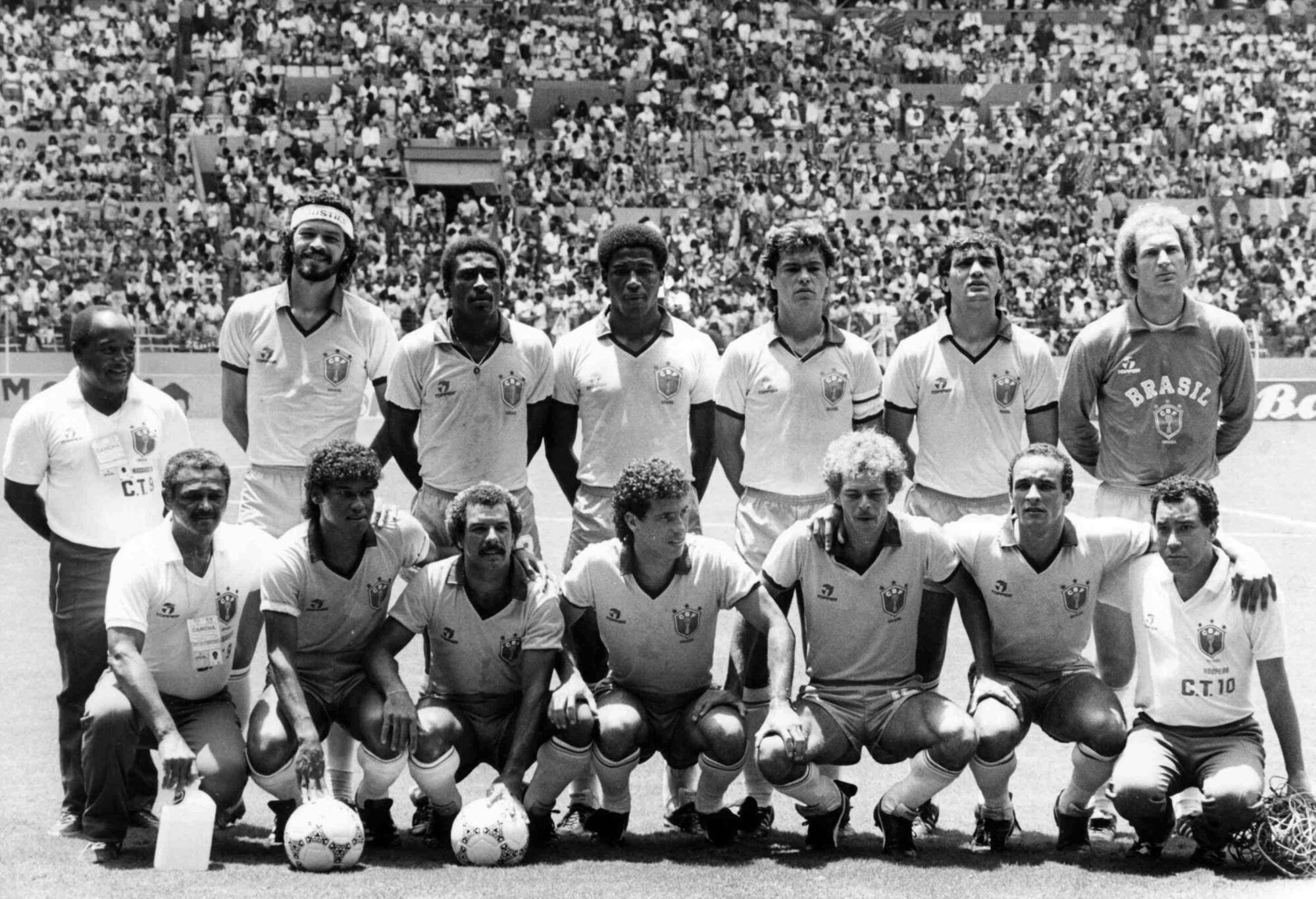
The Brazilian team line up for photographers before their Football World Cup second round match against Poland in Guadalajara, Mexico in this June 1986. File photo
Ireland didn’t make it to Spain for the 1982 World Cup finals, a byzantine story of bad luck and bent officials that’s worthy of a book in itself, but my cousin Liam Ryan did. Well, why not?
There were six of them in it. They were young, they were civil servants in Dublin and they were always listening to the young ones in the office rhapsodising about the delights of package trips to Torremolinos. A lightbulb duly popped.
Why not try a fortnight in Torremolinos themselves and take in the Scotland games in Malaga, 15 minutes up the line on the train? And if they couldn’t source tickets, sure weren’t they on a sun holiday?
On landing in Spain they encountered two hitches. First, the tickets for Scotland’s three fixtures in Group 6 came as a package rather than as singles. No matter, they had sufficient funds. Second, Seville – venue for Scotland versus Brazil – was miles away.
Liam Ryan still groans at the memory 39 years later. “Four hours on a bus. Over a mountain. Over cliffs. Horrendous.”
It was worth it in the end. Pardon the cliché but there really was a carnival atmosphere outside the Estadio Villamarin, and this despite the fact that - per Liam’s calculations - the attendance comprised 60% Spaniards, 30% Scots and only 10% Brazilians.
He inserted himself halfway up the terrace behind the goal Scotland were defending in the first half. With 33 minutes gone Brazil won a free kick on the edge of the area. Zico took it. Over to our man on the spot for what happened next.
“We saw the full banana of the ball after Zico struck it. It was two metres outside the post. Alan Rough didn’t move a muscle. He must have said to himself, ‘That’s never going in.’ Then it came back in, off the inside of the post, into a place you’d have thought it was impossible to put it.”
All of this is apropos of my Christmas reading. 1982 Brazil – The Glorious Failure is the work of a chap called Stuart Horsfield, who as a 10-year-old in Yorkshire was entranced by the men in the canary-yellow shirts and as an adult remained so enraptured that he wrote a book about them.
For the benefit of younger readers, Tele Santana’s Brazil were not unlike Guardiola’s Barcelona except far more exciting. Possession, rather than being an end in itself, was a means to scoring goals, of which they hit 15 in five outings in the 1982 finals.
Most of the goals were merely brilliant. Some were unforgettable. They can all be found on YouTube. Do yourself the obvious favour.
The doomed romantics of Horsefield’s generation can name the players in their sleep. Zico, a classic number 10. The piratically bearded Junior, rampaging forward from left-back. The chain-smoking captain Socrates, subject of a tiresome Irish sporting urban myth. Toninho Cerezo, the heart and lungs of the team. Eder, the winger with the cannon of a left foot.

Sadly they also had Waldir Peres between the sticks (never trust a bald goalie) and the big lummox Serginho at centre-forward. Junior, meanwhile, would prove better at going forward than defending. It finished badly against Italy. Then again, the clue is in the title of the book.
All the more poignant a read in the wake of Paolo Rossi’s passing, The Glorious Failure includes a photo of Zico’s free-kick against Scotland. Obviously you’d have to know him, but visible halfway up the terrace behind poor Alan Rough is, much to his amusement, Liam Ryan.
He’ll always have Seville.
Monday Music Corner (as opposed to Monday Book Corner): I may have come late to the party – certainly far later than her hordes of teen and tweenie fans - but for the past few years I’ve harboured a musical love that dared not speak its name. Well, not until now.
Yes. I adore Taylor Swift.
The bangers! The boyfriends! The break-ups! The biographical bangers about the boyfriends and the break-ups! We Are Never Ever Getting Back Together indeed.
Of late, keen to explore her boundaries, Swift linked up with The National and Bon Iver, two acts beloved by a certain segment of the middle-aged male demographic. With an industriousness that would do justice to the Limerick half-forward line she’s put out not one but two albums – Folklore and Evermore - in recent months.
They’re long. They’re tuneful. They’re mellow. They’re absorbing. Evermore has been on repeat play chez nous for the past three weeks and looks like remaining so.
Tay Tay forevermore!
First complaint about last week’s TG4 documentary on Dawn Run?

The makers could have shown more actual racing footage. It would have been nice, for instance, to witness the mare’s defeat by Sabin Du Loir in what in hindsight was a roaring hot iteration of the Sun Alliance Hurdle. (For six marks, who finished third?) Ditto her triumph in the Irish Champion Hurdle the following season.
Second complaint about the documentary?
There wasn’t one. This was an absorbing tale skilfully told, not least because it alchemised what might have been the story of a horse into a story about humans.
There was Tony Mullins, jocked off his father’s stable star for both the Champion Hurdle and the Gold Cup, wry and engaging, still hurting without being bitter. There was Jonjo O’Neill, the man who took over on Dawn Run, appreciative of his good fortune and philosophical about racing’s vagaries. There was Tony’s brother Tom, chipping in every now and then with his drollery.
All of which leads to a drum your correspondent has been banging for the past ten years. When is someone going to write a book about Dawn Run’s Gold Cup?
Most of the principals are still with us and, as we saw last weekend, both happy to chat and very good at it too. It will not always be this way.
Third to Sabin Du Loir and Dawn Run at Cheltenham in 1983, incidentally? West Tip, winner of the 1986 Grand National. Told you it was a hot race.
Bad enough for an article about soccer movies in one of last week’s newspapers to describe Fever Pitch as a novel.
Far, far worse for it to assert that the Allied POWs in Escape to Victory won the match.
Tsk and tut. As anyone who’s seen the film 20 times will confirm, proceedings were abandoned with the score 4-4.
Now clearly Pele, Michael Caine et al were moral victors, especially after they retrieved a four-goal deficit and Stallone saved that late penalty. But still.
The Pools Panel would definitely have deemed it a draw.