Ciara Griffin: France reload with eye to the future, Ireland aim to frustrate English juggenaut
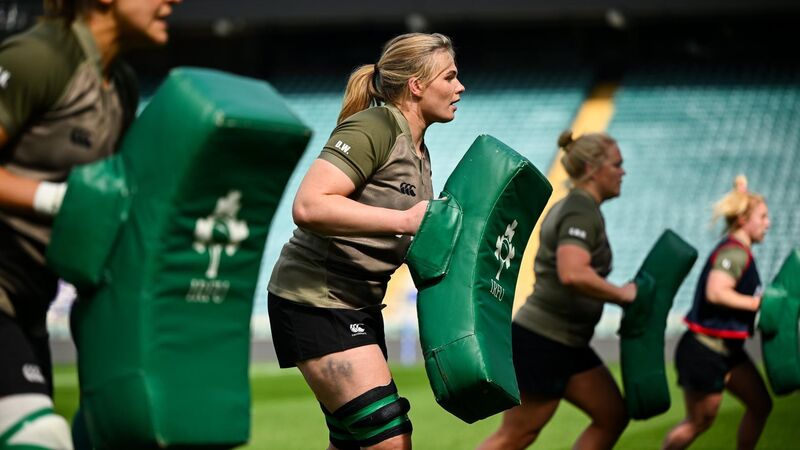
SHOULDER TO SHOULDER: Dorothy Wall, centre, with Erin King, Cliodhna Moloney MacDonald and Neve Jones during an Ireland Women's Rugby captain's run. Pic: Shauna Clinton/Sportsfile.
France’s new head coach, François Ratier, has wasted little time in delivering on his promise to reshape the squad with an eye on the future.
This weekend marks a clear statement of intent, to be title contenders for the Six Nations championship, as a new era begins to take form.
In a bold selection, no fewer than six French players are set to earn their first international caps on Saturday, an unmistakable signal that renewal, not short-term caution, is driving France’s direction.
Despite the bold starting XV, Ratier has reinforced his selection with a powerful 6–2 bench split, stacked with experience in Élisa Riffonneau, Yllana Brosseau, Rose Bernadou, and Charlotte Escudero.
Read More
For this opening test against Italy, France still depends on its leadership. Captain Manae Feleu anchors the side, while the experienced Pauline Bourdon-Sansus directs play from scrum-half alongside Carla Arbez.
In midfield, Gabrielle Vernier brings consistency in her 59th cap, and Axelle Berthoumieu returns, fully reintegrated after a disrupted end to her 2025 World Cup.
Ireland’s Six Nations campaign could hardly begin in more daunting fashion. An opening trip to Twickenham to face reigning world champions England is, on paper, as unforgiving as it gets and the scale of the occasion only sharpens the challenge.
A crowd in excess of 75,000 will pack into what has become a fortress, a venue where the Red Roses last celebrated their coronation as global champions. This, in many ways, feels like a homecoming.
England will treat this curtain-raiser as more than just a first fixture. Under new captain Meg Jones, there is a clear intent to reassert dominance early, to set the tone for the championship and underline their evolution.
This is a side not content with past success, they are looking to raise their ceiling again with a squad goal to win all their matches in 2026.
Ireland, however, arrive with edge and motivation of their own. The memory of a World Cup exit to France clouded by controversy still lingers, and it has clearly fuelled a response within the camp.
The messaging has been consistent from players, a commitment to more ambitious, phase-based rugby, and a belief that they can test top-tier opposition.
There is also a sense of occasion within the Irish ranks. Erin King not only captains the side for the first time, a defining step in her leadership journey, but also marks her long-awaited return after the serious knee injury she suffered in this very fixture last year. It adds an emotional edge to an already significant moment.
Alongside her, Cliodhna Moloney-MacDonald reaches the milestone of 50 international caps, bringing experience and composure to the occasion, while the squad is further strengthened by the return of Dorothy Wall following her recovery from an achilles injury.
Head coach Scott Bemand has opted for power and intent in selection, particularly in a back row that could prove pivotal.
The combination of Hogan, King, and Wafer is dynamic and confrontational, built to disrupt. Their primary task will be to slow England’s breakdown ball, an area where the Red Roses thrive. Denying quick ruck speed is essential if Ireland are to blunt England’s attacking rhythm.
Defensively, discipline and structure will be non-negotiable. England’s offloading game can quickly fracture defensive lines, and Ireland must show urgency on the edge to contain the threats posed by players like Kildunne and Breach, both capable of turning half-chances into decisive breaks.
For Ireland, success will not necessarily be defined by dominance, but by control. If they can frustrate England at the breakdown, force them into multiple phases, and disrupt their flow, they give themselves a foothold. Equally, efficiency in the green zone entries into the English 22 metre will be crucial. Points must follow pressure, otherwise, the gap will widen quickly.
It is a formidable task, but it is also an opportunity for Ireland to test their growth, their resilience, and their ability to translate intent into execution against the very best.
Wales enter their opening home fixture against Scotland under sharp scrutiny. Playing at home brings expectation as much as advantage, and there is a clear sense that an opening win is necessary. Recent inconsistency has left questions around their ability to close out tight contests, and this is an early opportunity to reset the narrative. The physical edge of their pack spear headed by Pyrs and Tuipulotu along with territorial kicking game of George should give them a strong platform, but accuracy will be key.
Scotland arrive with quiet confidence under new head coach Sione Fukofuka. Their attacking structure has evolved, with a willingness to move the ball and challenge defences in the wider channels. If they can generate quick ruck speed, they have the tools to test Wales’ defensive organisation.
Wales will look to impose themselves early, while Scotland may be content to absorb pressure and strike with precision on the counter attack with the interlinking play of Lloyd and Rollie.