Christy O'Connor Talking Points: Ulster drama rarely the same when exported
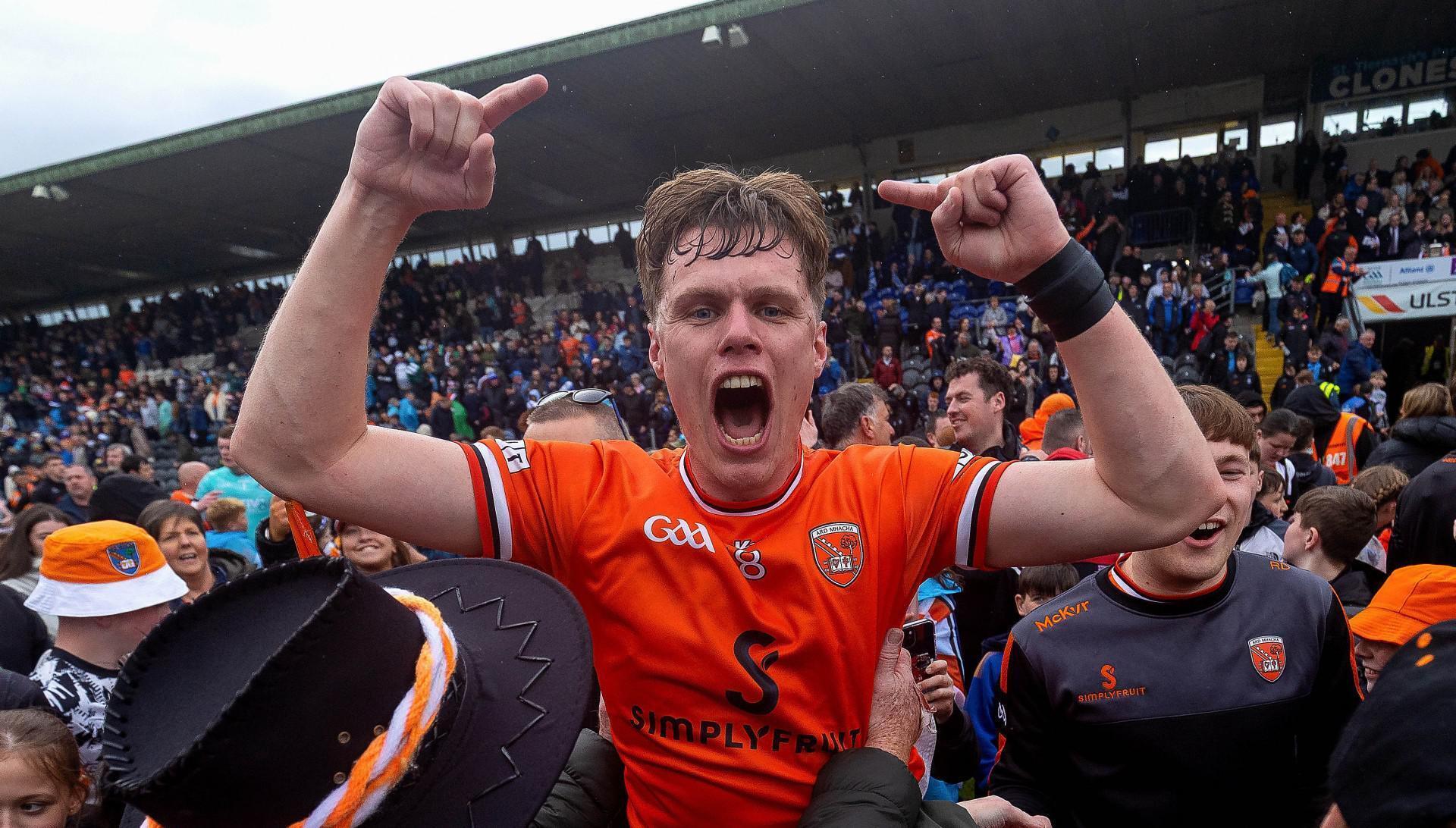
Armagh's Oisin O'Neill celebrates. Pic: ©INPHO/Tom O'Hanlon.

The first warning signs of what was the come arrived as early as the seventh minute of the 2024 Armagh-Derry All-Ireland series group game when Oisin Conaty fired a rocket past Odhran Lynch. The ball cracked off the underside of the crossbar and bounced away to safety. But it was only delaying the inevitable for Derry.
Six minutes later, Ross McQuillan drilled the ball past Lynch. Armagh had their second goal shortly afterwards from Conor Turbitt.
Armagh could have had another couple of goals before the break before Rian O’Neill got their third in the 53rd minute. Armagh won pulling up.
Derry were only a shell of the side that had beaten Armagh on penalties in the previous year’s Ulster final, but the lack of jeopardy contributed to the anaemia of Derry’s performance.
Despite losing their opening two group matches to Galway and Armagh, Derry knew that a win against Westmeath in round 3 would see them qualify. And that’s exactly what happened.
That Armagh-Derry game certainly didn’t feel like an Ulster clash.
Read More
In the history of the All-Ireland qualifiers, Super 8s round robin format, and the current system, there have been 64 games involving Ulster teams meeting outside of the Ulster Championship.
Yet only 24 of those matches were decided by one score. Would that data correlate in the Ulster Championship? Highly unlikely.
Thirteen of those games were decided by one point, but 26 were won by margins of six points or more - 41%. Those numbers are surprising but, while the Ulster championship has always been claustrophobic and tense, there hasn’t been those same vibes when Ulster sides meet each other outside of the provincial championship.
Last year’s numbers were mixed. In the group stages, Tyrone edged Donegal by three points, Armagh beat Derry by four, while Monaghan overcame Down by the same margin. Yet Donegal and Tyrone whacked Cavan by 19 and 13 points respectively. Monaghan looked to have Donegal in a bind at half-time of their All-Ireland quarter-final last June but Donegal outscored their opponents by 1-15 to 0-5 in the second half.
The Ulster Championship never seemed made for export, especially when it was essentially a series of localised arguments soaked in sulphur, capable of combusting and igniting at any second.
Moving the stage, where Ulster teams could regularly meet in the All-Ireland series, always risked diluting the show’s appeal. But the competitiveness of the province still made those fixtures highly attractive. The appeal was all the greater again in those early qualifier days because the stakes increased in tandem with Ulster’s status and profile.
Armagh and Tyrone produced their two greatest teams at the same time. The 2003 All-Ireland final was the first time two counties from the same province met on that stage. The 2005 Armagh-Tyrone All-Ireland semi-final was one of the greatest games ever played. In a golden era for Ulster football, big local clashes outside the province were inevitable.
Armagh and Donegal played Ulster finals in Croke Park in 2004 and 2006 but their biggest meeting was the 2003 All-Ireland semi-final. Fermanagh’s greatest day was their All-Ireland quarter-final victory against Armagh in 2004. In their previous qualifier game, Fermanagh edged past Donegal by one point.
Brendan Devenney was sent off for Donegal that day. He subsequently received a 24-week ban for pushing the referee in frustration. Early the following year, Devenney outlined his disillusionment with Ulster football. “You go up to Clones and can feel the hatred,” he said. “It’s a much friendlier vibe in the qualifiers.”
Meeting another Ulster side in a different setting did nothing to diffuse those neighbourly hostilities, but the emotional investment was different up to a certain point. The qualifiers didn’t have anything like the same long run as Ulster where teams were eyeing each other up for seven to eight months. Some of those all-Ulster qualifier clashes felt more subdued compared to the fire of Ulster. But it ramped up whenever Ulster sides met later in the summer.
There were other times when hostilities seemed less intense, less claustrophobic outside of Ulster. In 2009, Derry edged past Monaghan in a low-scoring Ulster quarter-final dog-fight. A few weeks later they played out a classic qualifier with 39 scores.
Meeting outside Ulster didn’t reduce the importance of those clashes but they certainly took the edge off them. In time, that stress and tension was decreased by status and circumstance. When Armagh and Tyrone met in a 2014 qualifier, it was a marquee game in all but name. When the sides met again in the 2017 All-Ireland quarter-final, Tyrone whacked Armagh by 18 points, which was Tyrone’s biggest championship win against their rivals.
Two years later, the Malachy O’Rourke era with Monaghan ended in a low-key derby qualifier defeat to Armagh in Clones. Monaghan had narrowly lost the previous year’s All-Ireland semi-final to Tyrone, but that defeat to Armagh barely even registered outside the two counties.
The introduction of the round robin in 2023 further reduced the appeal of Ulster sides meeting outside the province because none of those clashes carried that whiff of sulphur associated with an Ulster championship match. They couldn’t when the same jeopardy didn’t exist.
There is a second chance for whoever loses the Armagh-Derry clash in the Athletic Grounds tomorrow but less jeopardy in the new system has smothered the match in far more anticipation than last year’s round robin meeting.
It's not an Ulster championship meeting. But the new system makes it feel more like one.
Before they faced Dublin in the Leinster semi-final four weeks ago, Louth found themselves in a rarified space against the Dubs – fancied to win. Louth were the reigning Leinster champions and in good form, whereas Dublin looked in a heap. Relegated from Division 1, the Dubs just fell over the line against Wicklow, while they’d lost their manager, Ger Brennan, to suspension, and were without their best player, Con O’Callaghan.
The whole tone of the relationship appeared to have changed, but Dublin showed that it hadn’t. The comprehensive manner of their 10-point win in the circumstances was Dublin’s way of reminding Louth of their place in the relationship; Dublin’s average winning margin against Louth in their previous five championship matches remained just north of 15 points.
The defeat also extended Louth’s wait for a championship win against the Dubs to 53 years. Since Louth’s last win against their neighbours in the 1973 Leinster Championship after a replay in Navan, they have failed to beat the Dubs in 17 matches. The closest Louth came to the Dubs in that time was in 1992 when they got to within three points in a Leinster semi-final in Croke Park.
In 1975 and 2024, Louth only had to wait a year to try and make up for that disappointment of losing a championship match to Dublin. But they’ve only had to wait a month to try and seek atonement now.
“We talked prior to this game about trying to close gaps,” said Louth manager Gavin Devlin after that game in early May. “Whatever about today, we'll have another opportunity to see if we can close those gaps.”
They found out a few days later that the chance against Dublin would come sooner than expected, but Sunday is a glorious opportunity for Louth on multiple counts. As well as trying to win a first championship game against the Dubs in over half a century, Louth also have the chance to subject Dublin to successive championship defeats in the same season for the first time in their history.