Christy O'Connor's talking points: When O'Donnell turns up, he always turns it on
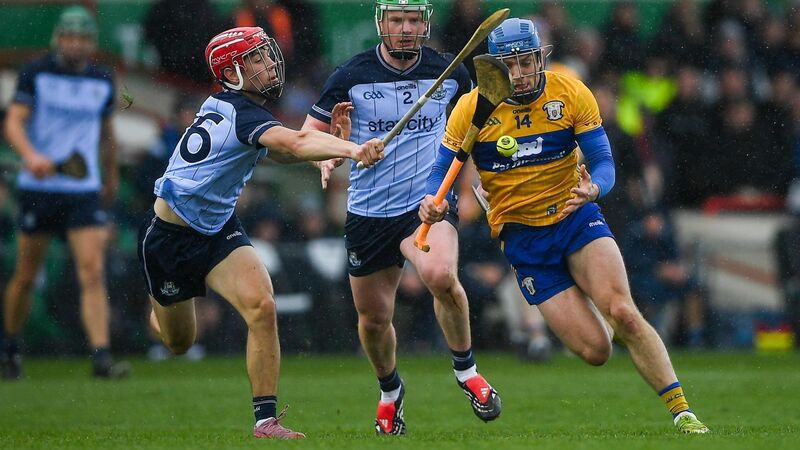
NO ONE LIKE HIM: Shane O'Donnell of Clare in action against Conor Groarke of Dublin during the Allianz Hurling League Division 1B final match between Clare and Dublin at TUS Gaelic Grounds in Limerick. Photo by John Sheridan/Sportsfile
When Shane O’Donnell was introduced in the 45th minute of the Clare-Tipperary championship match last May, the roof nearly blew off the Cusack Park stand. Three months earlier, O’Donnell’s season had been written off after undergoing surgery for a serious shoulder injury. The news was like a bombshell around the county. It was even more personally devastating because O’Donnell had planned the 2025 season to be his last with Clare.
The initial time-frame of recovery was six months but O’Donnell was already passing key markers after six weeks. After 12 weeks, O’Donnell felt he could knock two months off the initial target of return to play. By late March, he felt he could make it back for the latter stages of the Munster championship. That charge just needed to be expedited because of the perilous position Clare found themselves before Round 3 against Tipperary when their season was on the line.
O’Donnell went into that game having literally done no training. He hadn’t trained with the group once. The first time he pucked a ball was a few days before the game. O’Donnell wasn’t concerned. He had mentally prepared to do something. He felt he could contribute. And he did.
Within a minute of being introduced, O’Donnell had climbed into the clouds to secure a puckout and win a free. His priceless capacity to win possession under all kinds of duress has always been one of O’Donnell’s strongest weapons but raw willpower and mental strength loaded the chamber that evening.
It was the most graphic illustration of how O’Donnell has been consistently able to perform at an elite level without anything like the same preparation deemed required to operate at that level O’Donnell consistently does.
O’Donnell first saw the benefits of that approach in 2019 when missing the whole league while in Harvard University on a Fullbright scholarship. Then a serious concussion injury in 2021 completely altered his approach, which saw O’Donnell focus more on gym work and individual training during the spring. And that effectively meant him writing off league games.
He didn’t play in the league in 2022 and 2023, while his only league game in 2024 was the second half of the final against Kilkenny. He did play 13 minutes against Antrim back in February – which was unusual for him – but yesterday was the first league game O’Donnell had started since Clare beat Dublin in round 4 of the 2021 campaign.
That approach has served O’Donnell well. He has been in the form of his life since 2022, while O’Donnell also feels that template has prolonged his career. And yesterday again provided more evidence of how O’Donnell is able to just arrive into a big game without effectively having played all season – and look untouchable.
From just seven plays in the first half, O’Donnell scored 1-1, was fouled for three converted frees, had another assist, and set up another scoring chance. For one of those frees, O’Donnell set up Diarmuid Ryan for a goal chance.
O’Donnell did go off at half-time with an injury. That is a slight worry on the eve of the championship but it’s less of a concern when it’s O’Donnell. Because he doesn’t need the same training-time or match-time that everyone else seems to require.
When O’Donnell turns up, he always turns it on.
When Limerick dominated Cork in the championship between 2021-23, defeating them in four successive matches by an aggregate margin of 36 points, Limerick controlled every term and condition that mattered in those matches.
Limerick physically bossed the contest to such an overwhelming degree, especially in 2021 and 2022, that they dominated all the key metrics. The shot count was always top of that list but it had to be when it governed so much of Limerick’s template.
Under Pat Ryan though, Cork developed a formula that worked against Limerick; keep the ball out of their hands; keep the pace up; don’t risk turnovers by engaging in too much intricate or short passing; reset quickly on Nickie Quaid’s puckouts; deliver their own puckouts at a lightning pace before Limerick could get defensively set. And keep shooting.
In the three big championship matches that Cork have beaten Limerick in the last two years, they got off more shots in two of those matches. Cork got off one less shot in the 2024 All-Ireland semi-final (49-50) but their shot count was still way higher than Limerick wanted, or needed, it to be. Because rampant gunslinging was always going to suit Cork more.
Puckouts became another huge issue for Limerick, especially the Cork restart. In the 2024 Munster round robin, Cork dismantled the Limerick half-back line in the air, mining 3-15 off their own puckout, with 3-10 from long puckouts. When Cork beat them in Croke Park later that summer in the All-Ireland semi-final, Limerick could never get control on restarts again; Cork scored 1-18 from puckouts; 31 of their 49 shots were sourced from restarts.
Cork weren’t as effective off their own puckout in last year’s Munster final but the Cork half-forward line disorientated the Limerick half-back line from their constant rotation.
That was a consistent systems failure for Limerick, but those areas were emphatically addressed yesterday. The Limerick half-back line were totally dominant. The Cork half-forward line were completely ineffective. Cork did get 0-10 off their own restarts but Limerick sourced 1-6 off Patrick Collins’ puckouts.
The shot count numbers were also radically turned on its head. That was evident in the first quarter when the shot count was 17-4. Limerick had 1-12 on the board inside 21 minutes. They only scored 0-1 for the remainder of the half but they still only had one less shot than Cork in that period.
By the end of the match, Limerick had 17 more shots. Limerick’s golden number around their shot count is 50 - it was 46 here. It may still only be the league but Limerick were still keen to turn recent statistical trends back in their favour.
And they certainly did yesterday.
In the 11th minute of last year’s Cork county final, Sarsfields’ Donal English had possession in the full-back line. With the Sars defence appearing to be in control of the play, goalkeeper Ben Graham moved away from the goal to receive an anticipated switch pass. Except English lost possession and Midleton’s Evan McGrath scooped up the loose sliotar and hit it into an empty net.
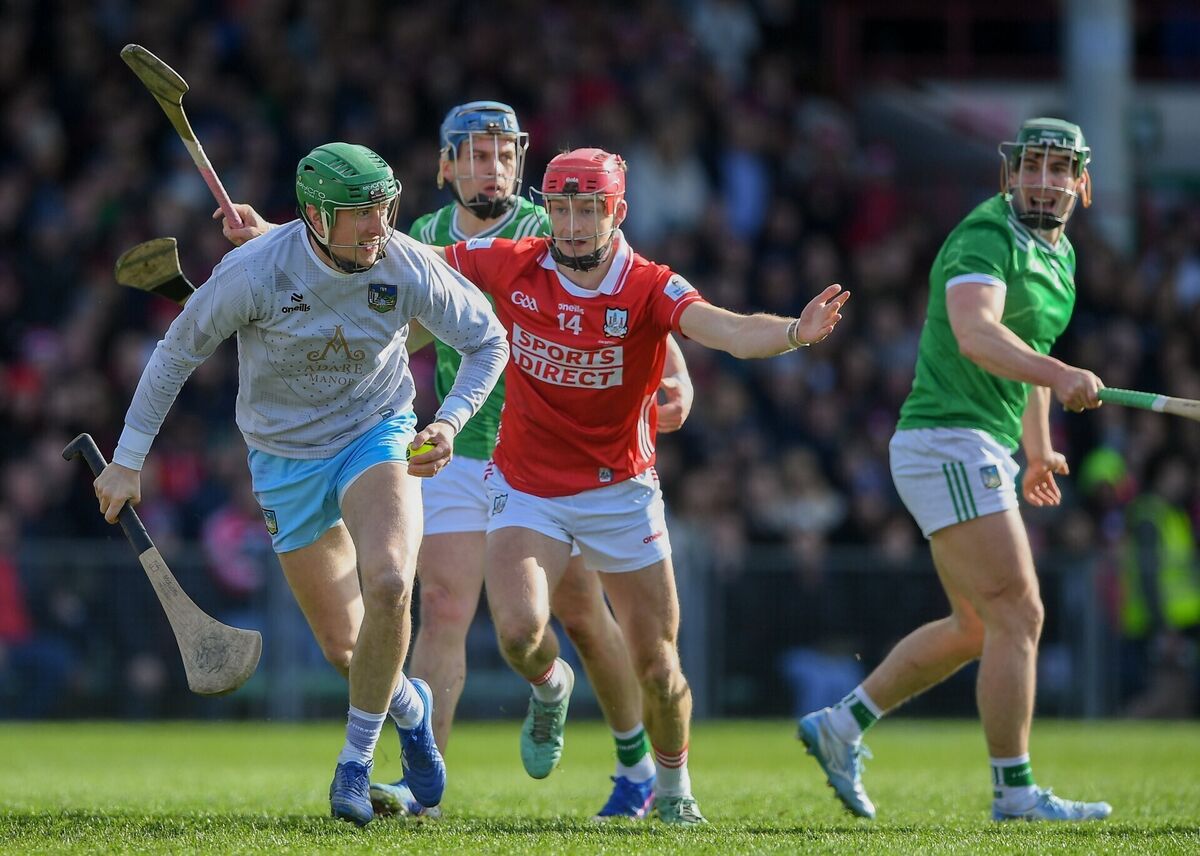
There were shades of that yesterday in the Gaelic Grounds when Nickie Quaid moved away from the goal to take a cross-field pass from Diarmaid Byrnes close to the endline. Except Byrnes didn’t strike the ball cleanly, or high enough, and Brian Hayes batted it into an empty net.
It was a complete gift, just like the Midleton goal had been last October, but that is the risk goalkeepers often take now to be an out-ball option. Why do they take that chance and leave the goal wide open? As well as taking the heat off a defence under pressure, a goalkeeper can be a highly creative attacking influence, especially when the play is switched and that channel is wide open.
Quaid thought it would be but Byrnes just didn’t strike the ball like he needed to. Will that place goalkeepers more on guard heading into the championship? Will they be less inclined to leave their goal wide open? Maybe, but only slightly. Because it certainly won’t alter the principle of what goalkeepers are trying to do.
It's defenders that will need to be more sure, and secure, in that position.