John Fogarty: The power and problems of a crowd
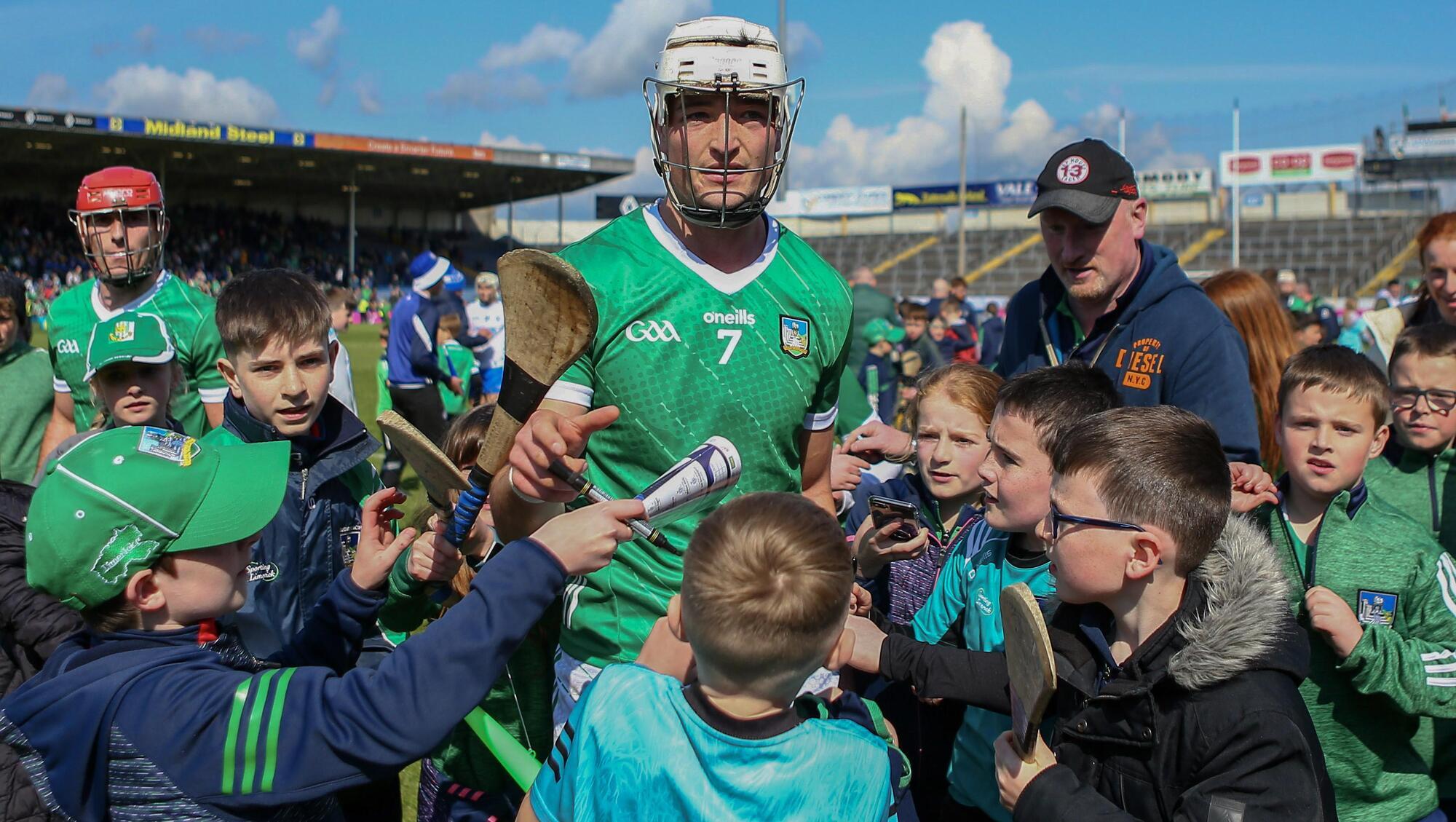
GENERATION GAME: Kyle Hayes is surrounded by young Limerick supporters after Sunday’s win over Waterford. Pic: INPHO/Ken Sutton

Difficult as it is to believe looking out upon the green legions from the Kinane Stand gantry as they outnumbered Waterford’s diehards 10 to one but there was a time when John Kiely looked upon elements of the Limerick support as a hindrance.
In his second ever game as senior manager in 2017 with a team featuring just three starters from this past Sunday, Cork cut Limerick open for seven goals in the province’s pre-season competition.
The remarks that came down from the Mick Mackey Stand that January day was excoriating.
Kiely recalled weeks later: “That day against Cork in the Munster League, there were quite a number of people in the crowd who were extremely abusive and it was not at all appropriate that players be treated like that on the day, given the amount of time and effort and work they put into preparing themselves on the pitch, and off the pitch.
“That is not something we would like to see again. We have an awful lot of decent people involved in hurling in Limerick, and if they are people out there that aren’t behind the team, we would rather they stayed away.”
Shane Dowling had said something similar about some Limerick fans in 2013 but the group have had no reason to say a hard word about them since Kiely’s first year in charge.
Success has obviously helped but Limerick fans, as miffed as they might be at times, are known to follow through thick and thin.
The same can’t be said or at least no longer be mentioned of other counties, including Waterford.
As it was in the Gaelic Grounds last year when they were coming off the back of a Division 1 title and an opening Munster win over Tipperary, they were conspicuous by their absence. It prompted then manager Liam Cahill to call on their support for the following game against Cork.
“If I’m being really honest, I thought there’d be more of them there. When we came in on the bus, the colour just wasn’t there and we kind of had a feeling that the Waterford people didn’t travel...”
The same question about the lack of backing was put to Cahill’s successor Davy Fitzgerald on Sunday but he kicked for touch.
“I am extremely proud of who was there today. Might have been outnumbered but they gave everything they could today,” he said.
Nevertheless, the Waterford management had prepared their players for the small support numbers.
Selector Peter Queally had spoken in the build-up of the negativity in the county, of being written off by their own, and so it transpired.
Their performance should convince a bigger party to travel to Cork on Sunday but it was the county who let down the team this past weekend, not the other way around as was the case in Ennis last year.
Of course, it’s a trust issue but abandoning a team who were so in need of a jolt in the closing stages in Thurles didn’t say much about their loyalties. Instead, the vacuum was filled by Limerick screams for Liam Gordon to make calls in the favour of the men in green, indignation at Waterford winning frees, there were whistles for the game to be blown up.
Leading by four points at half-time, their jeering and booing of the referee as he made his way off the pitch was extraordinary.
Was it just a coincidence Stephen Bennett, who converted all but one free, stood over less placed balls in the second half?
Limerick made Waterford’s “home” their own and played a pivotal part in rousing their team when Gearóid Hegarty was sent off.
The delay that came after his dismissal certainly allowed Limerick’s management the time to compensate for his departure but soon after it resumed, their flock’s voices rose as if aware of their heightened responsibility.
There are some drawbacks to a fanatical following, 3,500 of which are season ticket holders, the largest in hurling.
Listening to the applause that greeted some of their players being replaced, you would swear the game was won long before it was.
And when Kiely speaks of his team being subjected to a “softening-up exercise”, he must also consider how much his own people have become too used to a good thing.
Unlike some pundits, as Kiely claims, they may not wish to fatten their team with flattery but the worth they place on their beloved team can have that effect. Their hype machine is hybrid, self-sustaining as it is fuelled by podcasts and whatnot.
Naming his strongest team possible, Kiely most certainly was expecting a contest against Waterford, much more than what one of his predecessors told Fitzgerald a couple of weeks before the game.
But as Kiely noted, there is only so much he can control.
Likewise, Fitzgerald can only ask Waterford people to abide by this team. Mo’ or no fanfare, mo’ problems.
This day next week, The Dillon Quirke Foundation launches its fundraising drive in the Clonoulty-Rossmore GAA Grounds named after the late Tipperary hurler.
In association with the Circet All-Ireland GAA Golf Challenge, a host of inter-county hurling managers are due to attend on the morning to lend support as the foundation looks for GAA clubs and individuals to each contribute €100 towards its objective of providing cardiac screening across the organisation for all over the age of 12.
As noble an endeavour in the GAA as there can be. May 2 also marks the draw for the Sam Maguire Cup with the Connacht and Munster winners set to begin their campaigns on the weekend of May 20/21, while the Leinster and Ulster champions commence their groups six or seven days later. The reason for that is as the Leinster and Ulster championships take longer to complete, they can’t all start at the same time.
The consequential problem is the finalists in Leinster and Ulster will only have one week between their first and second-round games while Connacht and Munster have a fortnight. Fair it isn’t but the GAA have confirmed this will be the case for the foreseeable future if the provincial calendars remain the same.
So, for all the hopes Kerry would be kept more honest by having to play at least another three championship games to win the Sam Maguire Cup, the structure favours them both outside as well as inside the provincial competition.
Neither is it equitable that Mayo, Tyrone, and Roscommon have at least six, five, and four weeks to prepare for the Sam Maguire Cup respectively but this is the difficulty in marrying provincial championships with the league as qualification avenues.
It bears repeating that this new championship format is imperfect in many facets but until people accept provincial championships are withering it’s the compromise that has to be grinned and bared.
“We’re in the Tailteann Cup and we will embrace the challenge of it,” insisted Colm O’Rourke after Meath’s loss to Offaly on Sunday.
“We are where we deserve to be. We’re not going to make any excuses. Just because we had great teams in the past doesn’t give us any right to be in the championship this year.”
A frank assessment of his team’s difficulties, the proof of his and Meath’s attitude to the secondary championship will come on May 13/14 when they start in the competition as first seeds in Páirc Tailteann.
O’Rourke has been a champion of the tiered structure. Last year, he hailed it as a success, saying: “The Tailteann Cup is a competition I’ve always wanted to see in the GAA. I thought it could have had a bit better promotion but the players and counties have embraced it.”
Can he hang on to all of his panel is the question. The rules about heading to play in the US have been sharpened and students still have exams so he should be able to retain enough. Perhaps he can sell it on the carrot that’s there for the winners, automatic qualification for next year’s Sam Maguire Cup.
It could also be the perfect environment for Meath to distill a game-plan that doesn’t break down as easily as it has since the middle of February.
But if Meath think for one second that they are too good playing Division 4 teams, then they are in for a rude awakening.