John Fogarty: Hurling happy to be a distraction to World Cup
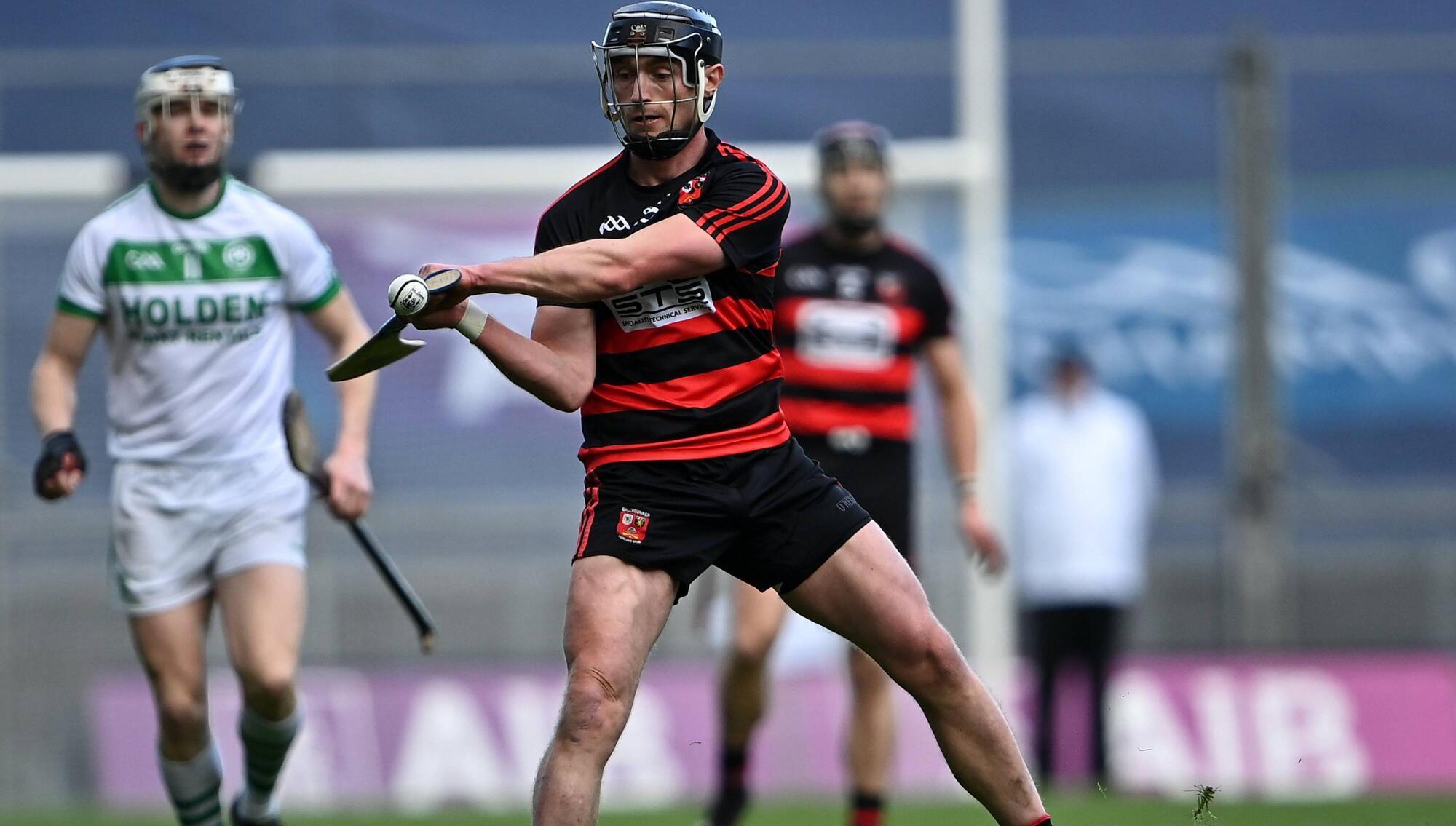
CLASH: Ballygunner’s Pauric Mahony gets his shot away against Shamrocks in last season’s All-Ireland club final. The pair’s semi-final meeting on Sunday clashes with the World Cup final. Pic: Piaras Ó Mídheach/Sportsfile

“Will Fifa reschedule?” was the tongue-in-cheek response of Nemeton chief executive Irial Mac Murchú to the news that the GAA had fixed the Ballygunner-Ballyhale Shamrocks All-Ireland Club SHC semi-final for 3.30pm this Sunday, 30 minutes after the World Cup final has kicked off in Qatar.
Clearly, Nemeton, who produce TG4’s live GAA coverage, have no problem with the clash. Certainly, the clubs don’t either. As a leading official in one of the clubs messaged, “The funny thing is we’re not playing in a World Cup.”
The potential clash with the goings-on in Doha had been flagged a couple of months but the provinces didn’t seem to be bothered. Like the football semi-finals, there was an offer to switch them to January but there were no takers. And so the GAA are being condemned for supposedly shooting themselves in the foot. For doing what they should be doing, which is facilitating their units. Like it did in 2007 when it brought forward Allianz League and All-Ireland club championship games a day earlier so as not to coincide with the first ever rugby game in Croke Park, the Six Nations Round 2 game between Ireland and France on Sunday, February 11.
“Croke Park doesn’t have the right to change times and dates of games,” said then GAA media relations officer Feargal McGill, now the association’s director of club, player, and games administration. “It’s simply a general wish by counties and clubs that their matches be played earlier and on Saturday to avoid a clash.”
Recognising the historical significance of the day and that the GAA had skin in the game by hosting the match, counties and clubs switched. That wasn’t the case four years later when the same two countries marked the opening of the new Lansdowne Road as the Allianz Hurling League was getting up and running for the year.
“Our policy over the years has been that if two counties agree to change a fixture, we’ll facilitate that in most cases,” explained McGill about the likes of Cork and Offaly and Galway and Wexford not willing to shift from the February 13 date.
In 2012, the GAA again stuck to their guns and organised nine football league games and an interprovincial hurling final as Ireland and France met in a rearranged Six Nations fixture in Paris on March 4.
“The rugby game might have some effect but the impact can be overplayed,” McGill remarked. “People have interests in several sports in the modern world and a GAA fan can’t be seen as just a GAA fan. But certain occasions like World Cups and European championships can have an effect on crowds at GAA games.”
McGill was referring to how Ireland’s involvement in the 1994 and 2002 World Cups impacted on Ulster SFC attendances, but in the context of next Sunday his point about the GAA fan is more salient. The association doesn’t have exclusive rights to the attention of any follower but neither does something as monumental an event as a World Cup. That has been established by the growing number of people who are watching TV and using the internet at the same time. Second screening, as it pertains to live sport, involves either interacting with the event in a different way or simply being distracted by something else on their smartphone or tablet.
In 2018, simultaneous smartphone internet and TV viewers made up almost 80% of all internet users in the US with only a quarter of “simultaneous users” viewing content related to what is on TV. Decreasing NFL viewing figures in the US has been partly ascribed to the phenomenon. Even for something as immediate and compelling as live sport, commanding the undivided attention of a viewer, even an attendee, is becoming increasingly ambitious. The GAA and RTÉ were given a taste of that this summer when Rory McIlroy’s pursuit of the 150th Open in St Andrew’s was followed keenly on the same afternoon as the July 17 All-Ireland SHC final.
Equally, the conclusion of the past season’s Premier League on May 22 last was of interest to those taking in the Cork-Tipperary final round Munster SHC meeting. This Sunday, 30 minutes will have been played in the Lusail Stadium by the time Liam Gordon throws in the ball between Ballygunner and Shamrocks. That might not be enough time to give them a head start in competing with the flurry of scores in Croke Park but it will be appreciated.
Flippancy aside, as eagerly awaited as the clash between the two clubs is, 17,117 attended their All-Ireland final double-header where Kilmacud Crokes’ participation in the football decider likely drew the largest crowd. Their previous All-Ireland semi-final meeting in Thurles in 2019 drew 3,944 spectators. On Sunday, Croke Park is their world as most sports fans’ eyes are directed elsewhere. But their game can be a welcome distraction to a main event that has already proven a turn-off for ethical reasons.
Instead, he criticised claims doing so would damage rural clubs with humble under-age memberships.
In his annual report, he wrote: “Claims of decoupling damaging the future prospects of the small club simply ring hollow. In fact, as well as reducing dropout, it will increase the chances of players in their 20s and 30s playing for longer with their clubs.”
Whatever the pros and cons of O’Donovan’s argument, nobody can deny his standpoint is genuine and he has given considerable thought to the matter. Having said that, his criticism of the age grades committee’s decision to allow counties not to decouple at U18 providing special conditions have been met was on the weak side.
“I am completely opposed to this,” he said. “Wherever we are with U17 or U18 decoupling, a hybrid mishmash in a county of this complexity is the road to nowhere.”
Before Cork delegates voted this past weekend in favour of a motion calling for the restoration of U18 as minor but with the decoupling of it and senior, O’Donovan had in October proposed the idea of allowing U18 to play adult for one-year only in 2023. Just like the age grades group are hoping to appease counties, O’Donovan had intending doing the same with Cork’s clubs.
With a county bearing a mazy matrix of fixtures, O’Donovan is right to claim putting a hybrid decoupling option would not suit Cork. And yet it clearly would be appropriate for counties who are predominantly single code. O’Donovan has asked them to think of Cork and its position as a fully-fledged dual county where there are fixtures in abundance.
In the GAA’s latest great divide, he probably knows that is wishful thinking.
Not much is thawing right now but relations between the Connacht Council and Mayo County Board seem to have improved if the county’s senior footballers’ recent use of the airdome in Bekan is anything to go by.
That’s not to say there is any preferential treatment shown to Kevin McStay’s training group.
“I think there was maybe an U14 football team in there from Kinvara before we trained — a hurling stronghold down to play an end of season competition, so it’s pulling them in from all over the country,” said Mayo assistant manager Stephen Rochford.
“Last week while we were training on the grass, an Australian Rules or maybe a GAA club in Australia or something with a group in Mayo were also in the facility.
"In fairness to the strong foresight of the Connacht Council, it’s a facility that will provide opportunities not just for Gaelic games but for wider corporate events.”
Following Congress’ staging there last February, GAA president Larry McCarthy was agreeable to more being erected.
“The immediate thing is going to be facilities and if we can get five or six domes around the country, I think that will solve a lot of local issues in that regard,” he said.
After an icy weekend when the dome’s appeal only grew stronger, the argument to follow Connacht’s example strengthens.