John Fogarty: GAA’s disciplinary crackdown is needed
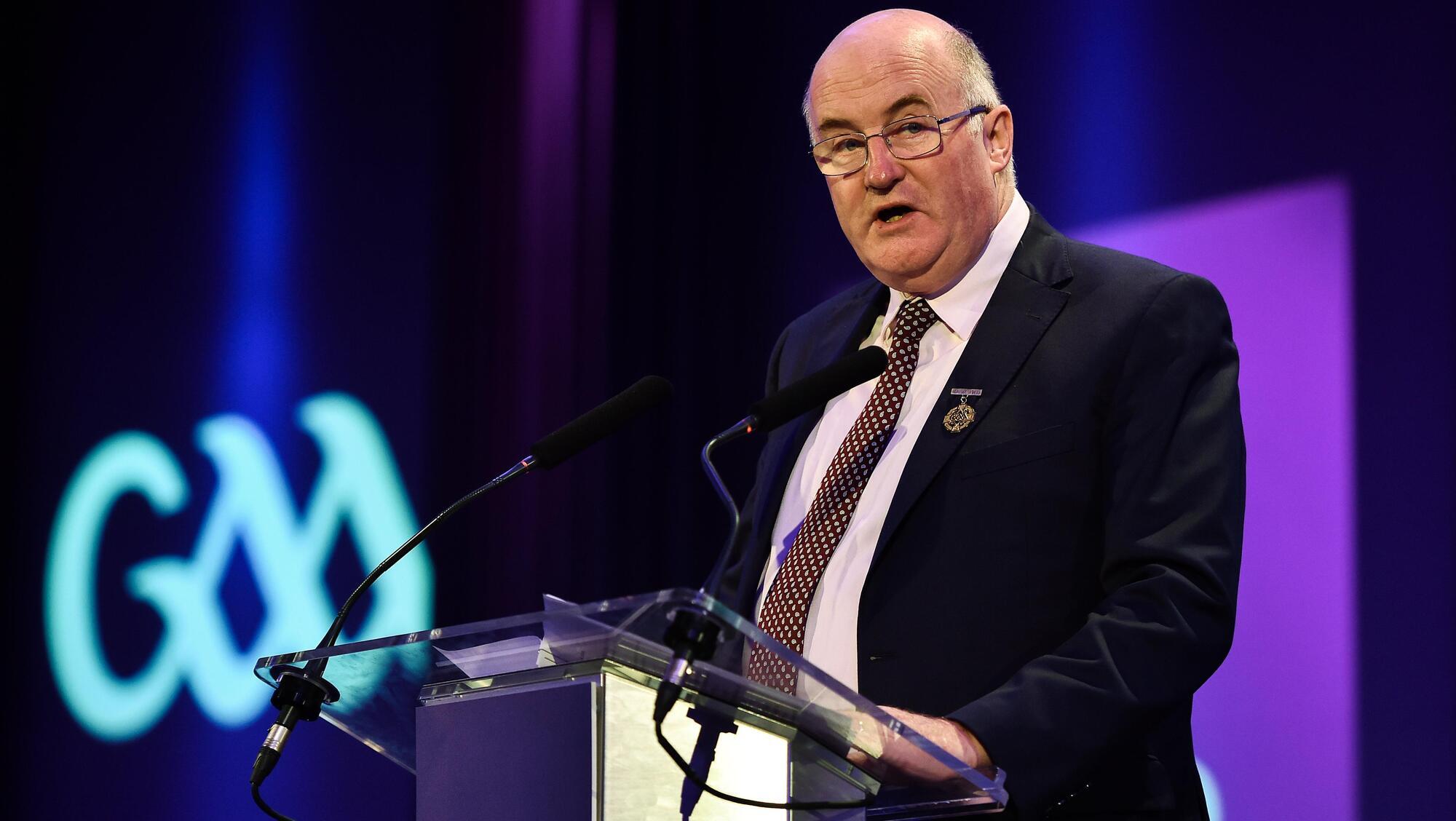
WARNING: Former GAA president John Horan had previously warned counties who broke Covid training bans that secretaries and county chairs could be penalised. This didn’t occur but new powers could see them held accountable for breaches of suspensions by team officials. File pic: Sam Barnes/Sportsfile

After sailing through Central Council last Saturday, the vast majority of the 14 motions put forward by the GAA’s three main disciplinary bodies should be endorsed into rule at Annual Congress in February.
One of the most comprehensive and necessary updates to the GAA Official Guide, it reflects the growing need to fortify order in the wake of violence at games, particularly towards match officials, but also the widespread reluctance to accept punishments.
Here’s a breakdown of the disciplinary crackdown:
The maximum ban that can be issued to an individual to rise from 96 weeks to 240 weeks.
A most welcome increase on the heaviest sanction but proof of the GAA’s wherewithal will be in its application for serious incidents such as referees being assaulted. GAA president Larry McCarthy only recently defended the 96-week maximum.
The minimum penalty available to hearing committee shall be doubled unless the body is satisfied the defending party’s request for a meeting, and their accompanying submission, is “not frivolous or vexatious and is not solely based on procedural or technical arguments”.
Basically, the disciplinary committees are tired of timewasters and those counties who charge solicitors to find loopholes rather than admit that they or their players did wrong. One inter-county football referee this year was asked to provide dozens of clarifications based on his match report. A player facing a sanction still has three opportunities to avoid it, which is more than fair, but the first step now has to be considered carefully.
Penalties for infractions by team officials previously on a match-ban basis to alter to a combination of a time-based suspension and match bans.
Team officials who serve suspensions will not be permitted any communication with their team during a time-based suspension and on match day for a match-based suspension.
Both motions tie in and make sense, although how exactly do they ensure managers stay away from their camps? The three football managers who were suspended for 12 weeks as a result of their teams training during the pandemic restrictions were only prevented from attending games that fell within that timeframe.
Any type of physical interference by a team official towards an opposing player or team official to be upgraded from a Category III (a) infraction to a Category IV (a) infraction (minor physical interference).
A logical move that increases the punishment from a two-game suspension to 12 weeks incorporating a two-game ban.
Penalties for infractions by team officials at under-age games to be doubled.
Rules don’t dictate culture but this one could assist in setting examples.
Penalties for secretary and chairperson of club/county etc for breaches of suspensions by team officials.
Something that echoes a warning GAA president John Horan gave to counties whose teams were found to have breached Covid training bans but ultimately didn’t transpire. Possibly a blow to the cult of the manager.
A Category VI misconduct charge against a player or Category V (a) misconduct charge by a team official at any level (ie striking or attempting to strike, or any type of assault on, a Referee, Umpire, Linesman or Sideline Official) to be heard by the national Central Hearings Committee.
A charge so serious should be dealt with by the highest suitable authority.
Central Council to issue guidelines around the type of clarification that can be sought by the defending party from match officials.
This had been a major bugbear for referees this past year. A defined list of what questions can be asked is necessary.
The hearings committee shall provide a reason if they decide to find an infraction not proven.
More of a clarification than anything else. It’s only right that an explanation is forthcoming with a decision.
The hearings committee to be given the power to send back a case to the relevant committee for re-processing.
The Central Hearings Committee already has this authority but this allows all such bodies to revert a case if the correct breach of rule hasn’t been cited.
The four provincial secretaries to become full members of the CCCC for disciplinary cases.
They have been for fixture-making but this extends their responsibilities.
Hearings and appeals at central level may be heard by a minimum of three members.
As the split season reduces the time between games, the disciplinary system must act accordingly and practically.
Defending parties can request either an in-person hearing or an online hearing.
For the same reason as above, players and team officials deserve a flexible option.
It’s 15 months since UL Wolverines launched their GAA’s first ever Pride jersey with the rainbow colours carried on the trim of their sleeves.
Co-launched by GAA president Larry McCarthy, it was an admirable gesture by the Limerick university club in support of the LGBTQ+ community. Fast forward to last month and Mayo have been told they cannot wear the same colours on their jersey numbers in their forthcoming league Division 1 games as part of their work with charity partner Mindspace Mayo.
Many will ask themselves what exactly the difference between UL’s symbolism and Mayo’s intended gesture is.
Not that the GAA would advertise it as the issue seems miniscule in the grand scheme of things but does part of it come down to the practicality of being able to identify the numbers in question? Might match officials find it more difficult to discern a player’s number is when it is multi-coloured instead of white with a green and red background?
Legible numbers are known to be a problem in GAA. Cork backed a Killeagh motion, which called for numbers to be clearly identifiable with clubs instructed to create a “clean number zone on the back of the jersey” if required.
Whatever the precise reasons for the refusal, it’s important for the GAA that they work with Mayo to allow an alternative gesture of LGBTQ+ solidarity.
As ever, Dublin GAA chief executive John Costello’s annual report issued on Monday raised a number of talking points, not least his views of the new All-Ireland senior football championship to be debuted next season.
A format which is likely to see Dublin play outside Croke Park three times, if not four — Leinster SFC quarter-final, the away and neutral Sam Maguire Cup games and possibly a provincial semi-final — from a total of nine or 10 SFC games if they go all the way, it is tantamount to a league competition. Going back to his report 11 years ago, Costello was in favour of provincial-based conferences with equal numbers of teams and has regularly spoke of the GAA’s need not to get too hung up on history and geography.
Yet, he was clear last year that the provinces couldn’t be done away with quickly.
“For all their limitations, you can’t erase so much history in one fell swoop,” he wrote before adding, “To blithely ignore the wishes of almost the entirety of Ulster would ultimately prove too divisive.”
At the same time, in his latest offering he intimates how much of a turn-off Leinster has become and will be even further in 2023 for Dublin supporters.
“Is there a bigger picture risk that we’ve conceived a competition with too many matches and that fans won’t fully engage until the knockout business begins?” he writes. “And what will the implications be for central coffers? Let’s just watch this space and not rush to judgement.”
Before they reach a Leinster final next year, Dessie Farrell’s side are likely to have 10 games under their belt not having faced genuine All-Ireland contenders. Will the prospect of a 13th consecutive provincial title be enough to attract the average Dublin follower? In the new calendar, the Allianz Football League does look slightly bloated but Costello’s remarks say more about Dublin than anybody else.