John Fogarty: Slogans only go so far, action is needed to protect refs
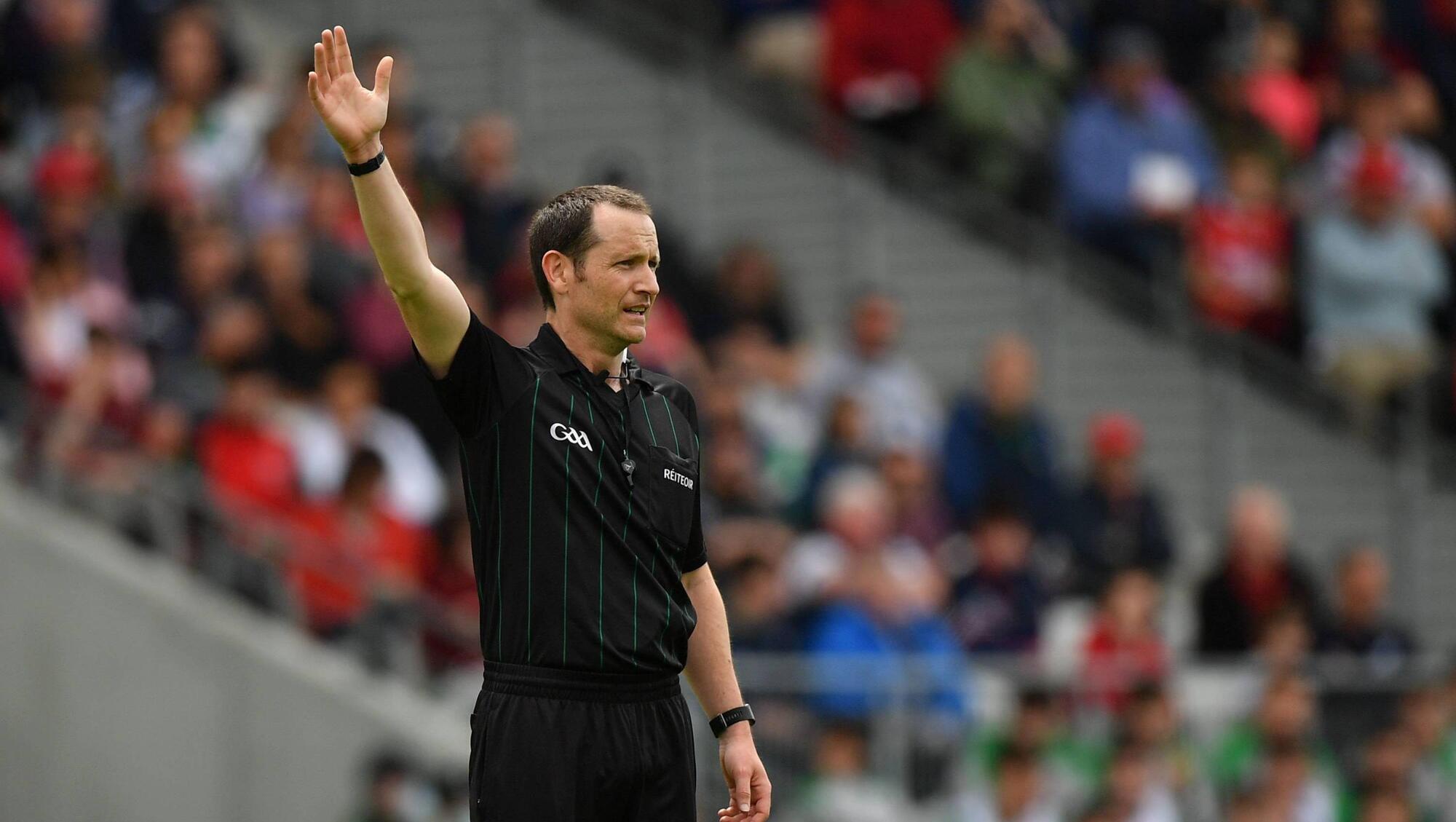
PUSHED: Mayo referee Jerome Henry said he was pushed and shoved after a Connacht club game. Pic: Eóin Noonan/Sportsfile
If what happened in Ballyforan last Wednesday achieves one thing, it is hoped that a critical mass of attacks on referees has been reached so that the GAA finally do something meaningful to counter the malaise.
“Give Respect, Get Respect”, says the GAA’s awarnesss campaign. But top level national officials personally chastising those who fire verbals at match officials and the quite frankly measly investment in the retention and recruitment of referees can and has only gone so far.
Outrage, as common as it is in society these days, dissipates. Twenty-three kilometres up the road from Ballyforan in Dr Hyde Park, the ugliness that transpired in last December’s Connacht SFC club semi-final between Mountbellew/Moylough and Pádraig Pearses should have been the line in the sand. It wasn’t.
Jerome Henry didn’t require an ambulance like Kevin Naughton but he too was shoved and stood on after not giving Barry McHugh an advanced mark (aka the root of all evil) in the closing stages of the game.
“(Named Mountbellew/Moylough player) came up to me, stood on my left foot and shoved me with force on the chest before shouting at me, ‘What the f**k, what the f**k’,” the Mayo referee wrote in his match report.
“I was pushed in the back on two different occasions, but I was unable to identify who pushed me. I was verbally abused by other An Creagán/Maigh Locha players and panel members, but I could not identify who they were exactly.
“When I was in the dressing room with my fellow match officials after the game, linesman Declan Corcoran told me that he had been deliberately shoulder charged by (named Mountbellew/Moylough player).”
Henry was also subjected to intense verbal abuse at the final whistle.
“(Named with jersey numbers) An Creagán/Maigh Locha players surrounded me in a threatening demeanour and were less than 1m from me as they shouted verbal abuse such as, 'You f**king cheat,' 'You’re a f**king p***k', 'Why didn’t you give us the f**king mark’, 'You f**king robbed us you p***k”, ‘What the f**k ref’, ‘You’re a f**king shocking referee’, ‘Do you not know what a f**king mark is’, ‘You are a f**king cheat, nothing else, a f**king cheat’.”
In total, Henry cited two players for assaulting a referee, one of them also for assaulting a linesman. Furthermore, the other was among six Mountbellew/Moylough players who was named as “using abusive conduct to a referee”.
Of those seven mentioned by Henry, six began last Sunday week’s championship win over Salthill-Knocknacarra in Tuam. The two who had been singled out for assaulting Henry and his linesman Corcoran began the game.
After the penalties were proposed by the Connacht Council’s competitions control committee, it was suggested there was one mistaken identity. Mountbellew/Moylough called for a fair hearing. It seemed they received more than that and a much more favourable outcome than what befell Henry.
Assaulting a referee or any match official is a Category VI offence and carries a minimum of a 48-week suspension “in all codes and at all levels with the offender’s team liable to disqualification where appropriate”.
It may not be until the Connacht championship, should Mountbellew/Moylough defend their Galway SFC title, that the “abusive conduct towards a referee” punishments are felt. According to the rulebook, those offences carry 12-week suspensions “in all codes and at all levels together with a two-match suspension in the same code and at the same level, applicable to the next games in the same competition, even if one or both games occur(s) in the following year’s competition”.
Unlike Ballyforan, there is clear video footage of Henry being pushed by two players. That they have been able to contribute handsomely to their club’s 100% start to the Galway senior football championship seems over-generous in the context of their behaviour last winter. But this is the way. Justice is not being seen to be served and so the vicious circle that chewed up and spat out Henry does the same to the likes of Naughton five days ago.
Crime doesn’t pay either. Look at how Roscommon referee Paddy Neilan was subject to what could only be interpreted as an interrogation by a suite of barristers working on behalf of Armagh after he cited three players for contributing to a melee in the final round game against Donegal in Letterkenny in March. Armagh eventually had to face up to some harsh realities but only when they were banged to rights in this year’s All-Ireland quarter-final.
Maybe because they are such experts on how the wind blows, commentators who dismissed claims of referee abuse just days before Henry was attacked last December are now piling on the GAA to do something for the much-maligned, now occasionally assaulted man in black.
But coming to the aid of referees has rarely been fashionable in Gaelic games. If it was, they wouldn’t be such an endangered species.
To move with the times, or the ages of the starlets of the senior inter-county game to be more precise, it has been decided to switch the young footballer and hurler of the year awards from U21 to U22.
In conjunction with the All-Stars, the nominations for both categories will be announced in the coming days and the move to widen the bracket is an attempt to reflect how much later into their 20s players are making their mark at the top level.
It’s not very often that All-Ireland champions have produced Young Player of the Year recipients, you may be surprised to hear. For all their eight seasons as kingpins, Con O’Callaghan in 2017 and Jack McCaffrey in ‘13 were the only two Dublin victors. Outside of them, the last All-Ireland winner/YPOTY was Cork’s Aidan Walsh in 2010.
Limerick didn’t have a nomination last season nor one in 2020 (Tipperary weren’t represented as winners in 2019 either), although Kyle Hayes was the victor in ‘18. His manager John Kiely recently touched on the dwindling number of players able to make their mark coming from U20.
“If you look across all the teams, how many teams are bringing new players into their teams now versus two, three, four, five years ago? I think we’ve seen a cliff-edge in terms of players coming through from U20. It has disappeared.
“We’re all bringing in a few players from 20s in. We’re bringing them in because we need to bring them in. It’s not because we have to bring them in. They’re good players but they have so much development to go through when they come into us, it’s insane. It’s like having your rookies coming out of college. They’re not ready.”
As before, and like the senior individual awards, the nominees will be chosen by the selection committees with the Gaelic Players Association membership in each code picking their best from the shortlist.
His better-known namesake continues to be linked with the Donegal manager’s job but former Leitrim goalkeeper Martin McHugh will be the focus of attention in Carrick-on-Shannon's Landmark Hotel this Sunday night with the launch of his autobiography.
Entitled and beautifully put together with the help of well-known Gaelic games journalist Jason Byrne, the book tells the story of the 1994 Connacht SFC-winning goalkeeper’s career and travails as he has twice been diagnosed with cancer.
From testicular cancer in 1999 to prostate cancer in 2015, McHugh’s story is one of inspiring endurance and a love affair with playing Gaelic football that has never waned, not even now in his early 50s.
Down as he was after the first diagnosis and the chemotherapy that followed, a phone-call to train a Kinaleck team in Cavan revived something in him that he figured was lost forever.
“I don’t know if I could have kept going if it wasn’t for football and the GAA. I don’t think I could," he admitted in an interview two years ago. “I love it so much. It gave me a purpose and something to get better for.”
As a man who has spoken candidly about his own cancer scare, Byrne is the ideal person to tell McHugh’s tale, which is as hilarious as it is honest.
“There’s no beating around the bush about it,” laughs McHugh.