‘I don’t feel like myself any more’. Why Irish women are missing the signs of menopause

Watch ‘We’ve Got This’ as Maia Dunphy and Dr Louise Fitzgerald discuss the menopause knowledge gap.
Menopause may have finally entered the chat, but it appears that many women may be failing to “connect the dots” between the signs and this natural stage of life.
Despite more information on menopause being available than ever before, cutting through the noise can pose a challenge of its own. A recent survey commissioned by women's intimate health brand CanesMeno found that 92%¹ of women affected by perimenopause or menopause experience symptoms, with hot flushes, lack of energy and difficulty sleeping each affecting over half.
Yet only 39%¹ say enough trusted resources exist, and just one in ten¹ say their workplace is genuinely supportive. The gap is not in what women know, but in the support they get. To help bridge this support gap, CanesMeno developed the CanesMeno Hub, a free-to-access comprehensive digital service offering accurate information, expert guidance and a helpful symptom tracker.
Dr Louise Fitzgerald is a GP with a special interest in menopause, leading menopause services in several clinics around Dublin. She agrees that while the enhanced dialogue on menopause is heartening, many women that she sees in her practice report feeling blindsided by the onset of factors including brain fog, insomnia, anxiety and exhaustion.
“What I often hear from women in a menopause clinic is, ‘I don't feel like I'm myself anymore’, and that's really upsetting,” Fitzgerald says. “But if we understand what is going on with our bodies, we recognise the signs, and we have the knowledge to support ourselves through that, it'll be a much more positive experience.
“As women, we have oestrogen receptors or atrium receptors from the top of our head all the way down to our toes, and oestrogen is the primary hormone that causes problems in the menopause, so that's why people report things like dry hair, or hair loss, dry eyes, itchy ears, metallic taste in their mouth, frozen shoulders, joint aches and pains, as well as the symptoms that we're really familiar with of hot flushes and sweats,” Fitzgerald explains.
Fitzgerald is keen to emphasise that menopausal symptoms are due to real hormonal changes. Oestrogen levels plummet, in turn prompting a cascade of effects, from hot flushes to itchy ears, as well as vaginal atrophy, a thinning and drying of the vaginal wall. Vaginal dryness is common and can affect up to one in three women as falling oestrogen levels reduce the body's natural vaginal lubrication.
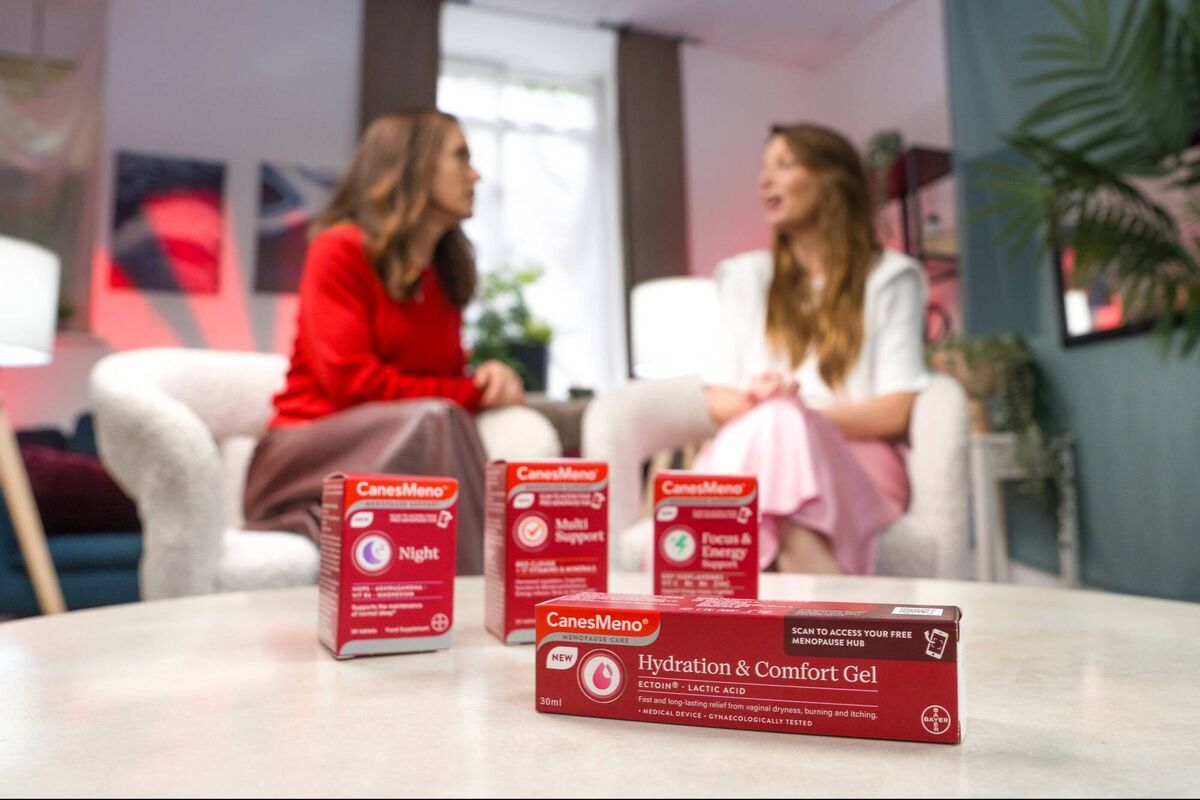
Over-the-counter products can help; CanesMeno has formulated its vaginal Hydration & Comfort Gel to help provide fast and long-lasting relief for up to five days from vaginal atrophy symptoms associated with menopause such as dryness, itching and burning. It can be used alongside systemic HRT, CanesMeno Hydration & Comfort Gel is made from 100% natural ingredients and is available from pharmacies nationwide.
Another important physical sign can be weight change, and more specifically weight gain. Again, this is not imagined; Fitzgerald says the average weight gain in perimenopause and menopause is 1.5kg per year. “This is phenomenal, and unfortunately, it tends to deposit around our midriff, so we hear people talking about the ‘meno belly’.”
These hormonal fluctuations may also cause emotional and cognitive changes. Fitzgerald says that while these may often be the first signs that women experience, it can be difficult to link them directly to the menopausal transition given the often-hectic reality of everyday life.
“Brain fog and verbal recalls were actually one of the first symptoms a lot of women will experience in perimenopause, so possibly even around 40, 41, 42, people might find they go to the supermarket and they can't remember what they were there for, and that's confusing,” she says. “Is it that you're not getting sleep because you're taking care of elderly relatives or children or is it that you are at the peak of your career and you're really busy, so that's what's impacting these cognitive changes?” Sleep, or lack thereof, can underpin these cognitive symptoms but Fitzgerald says “huge disruptions” in sleep are themselves common during perimenopause and menopause.
“Some women find it difficult to get to sleep, or other women find they're waking up overnight and are awake for hours and then can't get back to sleep, which obviously is very disruptive when you're trying to work and take care of other people.”

Tracking periods around this time is also crucial, she adds. “Periods change as you come up to the menopause and your periods stopping. And I think we actually don't expect that. We assume our periods will just keep going the way they are and suddenly stop.” The reality is that some women will experience more frequent or much heavier periods, or both.
Fitzgerald also explains that a woman will only be said to have gone through the menopause when she has had no periods for 12 consecutive months. “Once the periods have stopped, oestrogen drops down to a very low level. So we can still have menopausal signs at this stage related to that very low level of hormones, but the good news is our body will get used to this and those signs will eventually disappear.” It’s no wonder that joining the dots can be difficult when the picture is as complex and multifactorial as this; Fitzgerald urges women to keep a “menopause diary”, to track the patterns of these signs.
“I say to people, track your signs. How severe they might be exactly, and when are they happening, is it cyclical? Is it coming in times of your period? Or is it something that's there all the time?”
The CanesMeno personalised menopause tracker will do this for you, Fitzgerald adds. “You input your signs into this tracker and then it gives you free, private, and personalised insights,” she explains, adding that it’s one of her favourite resources. “It's not a replacement for your GP and I still say to people, try and have a trusted GP that you can get information from and share your signs with and feel comfortable with. But it's always important for us to have other resources that we can dip into on our own time.”
CanesMeno’s menopause hub also hosts a comprehensive library of articles that answer many commonly asked questions about menopause, as well as an information video. The hub complements a range of scientifically formulated products launched under CanesMeno, including food supplements and a vaginal dryness gel available from pharmacies only nationwide in Ireland. “This is a fantastic free hub that is there to support, educate, and empower women through the menopause,” Fitzgerald says.
When it comes to the menopause, the overarching problem, the GP believes, is a knowledge gap. The good news is that gaining knowledge can have a transformative effect. “What I find really powerful is that when you help someone through the menopause transition, whether it's self-management strategies or combination approaches, they come back to you and say, ‘I feel like myself again’. And that's really, really moving.”
¹Research conducted by Empathy Research on behalf of Canesten, August 2025.
CanesMeno® products are available in pharmacies nationwide and the CanesMeno® Hub is completely free to access HERE .
CanesMeno® Hydration and Comfort Gel is a medical device. The CanesMeno® Hub provides education on menopause, it is not intended to be a substitute for advice from a doctor and it is not a diagnostic tool.