New college course addresses skills shortage in ICT sector
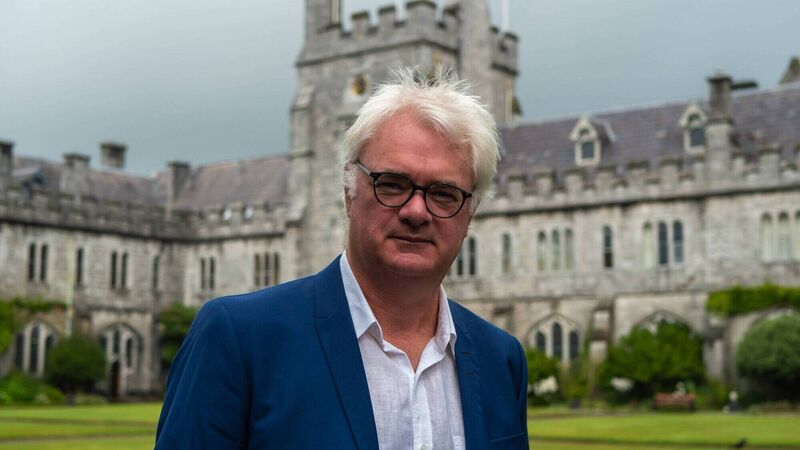
Patrick Crowley, Head of the School of Languages, Literatures and Cultures, University College Cork (Photo: Alana Daly Mulligan).
University College Cork has a new one—year Higher Diploma in Languages and Global Software Business to help address an emerging skills shortage in the ICT sector.
The new course is heavily subsidised by the Government Human Capital Initiative programme to support language graduates who are looking to upskill, or who are currently unemployed or returning to work.
Head of the School of Languages, Literatures and Cultures, and Co—Programme Director for the Higher Diploma in Languages and Global Software Business, Patrick Crowley, said, “This one year course combines a particular focus on the global software industry with languages, intercultural competency and localisation. What we want are strong language graduates with a 2:1 from their final year language module. We want to make a link between language graduates out there and the software sales industry.”
Speaking of tech industries such as VMWare, Eventbrite and Vox Pro, Crowley said, “They’re interested in linguistic competency, but also in graduates who have a strong capacity for critical thinking and creative problem-solving.”
The tech and software industry has a global reach and knowing how to bring your product across the globe is an important skill to have, “That process of adapting your product to different markets is a process of localisation — that is to say, adapting your product to another culture and language. Presenting a product online is not just about translating it linguistically, it’s about making it culturally understood,” said Crowley.
The Higher Diploma course is designed to develop the existing language skills of graduates within a business context and to help develop their competencies in ICT, software sales and technical support. The course is designed to provide critical knowledge and skills to language graduates who want to work in Ireland’s fast-paced software and technology sector.
The course is funded through the Government of Ireland Human Capital Initiative. Subsidies of between 90% and 100% are available, which opens up a new world of opportunity for language graduates. The course will be free of charge for those who are seeking work or looking to return to work.
Patrick Crowley has been tracking the employment landscape for language graduates over the past 30 years. It has always been varied (teaching, journalism, Department of Foreign Affairs and Trade, communications) but over the last decade or so, the demand for language graduates within the software industry has dramatically increased, “I’ve worked with a number of colleagues within the School and within the Department of Business Information Systems on this and they’ve been brilliant." The School of Languages, Literatures and Cultures has collaborated with the Department of Business Information Systems (BIS) bringing together the best of both our worlds in designing this new Higher Diploma.
"Joseph Feller and Jeremy Hayes have brought a real sense of excitement to this. It’s about the business world and employability, and we’ve really enjoyed it. Language graduates are in demand and can follow any number of exciting career paths. But we want language graduates to know that this is out there too.”
Through the Business Information Systems modules and the expertise of their staff, students develop competencies in relation to the ICT, software sales, technical support and localisation skills which are necessary for managing global relationships in the ICT sector.
The Programme Co-Director Jeremy Hayes (BIS) says, "This programme is designed for high-achieving language graduates who wish to work in global software and technology sales and support. This sector is rapidly expanding and is actively recruiting Irish graduates with language skills to expand their European and Middle East operations out of Ireland.
The year-long course allows graduates to combine their existing skills with a new set that focuses on sales and support. Through the Government subsidy, we expect there to be a high demand for registration, so we are encouraging interested students to apply as soon as possible." The programme also has input from industry leaders in the region.
The School of Languages, Literatures and Cultures offer French, German, Italian, Japanese, Korean, Mandarin Chinese, Portuguese, and Spanish, as well as classes in Galician, Basque and Catalan. “We offer more languages than other universities in Ireland. Our students develop strong linguistic competency; are trained to think critically, have the capacity to develop a convincing evidence-based argument; possess strong intercultural skills, and have the ability to respond creatively to intellectual questions. Our students engage with a notion of global citizenship and are ready to make an essential contribution to Ireland’s strategic global positioning as well as the need for humanities graduates equipped for a multilingual workplace. Languages are key to deepening knowledge and understanding — they open up doors to a global world.”
According to Crowley, languages are important in terms of their intrinsic worth (their cultural value) and the skills that are acquired that make students world-ready and work-ready.
Crowley says that Ireland is already a leading player in the software sales and IT world but it needs more language graduates. “We launched the programme in July of 2020 and this year’s cohort were a great group of students willing to get into the very different work of the software industry. They have already secured work in global companies such as Red Hat, Cloudbeds, Nuance, MicroFocus, Amazon, TikTok, and this is even before they graduate,” he said.
For Higher Diploma in Languages and Global Software Business student Faye Dowling, the course was a game-changer for her career.
“With a BA in World Languages and one year of practical experience, I found that I was still missing some key hard skills for business. The higher diploma has clearly been created with the goal of securing work for the students who take part and this has certainly been the case for me. Only halfway through the Higher Diploma, I was offered the position of Business Development Executive for Southern Europe with Nuance Communications, a world leader in AI and voice recognition technology.
This opportunity presented itself largely due to the interest in ICT, localisation and the global sales process that the course inspired in me during its initial stages. The course coordinators Patrick Crowley and Jeremy Hayes are always on hand and ready to help for any queries, and this has been especially important this year as the pandemic has meant that we are all learning from each other in a remote environment. For language graduates looking to fast track their careers, update their skillset and keep up with quickly advancing trends in technology, the Higher Diploma in Languages and Global is a great post-graduate option.”
For information about the Higher Diploma in Languages and Global Software Business and UCC’s other HCI Pillar 1 courses visit: www.UCC.ie/HCI